Cementing the future
pp. 14-15 · Read in the full issue
By Sophie Foster Huilebrand
their operation was safe. One former prominent resident was Max Ollson, who lived about two minutes away from the fac tory. He complained that his grapes were being affected and even had the media take pictures of the vines. Throughout the years that he complained FIL made no attempt to right the wrong, or even to admit that they were polluting the forest reserve. Mr Ollson went to his grave with smoke still filtering over the reserve, houses, children, and families in the area.
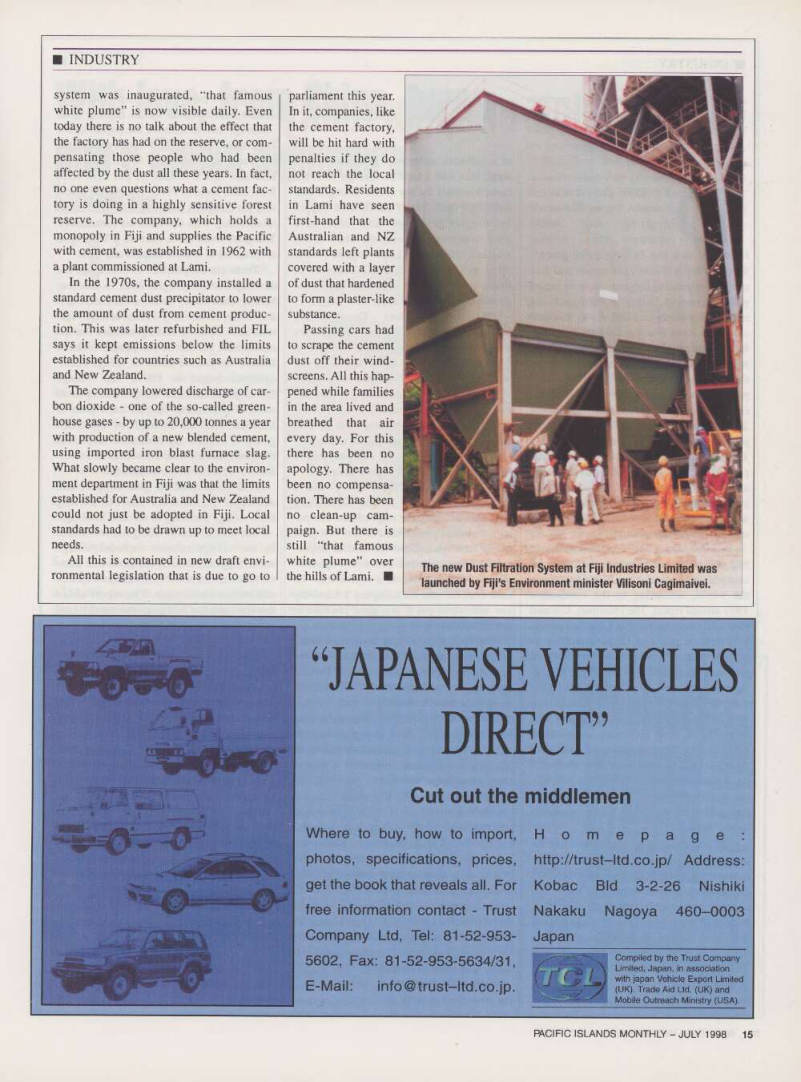
It was not until early June that FIL, a subsidiary of Fijian Holdings Limited, inaugurated the $1.3 million cement dust filter system. The cement factory received concessions by government to import equipment for the filtration system.
However, according to engineering
sources, that particular type of filtration system has been available on the market for about 10 years.
When asked why, if the technology had been around for a decade, the company had not taken this step before, operations man ager Stuart Ward said the use of the dust filtration system in a cement factory appli
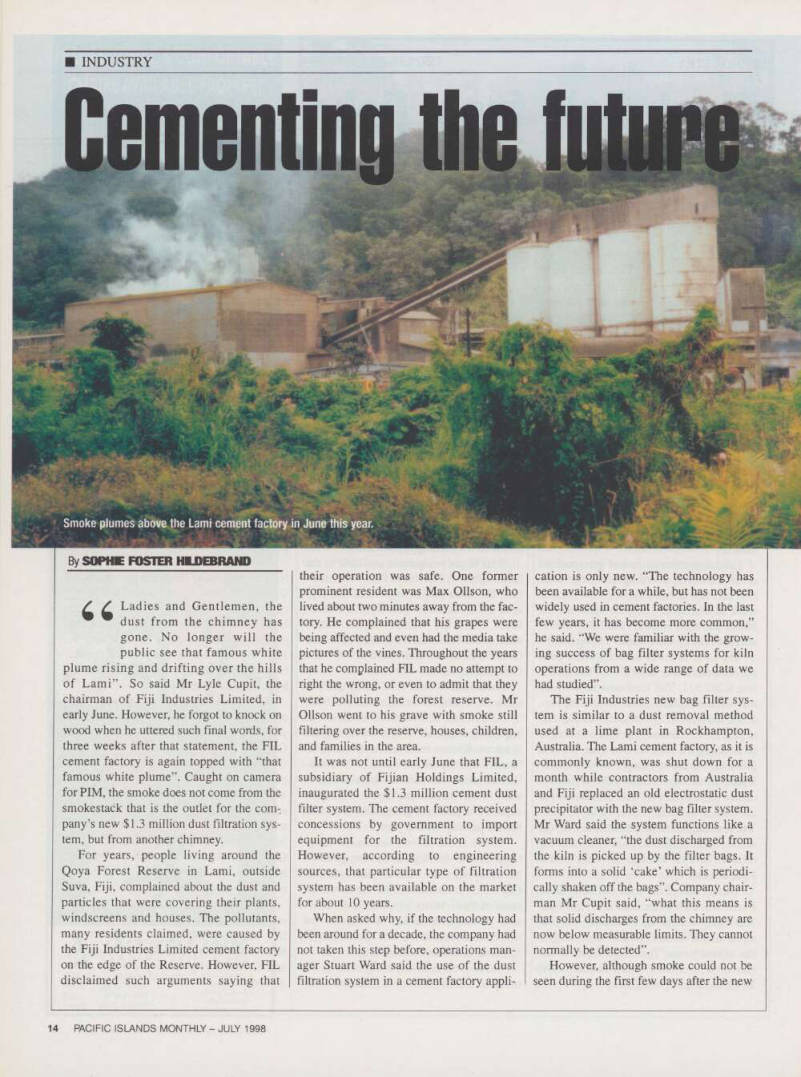
/ / Ladies and Gentlemen, the dust from the chimney has gone. No longer will the public see that famous white plume rising and drifting over the hills of Lami”. So said Mr Lyle Cupit, the chairman of Fiji Industries Limited, in early June. However, he forgot to knock on wood when he uttered such final words, for three weeks after that statement, the FIL cement factory is again topped with “that famous white plume”. Caught on camera for PIM, the smoke does not come from the smokestack that is the outlet for the com pany’s new $1.3 million dust filtration sys tem, but from another chimney.
For years, people living around the Qoya Forest Reserve in Lami, outside Suva, Fiji, complained about the dust and particles that were covering their plants, windscreens and houses. The pollutants, many residents claimed, were caused by the Fiji Industries Limited cement factory on the edge of the Reserve. However, FIL disclaimed such arguments saying that
cation is only new. “The technology has been available for a while, but has not been widely used in cement factories. In the last few years, it has become more common,” he said. “We were familiar with the grow ing success of bag filter systems for kiln operations from a wide range of data we had studied”.
The Fiji Industries new bag filter sys tem is similar to a dust removal method used at a lime plant in Rockhampton, Australia. The Lami cement factory, as it is commonly known, was shut down for a month while contractors from Australia and Fiji replaced an old electrostatic dust precipitator with the new bag filter system.
Mr Ward said the system functions like a vacuum cleaner, “the dust discharged from the kiln is picked up by the filter bags. It forms into a solid ‘cake’ which is periodi cally shaken off the bags”. Company chair man Mr Cupit said, “what this means is that solid discharges from the chimney are now below measurable limits. They cannot normally be detected”.
However, although smoke could not be seen during the first few days after the new
Smoke plumes above the Lami cement factory in June this year.
system was inaugurated, “that famous white plume” is now visible daily. Even today there is no talk about the effect that the factory has had on the reserve, or com pensating those people who had been affected by the dust all these years. In fact, no one even questions what a cement fac tory is doing in a highly sensitive forest reserve. The company, which holds a monopoly in Fiji and supplies the Pacific with cement, was established in 1962 with a plant commissioned at Lami.
In the 19705, the company installed a standard cement dust precipitator to lower the amount of dust from cement produc tion. This was later refurbished and FIL says it kept emissions below the limits established for countries such as Australia and New Zealand.
The company lowered discharge of car bon dioxide - one of the so-called green house gases - by up to 20,000 tonnes a year with production of a new blended cement, using imported iron blast furnace slag.
What slowly became clear to the environ ment department in Fiji was that the limits established for Australia and New Zealand could not just be adopted in Fiji. Local standards had to be drawn up to meet local needs.
All this is contained in new draft envi ronmental legislation that is due to go to
parliament this year.
In it, companies, like the cement factory, will be hit hard with penalties if they do not reach the local standards. Residents in Lami have seen first-hand that the Australian and NZ standards left plants covered with a layer of dust that hardened to form a plaster-like substance.
Passing cars had to scrape the cement dust off their wind screens. All this hap pened while families in the area lived and breathed that air every day. For this there has been no apology. There has been no compensa tion. There has been no clean-up cam paign. But there is still “that famous white plume” over the hills of Lami. ■
The new Dust Filtration System at Fiji Industries Limited was launched by Fiji’s Environment minister Vilisoni Cagimaivei.