Forme r N-test site worker worried
p. 12 · Read in the full issue
about Rongelap nuclear cleanup
By Giff Johnson
A FORMER Bikini Atoll worker issued a warning in early June to Marshall Islanders who will be working on the US-funded nuclear cleanup and rehabilitation project at Rongelap Atoll, scheduled to start in August. Marshall Islander John M. Milne, who worked in a nuclear cleanup program at Bikini in the 1970 s and heads the Marshall Islands Radiation Victims Association, expressed concern for the people who may go to Rongelap and work.
“Many of the members of our group (who worked at Bikini and Enewetak atolls) have radiation-related problems,” he said. “Our aim is to make sure that Marshallese who go to Rongelap are aware of the situation, and that the company doing the work provides precautionary measures for the workers (to insure their safety).” Radioactive fallout from nuclear weapons tests at Bikini in the 1950 s dusted Rongelap. It has been uninhabited for 13 years since Rongelap islander evacuated their home fearing exposure to radiation in the environment.
In response to Milne’s comments, Rongelap Mayor James Matayoshi said that the safety of workers involved in the Rongelap cleanup program is extremely important. “We’re meeting with the Department of Energy to see what role it can play in providing radiation monitoring during the phase one work,” he said.
Matayoshi would like to see all future
workers have whole body counts and urine tests by the DOE before beginning work at Rongelap, and then have them monitored during their time on Rongelap to detect any changes quickly and act on them. Safety issues raised by Marshall Islands Radiation Victims Association president John Milne are “legitimate concerns,” Matayoshi said.
“We’re moving forward with safety mea sures (for workers). It’s one of our priori ties.” Considering the construction work and clearing of jungle overgrowth planned for Rongelap before resettlement, “they’ll have to be exposed to radiation,” Milne said. “Our concern is to see that they are provided the means to safeguard their health.” He said that this might be in the form of masks to prevent inhaling radioac tive material during construction work or dosimeters worn by individuals to measure radiation exposure.
Workers at Bikini, more than 20 years ago, did not receive safety precautions or information during cleanup efforts, Milne said. Bikini was the site of 23 nuclear tests. “We want this new (Rongelap) crew to have an idea about radiation, so they know what to do on Rongelap,” Milne said. He said that Marshallese and others who had worked on Bikini and Enewetak (ground zero for 43 nuclear weapons tests) have “fallen through the cracks” of US provided health and compensation pro grams that do not recognise them as “exposed” to radiation. Without access to adequate medical treatment, many of these workers have died of cancers that, if diag nosed early, might have been treatable, he said, adding he didn’t want to see the same pattern repeated with Rongelap workers. ■
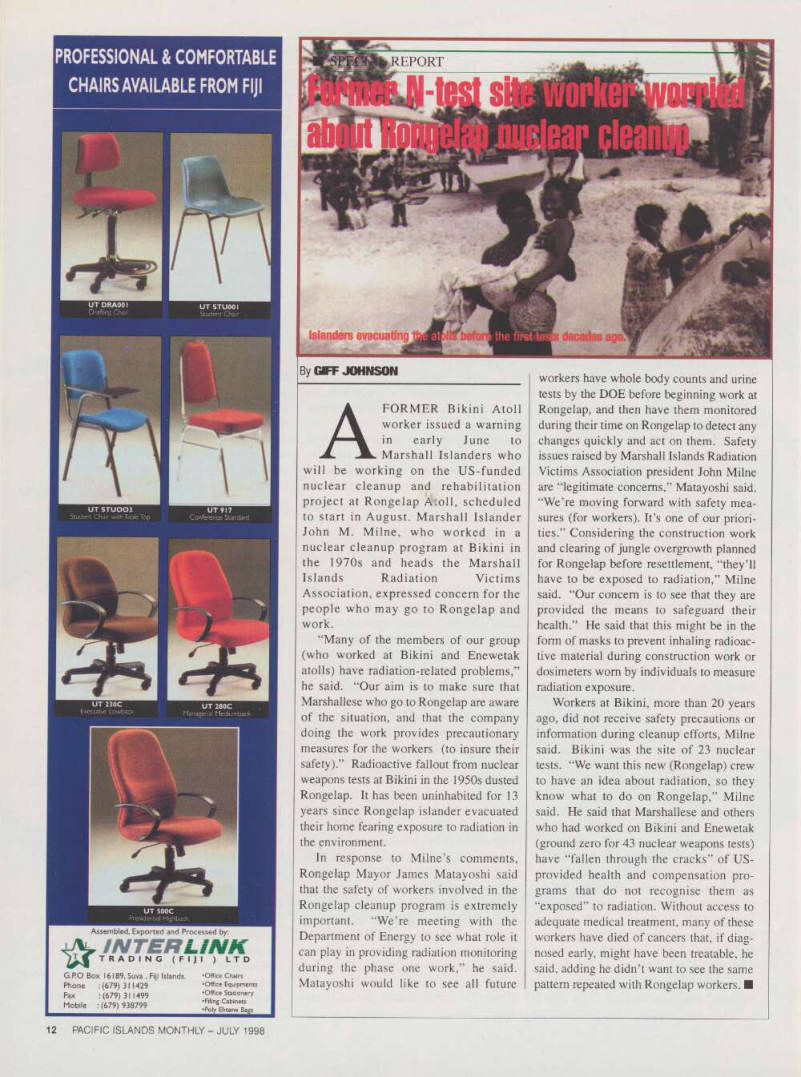
Islanders evacuating the atolls before the ffrst tests decades ago.