Special Report
pp. 10-11 · Read in the full issue
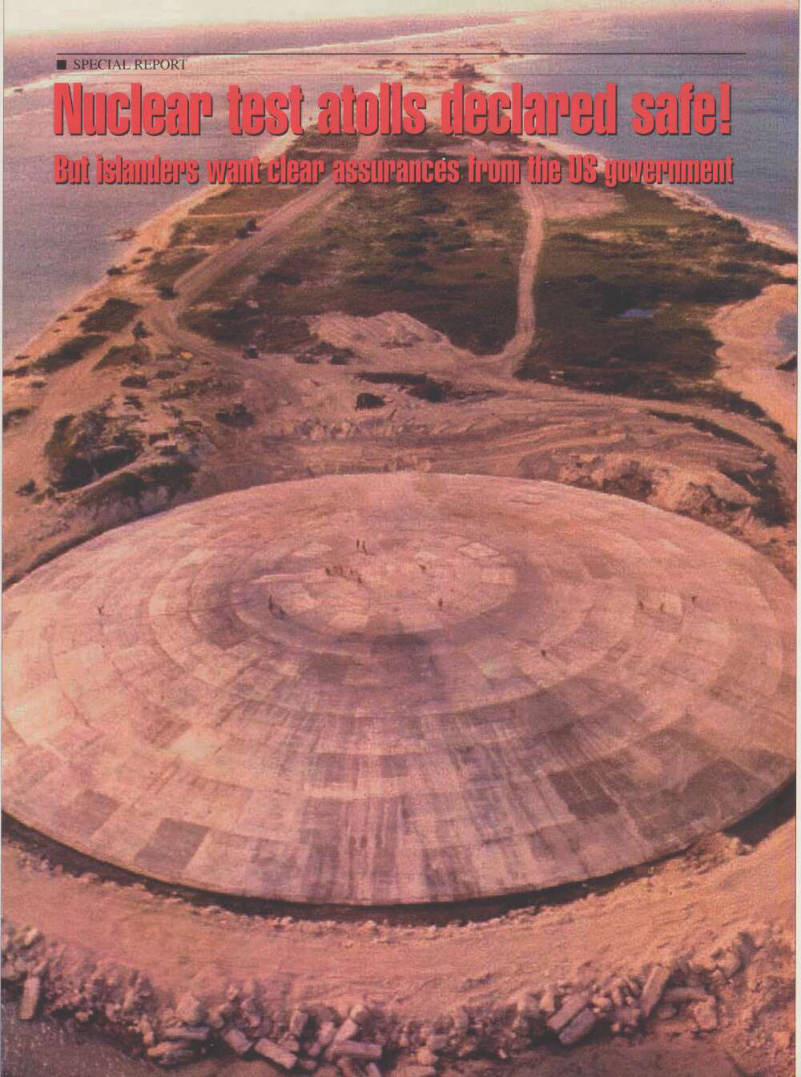
Nuclear test atolls declared safe!
But islanders want clear assurances from the US government
many Marshall Islanders is to completely scrape off the top 12-15 inches of top soil on residential islands, and remove the radioactive soil from the islands. But this is hugely expensive and will have severe environmental consequences by removing the islands’ best soil.
The combination method would scrape topsoil from the village areas, and replace it with crushed coral to minimise exposure in the portion of the island where people will spend the majority of their time. The rest of the island would be doused with fer tiliser, which Bikini experiments have shown will block the uptake of radioactive cesium by root crops. Robison has said that use of fertiliser prevents as much as 95 per cent of the radiation dose that would be received by a person eating local foods.
The final piece of the cleanup puzzle is imported food supplements to insure that islanders do not rely solely on locally grown coconuts, breadfruit and pandanus.
Part of the reason for aborting the Bikini resettlement in 1978 was heavy consump tion of local food (not treated with the fer tiliser method) by the 100 or so islanders
who had returned home following US assurances that the islands were safe.
Matayoshi said that Rongelap is fully aware that they don’t currently have enough funds for the cleanup they believe is necessary. However they are going ahead with phase one work to advance the resettlement process and show the US that they are making a good faith effort to cleanup Rongelap. This is in the hope the US government will ultimately provide the requirements for the safe resettlement of
Rongelap.
“We’ll make a trip to Rongelap in August to do a survey of the island,” he said. “We’ll look at property boundary lines and decide where to locate the dock, field station and other facilities (needed for the cleanup).” While getting the first phase
work moving, Matayoshi is also discussing
possible radiological assistance with the Department of Energy as well as indepen dent scientists.
Rongelap wants to have medical screening conducted before, during and after the cleanup and rehabilitation work so that both workers and future inhabitants
will have assurances that the island is safe, Matayoshi said. Meanwhile, Enewetak is preparing to file a claim seeking hundreds of millions of dollars for rehabilitating their former nuclear test site and for the
hardships experienced during 33 years of
forced exile.
Filing of the claim, with the Nuclear Claims Tribunal in Majuro, is expected before the end of August. Enewetak has already filed a claim, seeking $235 million, for “loss of use” of the atoll from 1947 to 1980. The Tribunal doesn’t have the money to pay for the cleanup. Most of its $45 million fund has gone into compensa tion payments for personal injury claims by Marshall Islanders.
The Tribunal is the agency created by the Compact of Free Association treaty between the US and Marshall Islands to judge all nuclear test claims. Enewetak is hopeful that once the Tribunal acts on its cleanup claim, it will provide a stronger foundation for the Marshall Islands gov ernment to return to the US government seeking aid to resolve the American nucle ar test legacy in the Marshall Islands. ■