Handmade paper comes to Fiji
p. 54 · Read in the full issue
Art
By Pauline Walker
Handmade paper is a product that is both beautiful and useful. It helps the environment by recycling a major component of the waste stream.
Its attractive surface promotes art and nurtures creativity.
Teaching the craft of making paper was the purpose of a free two-week workshop held recently at Oceania Centre for Arts and Culture, on the Suva
campus of the University of the South Pacific. Co-spon sored by the centre and UNDP, it targeted unem ployed youth with the aim of providing new skills to help them earn money.
Sofia Tekela, an Auckland-based Rotuman artist who creates greeting cards and even high-fashion clothing out of handmade paper, guided a dozen or so chosen participants through the process of paper-mak ing both from waste paper and from plant materials harvested locally.
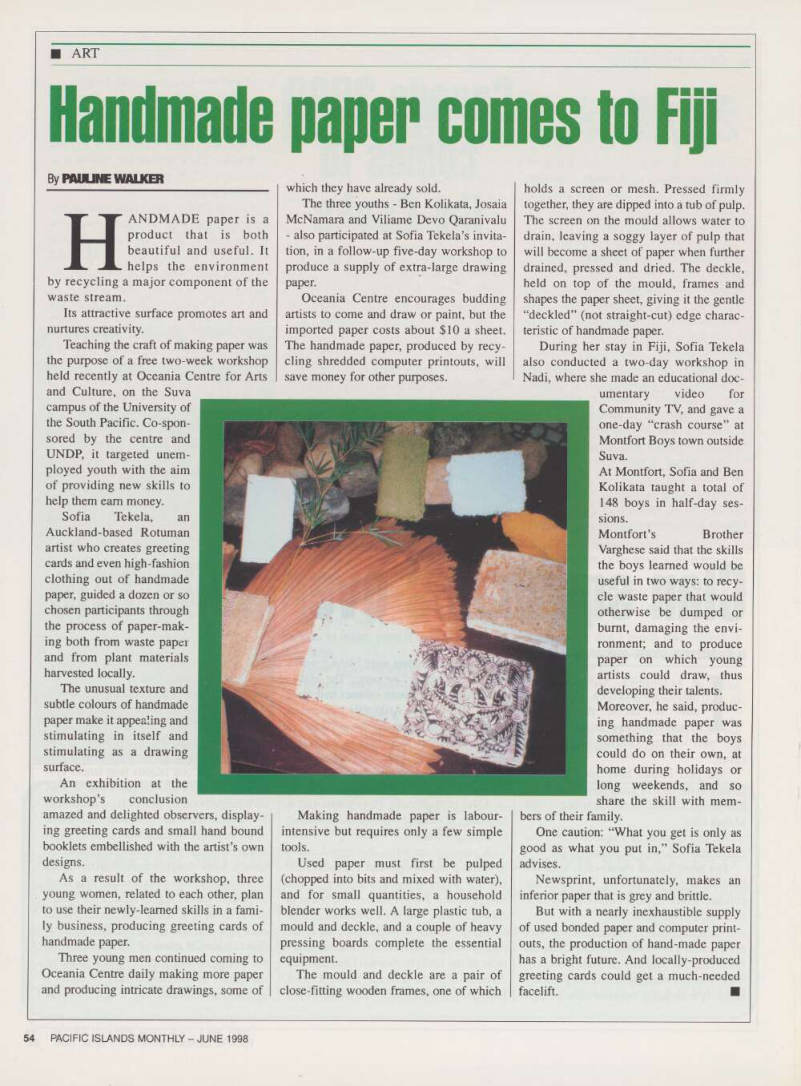
The unusual texture and subtle colours of handmade paper make it appealing and stimulating in itself and stimulating as a drawing surface.
An exhibition at the workshop’s conclusion
amazed and delighted observers, display ing greeting cards and small hand bound booklets embellished with the artist’s own designs.
As a result of the workshop, three young women, related to each other, plan to use their newly-leamed skills in a fami ly business, producing greeting cards of handmade paper.
Three young men continued coming to Oceania Centre daily making more paper and producing intricate drawings, some of
which they have already sold.
The three youths - Ben Kolikata, Josaia McNamara and Viliame Devo Qaranivalu - also participated at Sofia Tekela’s invita tion, in a follow-up five-day workshop to produce a supply of extra-large drawing paper.
Oceania Centre encourages budding artists to come and draw or paint, but the imported paper costs about $lO a sheet.
The handmade paper, produced by recy cling shredded computer printouts, will save money for other purposes.
Making handmade paper is labour intensive but requires only a few simple tools.
Used paper must first be pulped (chopped into bits and mixed with water), and for small quantities, a household blender works well. A large plastic tub, a mould and deckle, and a couple of heavy pressing boards complete the essential equipment.
The mould and deckle are a pair of close-fitting wooden frames, one of which
holds a screen or mesh. Pressed firmly together, they are dipped into a tub of pulp.
The screen on the mould allows water to drain, leaving a soggy layer of pulp that will become a sheet of paper when further drained, pressed and dried. The deckle, held on top of the mould, frames and shapes the paper sheet, giving it the gentle “deckled” (not straight-cut) edge charac teristic of handmade paper.
During her stay in Fiji, Sofia Tekela also conducted a two-day workshop in Nadi, where she made an educational doc
umentary video for Community TV, and gave a one-day “crash course” at Montfort Boys town outside Suva.
At Montfort, Sofia and Ben Kolikata taught a total of 148 boys in half-day ses sions.
Montfort’s Brother Varghese said that the skills the boys learned would be useful in two ways: to recy cle waste paper that would otherwise be dumped or burnt, damaging the envi ronment; and to produce paper on which young artists could draw, thus developing their talents.
Moreover, he said, produc ing handmade paper was something that the boys could do on their own, at
home during holidays or
long weekends, and so
share the skill with mem bers of their family.
One caution: “What you get is only as good as what you put in,” Sofia Tekela advises.
Newsprint, unfortunately, makes an inferior paper that is grey and brittle.
But with a nearly inexhaustible supply of used bonded paper and computer print outs, the production of hand-made paper has a bright future. And locally-produced greeting cards could get a much-needed facelift. ■