Tackling the elements
pp. 45-50 · Read in the full issue
Fishing Feature
THE subject of what gear to buy and from whom is certainly one for debate, and would make for a lively discussion in a room full of fishermen and managers.
You can seldom get two fishermen to agree on anything and this subject is no
exception.
There are as many opinions on the sub ject as there are fishermen.
So do not look to find any definitive answers as to what equipment to buy or how it should be used.
With that in mind, here are some thoughts on a few things to think about when it comes to choosing a supplier or buying fishing gear.
Keep in mind that fishermen tend to experiment and regularly find ways of
doing a particular task that may not always seem the most logical or efficient but gets the job done.
And that is what matters in the end.
A topic of discussion in any fishery, this focus is specifically on monofilament
longlining for pelagics.
In Hawaii, the largest fishery in both number of vessels (100 active) and ex-ves sel value (SUS7O million) is pelagic longlining tuna and swordfish.
Having grown from 38 boats in 1984 to 165 permitted vessels today, the Hawaii based longline fleet is one of the largest monofilament fleets in the world.
Significant developments in monofila
ment longlining are attributed to it.
In business, the goal most strive for is to become profitable.
In the fishing business, many variables
contribute to profitability such as the ves sel, captain and crew, location, gear and, to some extent, luck.
Assuming the vessel, captain and loca tion have been researched and selected properly, the selection and purchase of gear becomes one of the major issues
remaining.
When it comes to selecting what gear to buy, gaining as much information from local sources, other fishermen and research organisations is the obvious place to start.
However, keep in mind that fishermen, being independent souls, are not always excited about sharing information they have learned, or developed, on what does or does not catch fish.
Much of the experience comes at a high price, in both time and investment, and assisting the competition is not always an
attractive prospect.
So when it comes to gear selection and purchase, the suppliers with significant experience in the business can be a valu able component in the process.
When choosing equipment, it is impor tant to keep in mind that the purchase price is only one of the considerations of cost.
Availability and dependability will play a major role in the overall price you pay.
It is safe to say that prices for equip ment and supplies vary as much as 50 per cent or more.
However true savings are much more difficult to calculate.
What may be more important than how much money an item costs is what you received for your money.
All too often, the good deal turns out to be not quite what you wanted or thought
you were getting.
For some, the savings may outweigh the inconvenience, but for others they do not, and the savings evaporate.
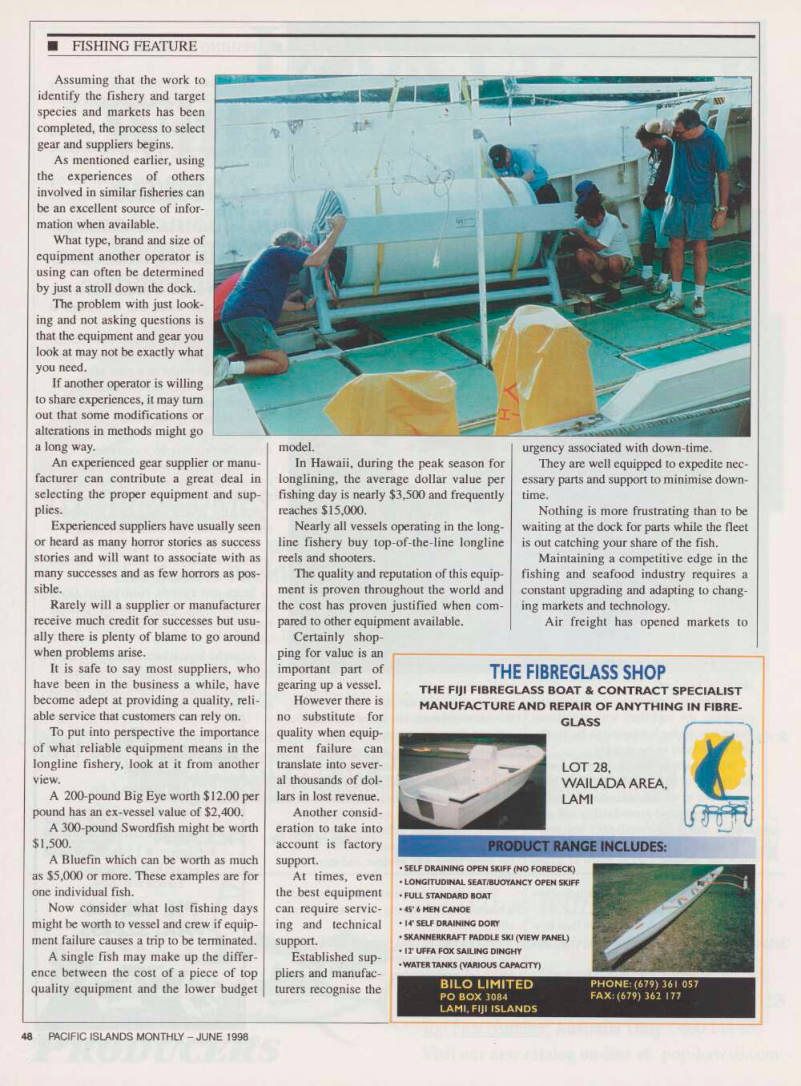
Take, for example, longline reels.
There are several manufacturers who make a similar product, designed to do a
similar job.
Materials may vary, construction meth ods and engineering differ, and drive spec ifications are not the same, yet they all do the same basic job: retrieve and store the line.
Some do the job better than others and it is a matter of weighing costs versus ben efits.
Aluminium or steel, large or small, sin gle or dual drive motors, decisions about which equipment to buy will have a signif icant effect on cost.
Remember, availability and reliability
will play a major role in the costs in the
long run.
Fixed equipment, such as reels and shooters, require special consideration
when selecting.
They, along with mainline, are the big ticket items that will usually be used for several years.
Also, these form the foundation on which the entire project is built.
The highest quality affordable general ly will prove to be the best option.
Terminal tackle, or the gear that actual ly goes in the water, can be looked at another way.
Leaders, crimps, hooks and similar tackle have a high turnover rate and a clos er look at cost might be a good idea.
These, and other items in this category, are more likely to be shopped around for.
Not suggesting that quality be ignored, in this case, products that may be less than top-of-the-line may be acceptable.
In addition, because these items are consumable, they will be cycled through the system.
Usually it will not create a problem unless the quality or size is not usable.
Other tackle that is deployed, but does not have an effective useful life, warrants investment in better quality.
Snaps and swivels, radio buoys, floats and float lines, will generally provide many years of service if properly main tained.
A careful look at better quality yet more expensive products should be considered.
Briefly, some thoughts on selecting gear, equipment and suppliers.
Assuming that the work to identify the fishery and target species and markets has been completed, the process to select
gear and suppliers begins.
As mentioned earlier, using the experiences of others involved in similar fisheries can be an excellent source of infor mation when available.
What type, brand and size of equipment another operator is using can often be determined by just a stroll down the dock.
The problem with just look ing and not asking questions is that the equipment and gear you look at may not be exactly what you need.
If another operator is willing to share experiences, it may turn out that some modifications or alterations in methods might go
a long way.
An experienced gear supplier or manu facturer can contribute a great deal in selecting the proper equipment and sup plies.
Experienced suppliers have usually seen or heard as many horror stories as success stories and will want to associate with as many successes and as few horrors as pos sible.
Rarely will a supplier or manufacturer receive much credit for successes but usu ally there is plenty of blame to go around when problems arise.
It is safe to say most suppliers, who have been in the business a while, have become adept at providing a quality, reli able service that customers can rely on.
To put into perspective the importance of what reliable equipment means in the longline fishery, look at it from another view.
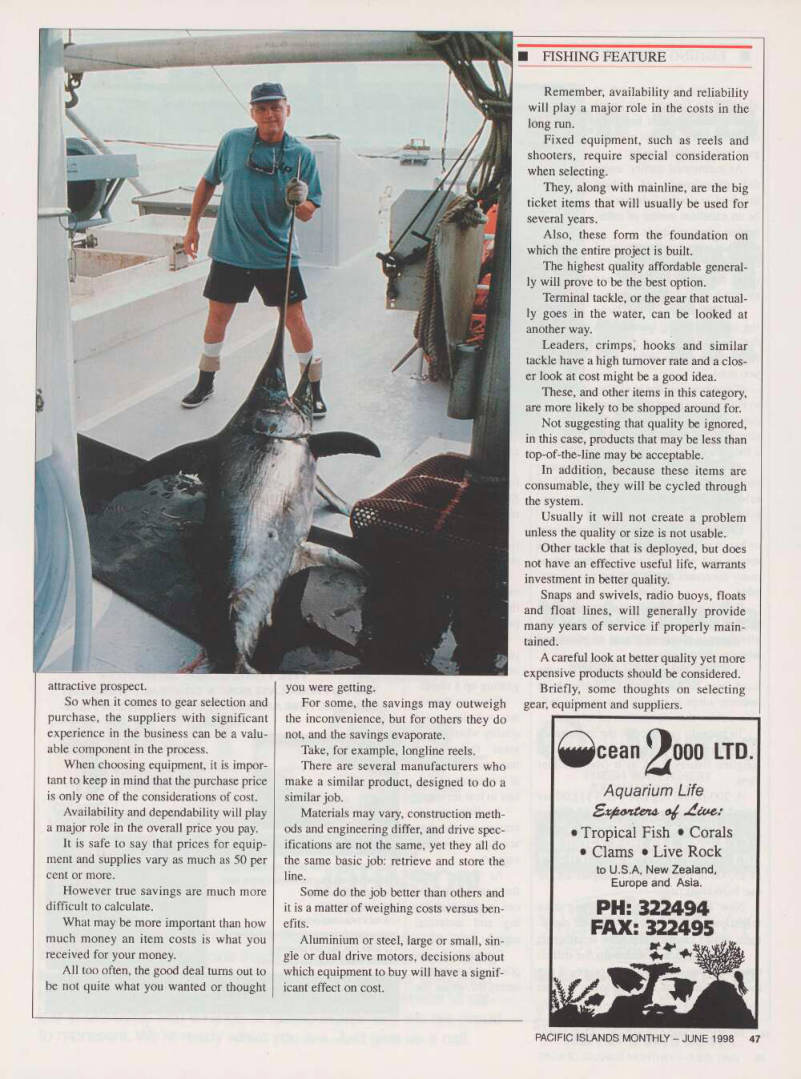
A 200-pound Big Eye worth $12.00 per pound has an ex-vessel value of $2,400.
A 300-pound Swordfish might be worth $1,500.
A Bluefin which can be worth as much as $5,000 or more. These examples are for one individual fish.
Now consider what lost fishing days might be worth to vessel and crew if equip ment failure causes a trip to be terminated.
A single fish may make up the differ ence between the cost of a piece of top quality equipment and the lower budget
model.
In Hawaii, during the peak season for longlining, the average dollar value per fishing day is nearly $3,500 and frequently reaches $15,000.
Nearly all vessels operating in the long line fishery buy top-of-the-line longline reels and shooters.
The quality and reputation of this equip ment is proven throughout the world and the cost has proven justified when com pared to other equipment available.
Certainly shop ping for value is an important part of gearing up a vessel.
However there is no substitute for quality when equip ment failure can translate into sever al thousands of dol lars in lost revenue.
Another consid eration to take into account is factory support.
At times, even the best equipment can require servic ing and technical support.
Established sup pliers and manufac turers recognise the
urgency associated with down-time.
They are well equipped to expedite nec essary parts and support to minimise down time.
Nothing is more frustrating than to be waiting at the dock for parts while the fleet is out catching your share of the fish.
Maintaining a competitive edge in the fishing and seafood industry requires a constant upgrading and adapting to chang ing markets and technology.
Air freight has opened markets to
developing countries around the world.
Locations that were once considered remote and nearly isolated now have daily jet service connecting them to world mar kets within hours.
Equipment and supplies ordered today are delivered tomorrow from a source thou sands of miles away.
Swordfish landed today in Australia are served in restaurants in Boston tomorrow.
The industry continues to expand into more of a world market.
As this happens, shore-side supplies and
services will play a more important role in keeping fishermen efficient and competi tive.
One thing to keep in mind is that relia bility, availability and support services, after the sale, will continue to play an important role after the initial purchase.
An experienced supplier, with the prop er support facilities, will prove to be a valu able asset for any fisherman.
Now, and in the long run, this will allow fishermen to do what they do best - catch fish. ■