New Zealand's wild side
pp. 42-43 · Read in the full issue
By Sally Andrew
SEEKING refuge from the
stormy seas of the roaring forties. South Pacific seal ers discovered Port Pegasus on Stewart Island in 1808.
They named it for their ship, then returned with cartographer William Stewart the following year, Captain Stokes on the Acheron did the most recent survey of the port - in 1849!
Using this ancient chart as we sailed past the Brothers Islands. I couldn’t help but think that one of them looked like a smiling gorilla. Did it think headwinds
gusting to thirty were funny? I didn’t. We entered the North Arm of Port Pegasus and anchored near Belltopper Falls.
In the morning we organised our back packs and set off walking. Tin mining was one of the many attempts to eke a living out of this wild and windy spot. Ship
building, farming, whaling, gold prospect
ing - all were attempted, but only fishing continues. Today, Stewart Island is a park reserve popular with European backpack ers. The trail up to the Tin Range is a dan gerous but spectacular trek through native bush to bald granite knobs where the weather can close in, disorienting and
chilling the novice hiker.
Fronts march across Stewart Island regularly and conditions can change rapidly. Hail, rain, fog,
gales - all interspersed
with arrogant sunshine and gentle breezes.
Pottering through Port
Pegasus, we stopped at
Twilight Cove,
Observation Cove and Smugglers Cove, a magi cal high-sided cavern with a narrow entrance and small beach, hidden away and filled with ferns and fearless songbirds.
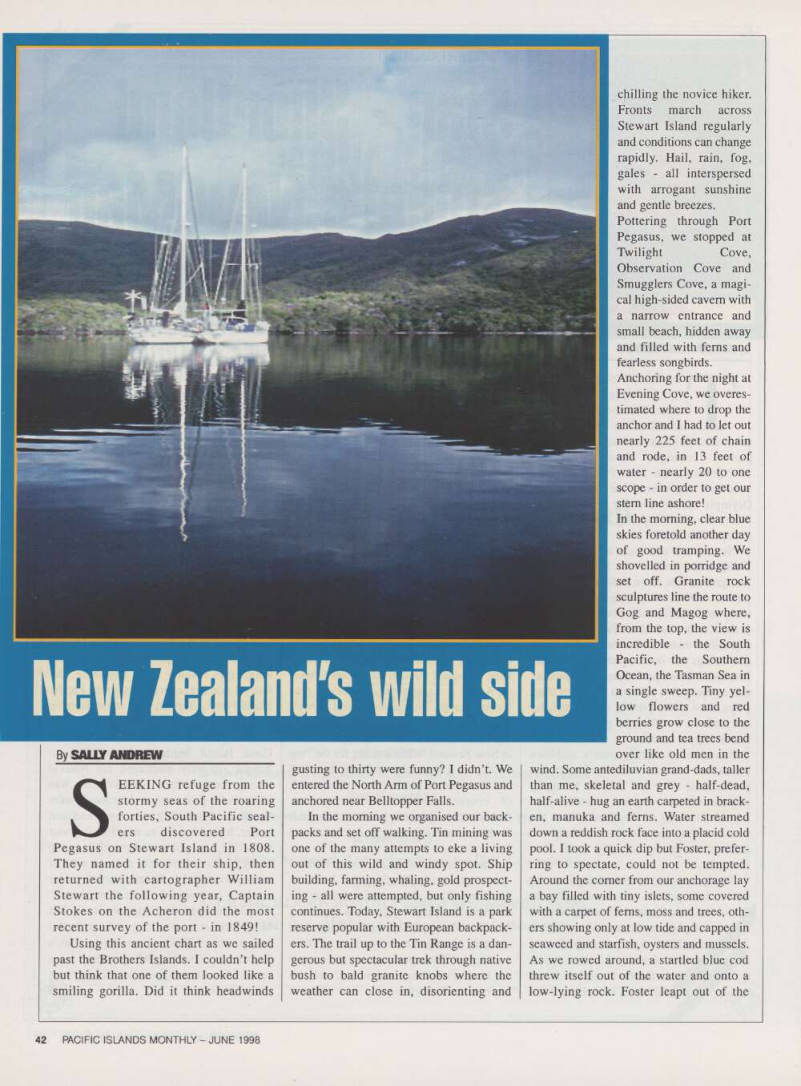
Anchoring for the night at Evening Cove, we overes timated where to drop the anchor and I had to let out nearly 225 feet of chain and rode, in 13 feet of water - nearly 20 to one scope - in order to get our stem line ashore!
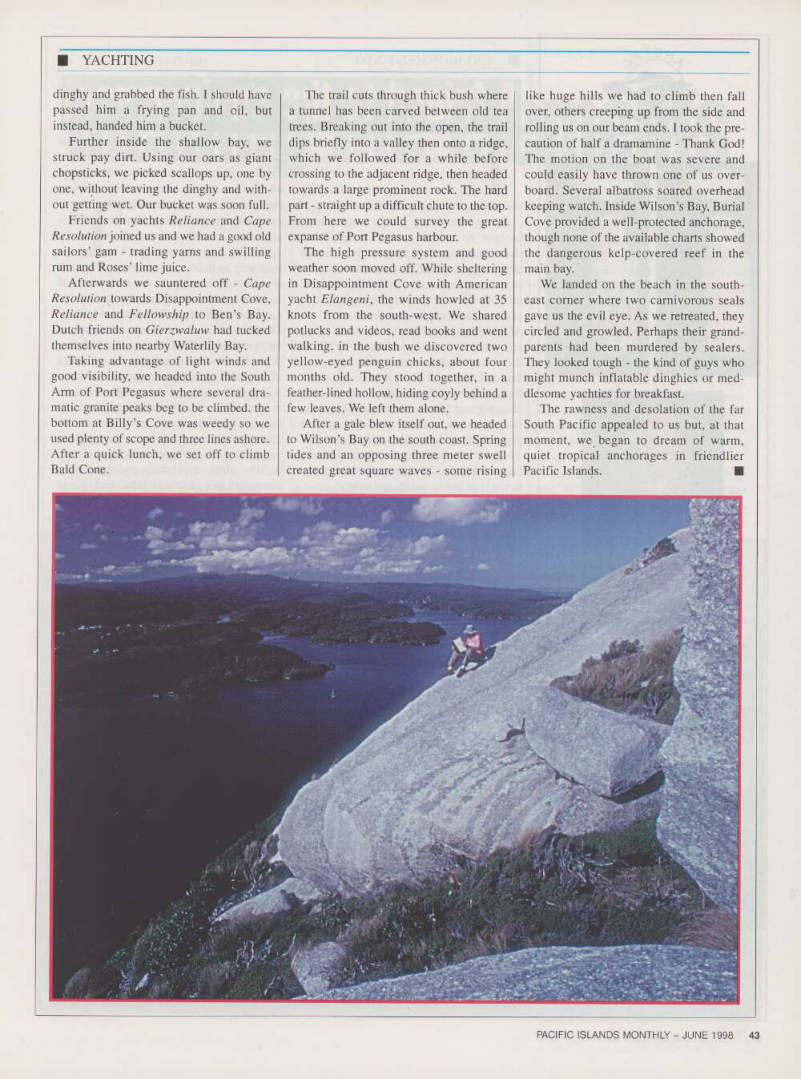
In the morning, clear blue skies foretold another day of good tramping. We shovelled in porridge and set off. Granite rock sculptures line the route to Gog and Magog where, from the top, the view is incredible - the South Pacific, the Southern Ocean, the Tasman Sea in a single sweep. Tiny yel low flowers and red berries grow close to the ground and tea trees bend over like old men in the
wind. Some antediluvian grand-dads, taller than me, skeletal and grey - half-dead, half-alive - hug an earth carpeted in brack en, manuka and ferns. Water streamed down a reddish rock face into a placid cold pool. I took a quick dip but Foster, prefer ring to spectate, could not be tempted.
Around the comer from our anchorage lay a bay filled with tiny islets, some covered with a carpet of ferns, moss and trees, oth ers showing only at low tide and capped in seaweed and starfish, oysters and mussels.
As we rowed around, a startled blue cod threw itself out of the water and onto a low-lying rock. Foster leapt out of the
■ Yachting
dinghy and grabbed the fish. I should have passed him a frying pan and oil, but instead, handed him a bucket.
Further inside the shallow bay, we struck pay dirt. Using our oars as giant chopsticks, we picked scallops up, one by one, without leaving the dinghy and with out getting wet. Our bucket was soon full.
Friends on yachts Reliance and Cape Resolution joined us and we had a good old sailors’ gam - trading yarns and swilling rum and Roses’ lime juice.
Afterwards we sauntered off - Cape Resolution towards Disappointment Cove, Reliance and Fellowship to Ben’s Bay.
Dutch friends on Gierzwaluw had tucked themselves into nearby Waterlily Bay.
Taking advantage of light winds and good visibility, we headed into the South Arm of Port Pegasus where several dra matic granite peaks beg to be climbed, the bottom at Billy’s Cove was weedy so we used plenty of scope and three lines ashore.
After a quick lunch, we set off to climb Bald Cone.
The trail cuts through thick bush where a tunnel has been carved between old tea trees. Breaking out into the open, the trail dips briefly into a valley then onto a ridge, which we followed for a while before crossing to the adjacent ridge, then headed towards a large prominent rock. The hard part - straight up a difficult chute to the top.
From here we could survey the great expanse of Port Pegasus harbour.
The high pressure system and good weather soon moved off. While sheltering in Disappointment Cove with American yacht Elangeni, the winds howled at 35 knots from the south-west. We shared potlucks and videos, read books and went walking, in the bush we discovered two yellow-eyed penguin chicks, about four months old. They stood together, in a feather-lined hollow, hiding coyly behind a few leaves. We left them alone.
After a gale blew itself out, we headed to Wilson’s Bay on the south coast. Spring tides and an opposing three meter swell created great square waves - some rising
like huge hills we had to climb then fall over, others creeping up from the side and rolling us on our beam ends. I took the pre caution of half a dramamine - Thank God!
The motion on the boat was severe and could easily have thrown one of us over board. Several albatross soared overhead keeping watch. Inside Wilson’s Bay, Burial Cove provided a well-protected anchorage, though none of the available charts showed the dangerous kelp-covered reef in the
main bay.
We landed on the beach in the south east comer where two carnivorous seals gave us the evil eye. As we retreated, they circled and growled. Perhaps their grand parents had been murdered by sealers.
They looked tough - the kind of guys who might munch inflatable dinghies or med dlesome yachties for breakfast.
The rawness and desolation of the far South Pacific appealed to us but, at that moment, we began to dream of warm, quiet tropical anchorages in friendlier Pacific Islands. ■