The Princess
p. 35 · Read in the full issue
and the pa'anga
By Michael Field
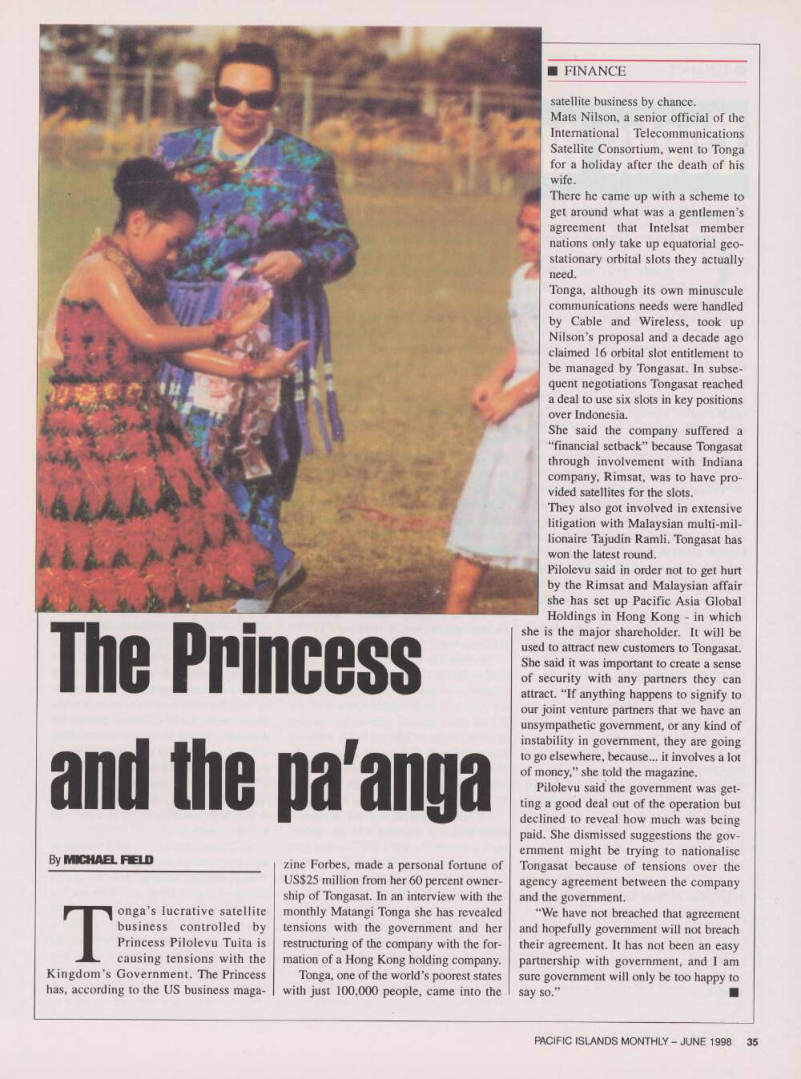
Tonga’s lucrative satellite business controlled by Princess Pilolevu Tuita is causing tensions with the Kingdom’s Government. The Princess has, according to the US business maga
zine Forbes, made a personal fortune of US$25 million from her 60 percent owner ship of Tongasat. In an interview with the monthly Matangi Tonga she has revealed tensions with the government and her restructuring of the company with the for mation of a Hong Kong holding company.
Tonga, one of the world’s poorest states with just 100,000 people, came into the
satellite business by chance.
Mats Nilson, a senior official of the International Telecommunications Satellite Consortium, went to Tonga for a holiday after the death of his wife.
There he came up with a scheme to get around what was a gentlemen’s agreement that Intelsat member nations only take up equatorial geo stationary orbital slots they actually need.
Tonga, although its own minuscule communications needs were handled by Cable and Wireless, took up Nilson’s proposal and a decade ago claimed 16 orbital slot entitlement to be managed by Tongasat. In subse quent negotiations Tongasat reached a deal to use six slots in key positions over Indonesia.
She said the company suffered a “financial setback” because Tongasat through involvement with Indiana company, Rimsat, was to have pro vided satellites for the slots.
They also got involved in extensive
litigation with Malaysian multi-mil
lionaire Tajudin Ramli. Tongasat has won the latest round.
Pilolevu said in order not to get hurt by the Rimsat and Malaysian affair she has set up Pacific Asia Global Holdings in Hong Kong - in which
she is the major shareholder. It will be used to attract new customers to Tongasat.
She said it was important to create a sense of security with any partners they can attract. “If anything happens to signify to our joint venture partners that we have an unsympathetic government, or any kind of instability in government, they are going to go elsewhere, because... it involves a lot of money,” she told the magazine.
Pilolevu said the government was get ting a good deal out of the operation but declined to reveal how much was being paid. She dismissed suggestions the gov ernment might be trying to nationalise Tongasat because of tensions over the agency agreement between the company and the government.
“We have not breached that agreement and hopefully government will not breach their agreement. It has not been an easy partnership with government, and I am sure government will only be too happy to say so.” ■