Water Music of Lokona
pp. 52-53 · Read in the full issue
Yachting
Pictures and Text by SALLY ANDREW
Sailing across the patch of water between the north east tip of Santo and the southernmost Banks Island in northern Vanuatu, our curiosity was piqued. Each nautical chart and guide book showed a different name for our des tination. I wondered which one the local folks used - Lokona (or Lacona, Lakon,
Lakoon), Gaua (or Gow) or Santa Maria?
In the hopes of catching a big fish for the village, we trailed our line astern. We were lucky. Within five minutes we landed two neon-bright mahimahi.
Arriving at Lakona Bay, we anchored far out in the roily bight. Before the hook was on the bottom, four canoe-loads of smiles paddled out to greet us. We storied on a bit, in mixed Bislama and English, then asked the oldest man, William, if he
would like a fish.
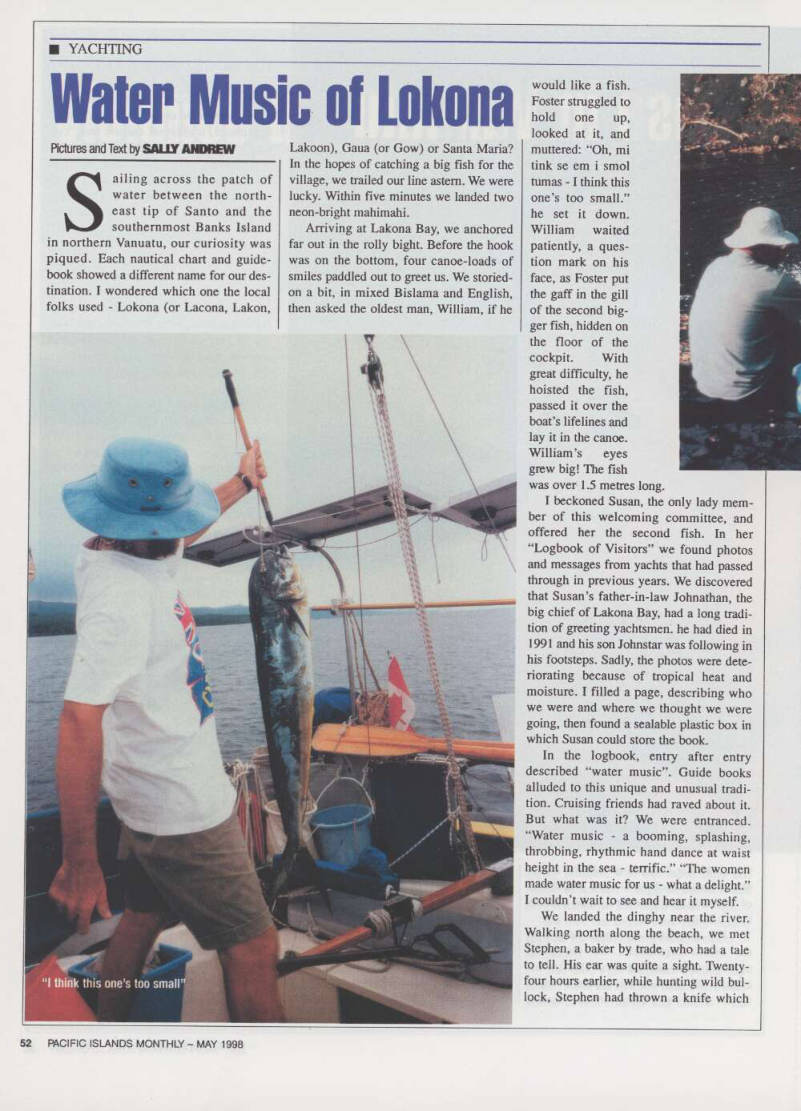
Foster struggled to hold one up, looked at it, and muttered; “Oh, mi tink se em i smol tumas -1 think this one’s too small.” he set it down.
William waited patiently, a ques tion mark on his face, as Foster put the gaff in the gill of the second big ger fish, hidden on the floor of the cockpit. With great difficulty, he hoisted the fish, passed it over the boat’s lifelines and lay it in the canoe.
William’s eyes grew big! The fish
was over 1.5 metres long.
I beckoned Susan, the only lady mem ber of this welcoming committee, and offered her the second fish. In her “Logbook of Visitors” we found photos and messages from yachts that had passed through in previous years. We discovered that Susan’s father-in-law Johnathan, the big chief of Lakona Bay, had a long tradi tion of greeting yachtsmen, he had died in 1991 and his son Johnstar was following in his footsteps. Sadly, the photos were dete riorating because of tropical heat and moisture. I filled a page, describing who we were and where we thought we were going, then found a sealable plastic box in which Susan could store the book.
In the logbook, entry after entry described “water music”. Guide books alluded to this unique and unusual tradi tion. Cruising friends had raved about it.
But what was it? We were entranced.
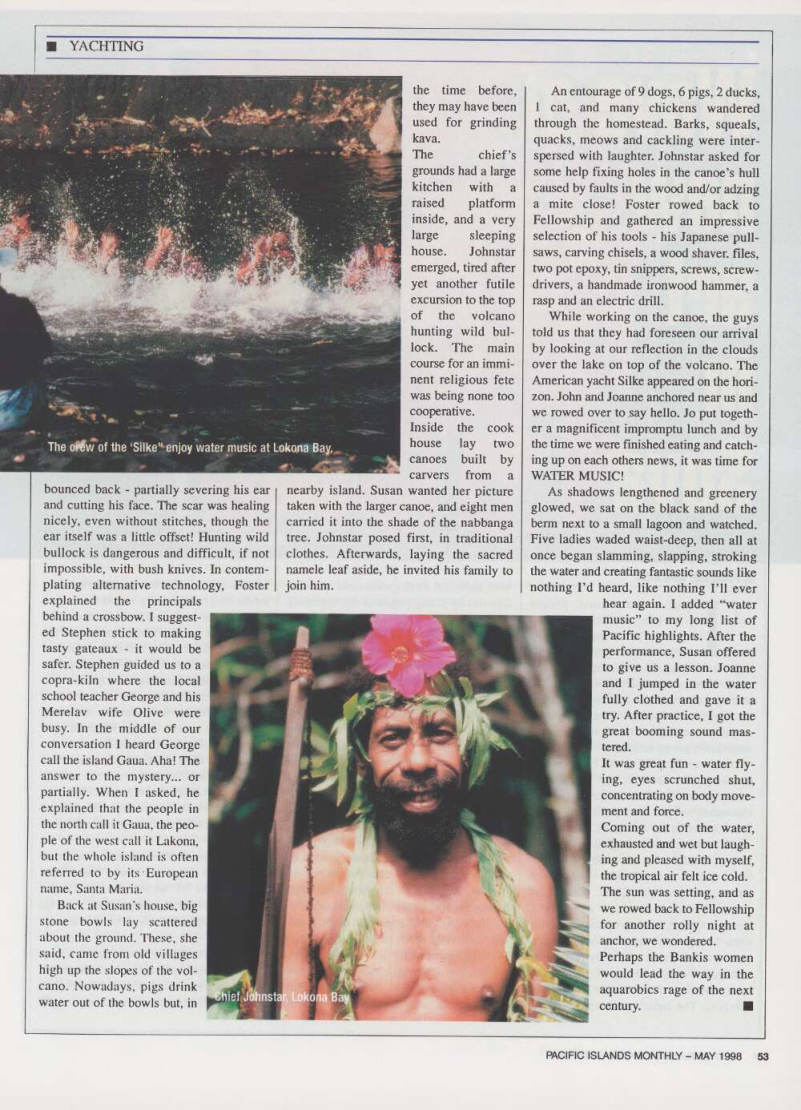
“Water music - a booming, splashing, throbbing, rhythmic hand dance at waist height in the sea - terrific.” “The women made water music for us - what a delight.”
I couldn’t wait to see and hear it myself.
We landed the dinghy near the river.
Walking north along the beach, we met Stephen, a baker by trade, who had a tale to tell. His ear was quite a sight. Twenty four hours earlier, while hunting wild bul lock, Stephen had thrown a knife which
"I think this one's too small"
bounced back - partially severing his ear and cutting his face. The scar was healing nicely, even without stitches, though the ear itself was a little offset! Hunting wild bullock is dangerous and difficult, if not impossible, with bush knives. In contem
plating alternative technology, Foster
explained the principals behind a crossbow. I suggest ed Stephen stick to making tasty gateaux - it would be safer. Stephen guided us to a copra-kiln where the local school teacher George and his Merelav wife Olive were busy. In the middle of our conversation I heard George call the island Gaua. Aha! The answer to the mystery... or partially. When I asked, he explained that the people in the north call it Gaua, the peo ple of the west call it Lakona, but the whole island is often referred to by its European name, Santa Maria.
Back at Susan’s house, big stone bowls lay scattered about the ground. These, she said, came from old villages high up the slopes of the vol cano. Nowadays, pigs drink water out of the bowls but, in
the time before, they may have been used for grinding kava.
The chief’s grounds had a large kitchen with a raised platform inside, and a very large sleeping house. Johnstar emerged, tired after yet another futile excursion to the top of the volcano hunting wild bul lock. The main course for an immi nent religious fete was being none too cooperative.
Inside the cook house lay two canoes built by carvers from a
nearby island. Susan wanted her picture taken with the larger canoe, and eight men carried it into the shade of the nabbanga tree. Johnstar posed first, in traditional clothes. Afterwards, laying the sacred namele leaf aside, he invited his family to
join him.
An entourage of 9 dogs, 6 pigs, 2 ducks, 1 cat, and many chickens wandered through the homestead. Barks, squeals, quacks, meows and cackling were inter spersed with laughter. Johnstar asked for some help fixing holes in the canoe’s hull caused by faults in the wood and/or adzing a mite close! Foster rowed back to Fellowship and gathered an impressive selection of his tools - his Japanese pull saws, carving chisels, a wood shaver, files, two pot epoxy, tin snippers, screws, screw drivers, a handmade ironwood hammer, a rasp and an electric drill.
While working on the canoe, the guys told us that they had foreseen our arrival by looking at our reflection in the clouds over the lake on top of the volcano. The American yacht Silke appeared on the hori zon. John and Joanne anchored near us and we rowed over to say hello. Jo put togeth er a magnificent impromptu lunch and by the time we were finished eating and catch ing up on each others news, it was time for
Water Music!
As shadows lengthened and greenery glowed, we sat on the black sand of the berm next to a small lagoon and watched.
Five ladies waded waist-deep, then all at once began slamming, slapping, stroking the water and creating fantastic sounds like nothing I’d heard, like nothing I’ll ever
hear again. I added “water music” to my long list of Pacific highlights. After the performance, Susan offered to give us a lesson. Joanne and I jumped in the water fully clothed and gave it a try. After practice, I got the great booming sound mas tered.
It was great fun - water fly ing, eyes scrunched shut, concentrating on body move ment and force.
Coming out of the water, exhausted and wet but laugh ing and pleased with myself, the tropical air felt ice cold.
The sun was setting, and as we rowed back to Fellowship for another roily night at anchor, we wondered.
Perhaps the Bankis women would lead the way in the aquarobics rage of the next century. ■
The orew of the 'Kilke" enjoy water music at Lokona Bay.
John star, Lokona Bay