Satellite television
pp. 39-41 · Read in the full issue

Telecommunications Feature
Satellite television in the South Pacific
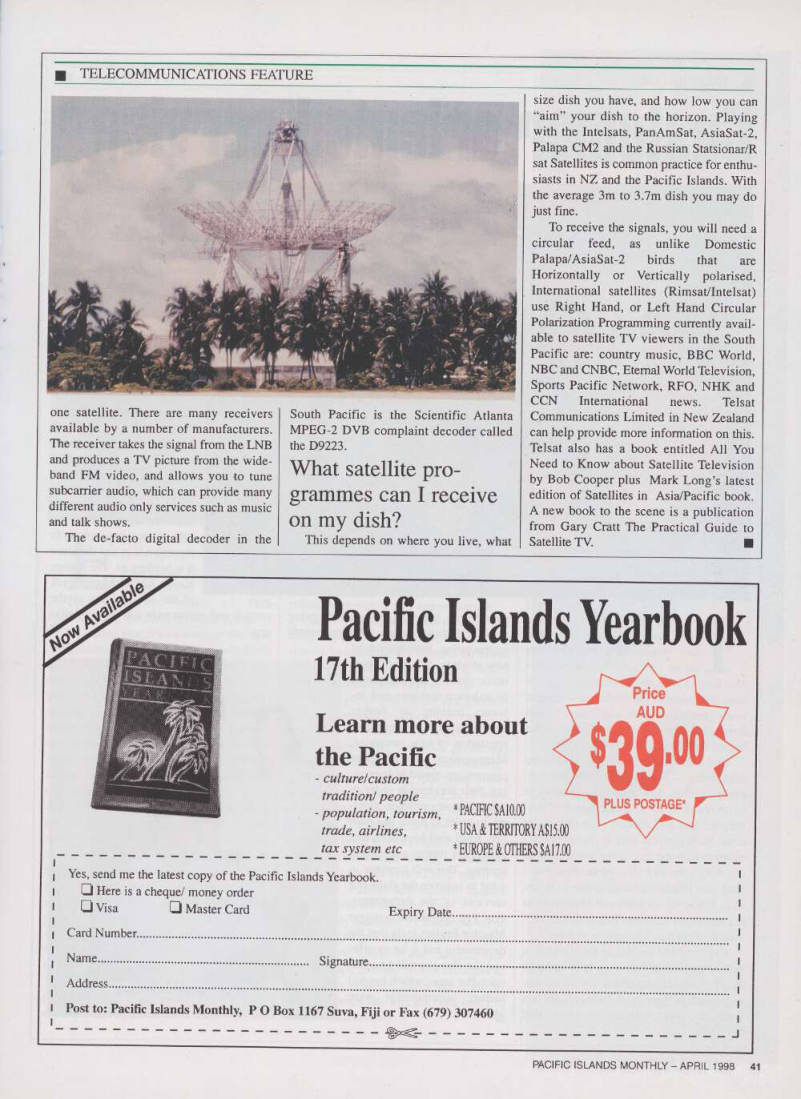
What is satellite televi sion? It consist of the most visible component, a parabolic reflector.
The dish/antenna is a device that focuses the microwave signals coming from the satellites much as the mirror in a reflecting telescope concentrates the light from dis tant g axis.
A device containing a motor that is used to swing the satellite dish east and west to allow it to focus on individual satellites, which may be as close to one another as 2 degrees of arc. Actuator ms are most com monly found in 18- and 24-inch lengths (the longer the arm, the wider the arc that the dish can “see”.
In addition, a more expensive aiming mechanism, called a “horizon-to-horizon”
mount, is capable of more precise aiming (important on Ku band and closely-spaced satellites), as well as being able see the entire satellite arc from your location given no physical obstructions between the dish and the satellite.
There is the LNB. This component amplifies the very weak signals from the dish and then converts them to a more suit able band of frequencies. LNB stands for Low Noise Block-converter.
There is also a device called an LNBF, which combines the LNB and Feed Horn into a single unit.
The LNBF device uses a simpler method for adjusting the polarity (voltage right on the LNB cable). However if the LNB part goes bad, you need to replaced. An LNBF is especially suitable for dedicated opera tions, such as a smaller dish used for only
one satellite. There are many receivers available by a number of manufacturers.
The receiver takes the signal from the LNB and produces a TV picture from the wide band EM video, and allows you to tune subcarrier audio, which can provide many different audio only services such as music and talk shows.
The de-facto digital decoder in the
South Pacific is the Scientific Atlanta MPEG-2 DVB complaint decoder called the D 9223.
What satellite pro
grammes can I receive
on my dish?
This depends on where you live, what
size dish you have, and how low you can “aim” your dish to the horizon. Playing with the Intelsats, PanAmSat, Asia Sat-2, Palapa CM2 and the Russian Statsionar/R sat Satellites is common practice for enthu siasts in NZ and the Pacific Islands. With the average 3m to 3.7 m dish you may do
just fine.
To receive the signals, you will need a circular feed, as unlike Domestic Palapa/AsiaSat-2 birds that are
Horizontally or Vertically polarised,
International satellites (Rimsat/Intelsat) use Right Hand, or Left Hand Circular Polarization Programming currently avail able to satellite TV viewers in the South Pacific are: country music, BBC World, NBC and CNBC, Eternal World Television, Sports Pacific Network, RFO, NHK and CCN International news. Telsat Communications Limited in New Zealand can help provide more information on this.
Telsat also has a book entitled All You Need to Know about Satellite Television by Bob Cooper plus Mark Long’s latest edition of Satellites in Asia/Pacific book.
A new book to the scene is a publication from Gary Cratt The Practical Guide to Satellite TV. ■