Whatever happened to PH211?
pp. 24-25 · Read in the full issue
Aviation
Whatever happened to PH211? 15 months after the crash, the causes have yet to be made public
By Chris Peteru
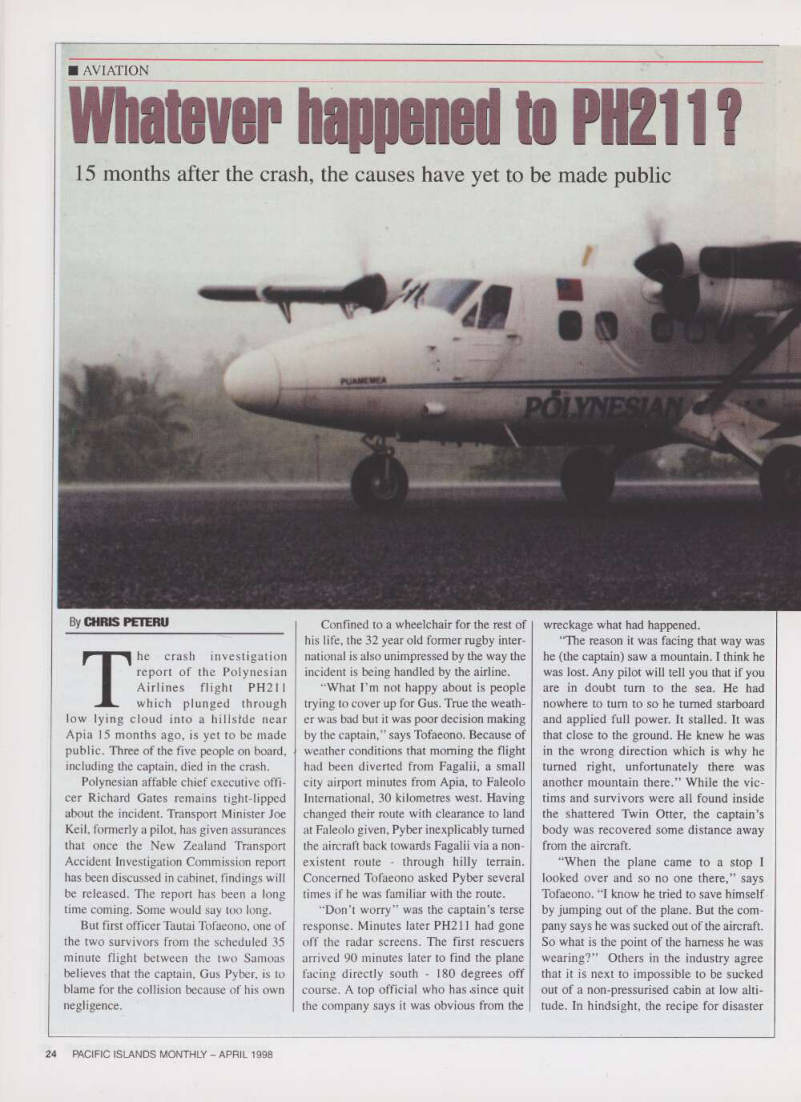
The crash investigation report of the Polynesian Airlines flight PH2II which plunged through low lying cloud into a hillside near Apia 15 months ago, is yet to be made public. Three of the five people on board, including the captain, died in the crash.
Polynesian affable chief executive offi cer Richard Gates remains tight-lipped about the incident. Transport Minister Joe Keil, formerly a pilot, has given assurances that once the New Zealand Transport Accident Investigation Commission report has been discussed in cabinet, findings will be released. The report has been a long time coming. Some would say too long.
But first officer Tautai Tofaeono, one of the two survivors from the scheduled 35 minute flight between the two Samoas believes that the captain, Gus Pyber, is to blame for the collision because of his own negligence.
Confined to a wheelchair for the rest of his life, the 32 year old former rugby inter national is also unimpressed by the way the incident is being handled by the airline.
“What I’m not happy about is people trying to cover up for Gus. True the weath er was bad but it was poor decision making by the captain,” says Tofaeono. Because of weather conditions that morning the flight had been diverted from Fagalii, a small city airport minutes from Apia, to Faleolo International, 30 kilometres west. Having changed their route with clearance to land at Faleolo given, Pyber inexplicably turned the aircraft back towards Fagalii via a non existent route - through hilly terrain.
Concerned Tofaeono asked Pyber several times if he was familiar with the route.
"Don’t worry” was the captain’s terse response. Minutes later PH2II had gone off the radar screens. The first rescuers arrived 90 minutes later to find the plane facing directly south - 180 degrees off course. A top official who has .since quit the company says it was obvious from the
wreckage what had happened.
“The reason it was facing that way was he (the captain) saw a mountain. I think he was lost. Any pilot will tell you that if you are in doubt turn to the sea. He had nowhere to turn to so he turned starboard and applied full power. It stalled. It was that close to the ground. He knew he was in the wrong direction which is why he turned right, unfortunately there was another mountain there.” While the vic tims and survivors were all found inside the shattered Twin Otter, the captain’s body was recovered some distance away from the aircraft.
“When the plane came to a stop I looked over and so no one there,” says Tofaeono. “I know he tried to save himself by jumping out of the plane. But the com pany says he was sucked out of the aircraft.
So what is the point of the harness he was wearing?” Others in the industry agree that it is next to impossible to be sucked out of a non-pressurised cabin at low alti tude. In hindsight, the recipe for disaster
had been scripted much earlier. Pyber arrived in Samoa to work for the airline although he had no experience with local flying conditions or Twin Otters.
Staff at Fagalii Airport remember him as little more than a headache to work for.
He alienated himself from the Samoan pilots and staff with a headmaster type leadership style. In less than a year he ordered the sacking of one high flying pilot for alleged misconduct, demoted Tofaeono for alleged insubordination and sacked the airport manager for filing a report on his
“wacky” flying methods.
Although his personality is irrelevant to straight out flying ability, he came up short in that department as well.
Despite giving the impression that he
had logged many hours on different types of aircraft the reality was that he had amassed less than a 1000 hours of total fly ing time, having largely been an adminis trator with other airlines, one being a com pany that flew antiquated DC3s and went bankrupt.
Months before the crash a controller at Fagalii Airport, Anitipa Finau said his “stu pidity and inexperience ... almost caused a collision when he tried to land without clearance.” This was only brought to the attention of the company after a terrified passenger complained to the transport min ister’s office. Pyber who failed to follow proper procedure by noting the incident in flight reports was allowed to continue fly ing. No disciplinary action was taken by
management. During flight familiarisation
he lost the respect of junior flying officers by “repeating the mistakes of his own stu dents ... failing to respond and act accord ingly,” says Finau.
Despite the background, he was given the rating to fly Twin Otters, and then appointed the short haul manager. Insiders acknowledge that the plane had flown with a number of defects by relying on the plane’s back up systems to cover potential problems.
At the time of the crash, PH2II was fly ing with one of its three on board compass
es expired. “I know when I was with the Polynesian we had a lot of problems get ting spare parts.. “On one occasion the 737-300 was grounded for three days with a flat tyre because we didn’t have a spare.
It cost the company $A46,000 (SUS2B,OOO) to hire a Lear jet to bring one tyre from Melbourne.”
Meanwhile Tofeono remains on the payroll but is awaiting the release of the accident report before considering any legal options.
“I am not bitter personally, but I want the truth to be heard.” Relatives of the other survivor, a six year old girl, are suing Polynesian Airlines for SUSI 2 million through the American Samoa courts.
Last June Gates told the Sunday Newsline that “the company is doing everything within its power together with the insurance people to ensure that he is looked after in an appropriate manner, that he has a future and that his family is looked after.”
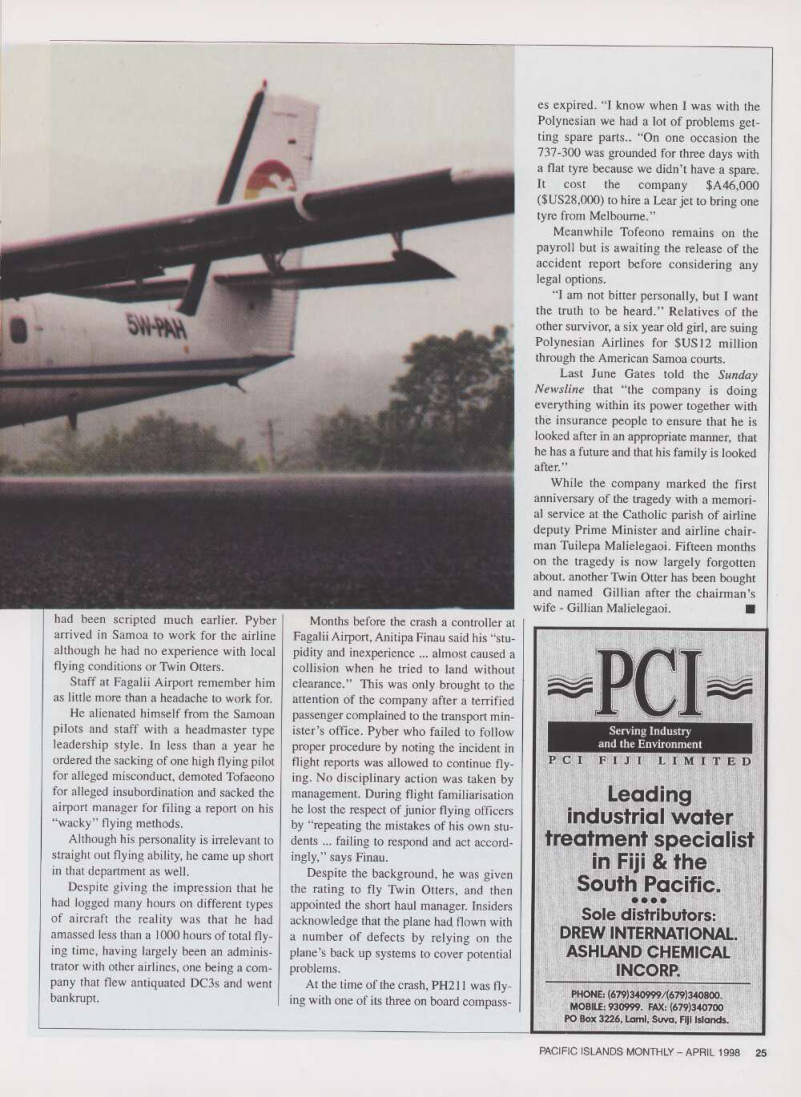
While the company marked the first anniversary of the tragedy with a memori al service at the Catholic parish of airline deputy Prime Minister and airline chair man Tuilepa Malielegaoi. Fifteen months on the tragedy is now largely forgotten about, another Twin Otter has been bought and named Gillian after the chairman’s wife - Gillian Malielegaoi. ■