The magic of pine and teachers
pp. 52-53 · Read in the full issue
Yachting
Text and photography by SALLY ANDREW
For weeks we hid in the backwaters of Baie du Prony, battling with the insidious red mud of New Caledonia’s Grand Terre. Although the cyclone season had ended, the weather remained unstable.
Eventually the isobars synchronised to give us a favourable wind to sale to Isles of Pines and we headed south.
After an easy eight hour reach, we dropped anchor in a patch of fine white sand off the beach of Kuto Bay. Wow!
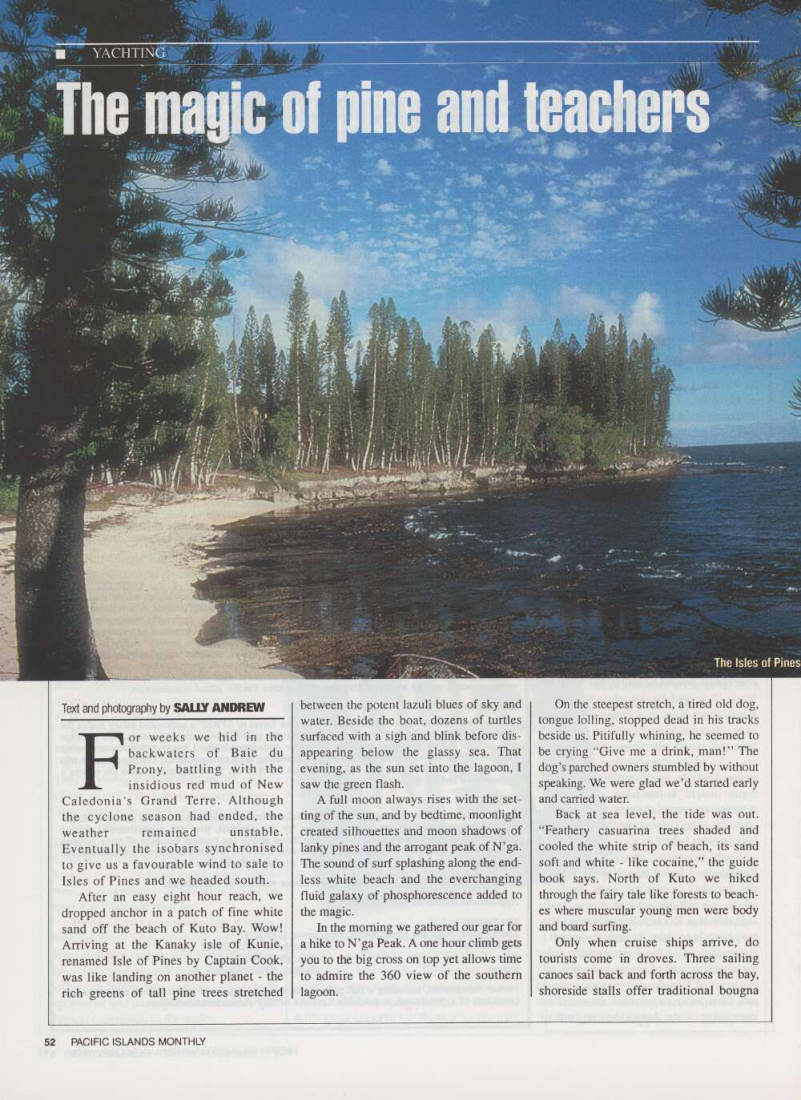
Arriving at the Kanaky isle of Kunie, renamed Isle of Pines by Captain Cook, was like landing on another planet - the rich greens of tall pine trees stretched
between the potent lazuli blues of sky and water. Beside the boat, dozens of turtles surfaced with a sigh and blink before dis appearing below the glassy sea. That evening, as the sun set into the lagoon, I saw the green flash.
A full moon always rises with the set ting of the sun, and by bedtime, moonlight created silhouettes and moon shadows of lanky pines and the arrogant peak of N’ga.
The sound of surf splashing along the end less white beach and the everchanging fluid galaxy of phosphorescence added to
the magic.
In the morning we gathered our gear for a hike to N’ga Peak. A one hour climb gets you to the big cross on top yet allows time to admire the 360 view of the southern lagoon.
On the steepest stretch, a tired old dog, tongue lolling, stopped dead in his tracks beside us. Pitifully whining, he seemed to be crying “Give me a drink, man!” The dog’s parched owners stumbled by without speaking. We were glad we’d started early and carried water.
Back at sea level, the tide was out.
“Feathery casuarina trees shaded and cooled the white strip of beach, its sand soft and white - like cocaine,” the guide book says. North of Kuto we hiked through the fairy tale like forests to beach es where muscular young men were body and board surfing.
Only when cruise ships arrive, do tourists come in droves. Three sailing canoes sail back and forth across the bay, shoreside stalls offer traditional bougna
The Isles of Pines
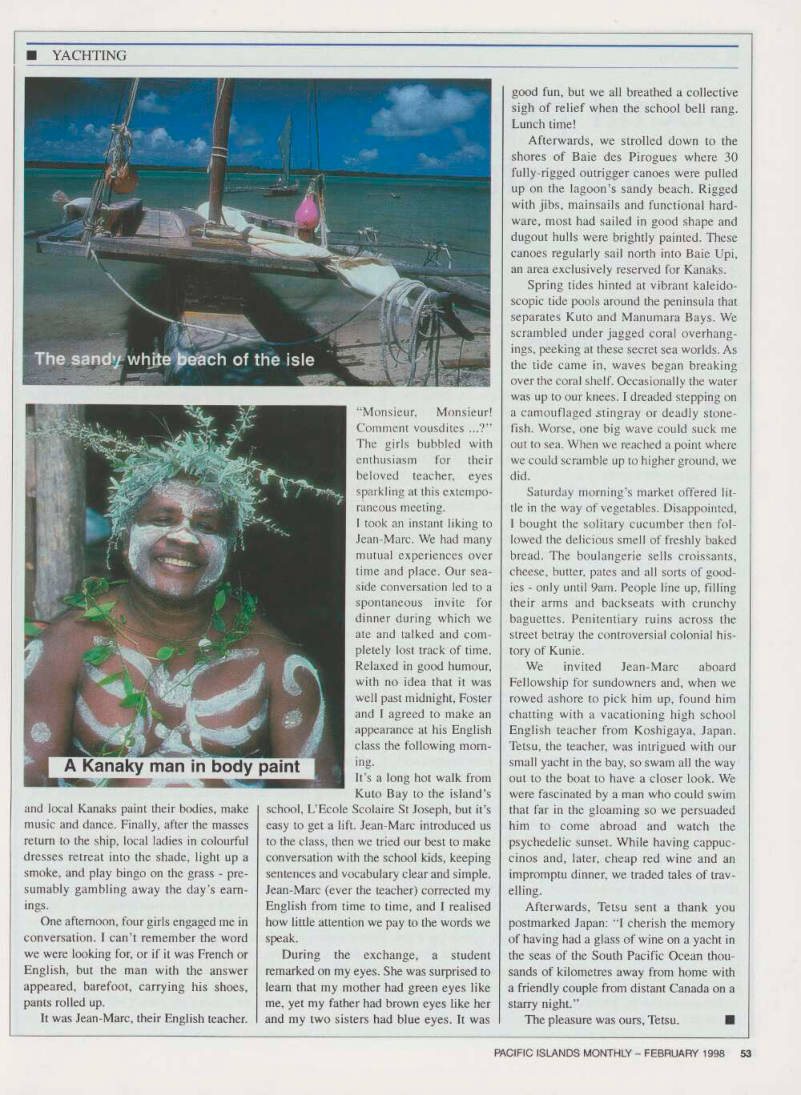
and local Kanaks paint their bodies, make music and dance. Finally, after the masses return to the ship, local ladies in colourful dresses retreat into the shade, light up a smoke, and play bingo on the grass - pre sumably gambling away the day’s earn ings.
One afternoon, four girls engaged me in conversation. I can’t remember the word we were looking for, or if it was French or English, but the man with the answer appeared, barefoot, carrying his shoes, pants rolled up.
It was Jean-Marc, their English teacher.
“Monsieur, Monsieur!
Comment vousdites ...?”
The girls bubbled with enthusiasm for their beloved teacher, eyes sparkling at this extempo raneous meeting. 1 took an instant liking to Jean-Marc. We had many mutual experiences over time and place. Our sea side conversation led to a spontaneous invite for dinner during which we ate and talked and com pletely lost track of time.
Relaxed in good humour, with no idea that it was well past midnight, Foster and I agreed to make an appearance at his English class the following morn ing.
It’s a long hot walk from Kuto Bay to the island’s
school, L’Ecole Scolaire St Joseph, but it’s easy to get a lift. Jean-Marc introduced us to the class, then we tried our best to make conversation with the school kids, keeping sentences and vocabulary clear and simple.
Jean-Marc (ever the teacher) corrected my English from time to time, and I realised how little attention we pay to the words we
speak.
During the exchange, a student remarked on my eyes. She was surprised to learn that my mother had green eyes like me, yet my father had brown eyes like her and my two sisters had blue eyes. It was
good fun, but we all breathed a collective sigh of relief when the school bell rang.
Lunch time!
Afterwards, we strolled down to the shores of Baie des Pirogues where 30 fully-rigged outrigger canoes were pulled up on the lagoon’s sandy beach. Rigged with jibs, mainsails and functional hard ware, most had sailed in good shape and dugout hulls were brightly painted. These canoes regularly sail north into Baie Upi, an area exclusively reserved for Kanaks.
Spring tides hinted at vibrant kaleido scopic tide pools around the peninsula that separates Kuto and Manumara Bays. We scrambled under jagged coral overhang ings, peeking at these secret sea worlds. As the tide came in, waves began breaking over the coral shelf. Occasionally the water was up to our knees. I dreaded stepping on a camouflaged .stingray or deadly stone fish. Worse, one big wave could suck me out to sea. When we reached a point where we could scramble up to higher ground, we did.
Saturday morning’s market offered lit tle in the way of vegetables. Disappointed, I bought the solitary cucumber then fol lowed the delicious smell of freshly baked bread. The boulangerie sells croissants, cheese, butter, pates and all sorts of good ies - only until 9am. People line up, filling their arms and backseats with crunchy baguettes. Penitentiary ruins across the street betray the controversial colonial his tory of Kunie.
We invited Jean-Marc aboard Fellowship for sundowners and, when we rowed ashore to pick him up, found him chatting with a vacationing high school English teacher from Koshigaya, Japan.
Tetsu, the teacher, was intrigued with our small yacht in the bay, so swam all the way out to the boat to have a closer look. We were fascinated by a man who could swim that far in the gloaming so we persuaded him to come abroad and watch the psychedelic sunset. While having cappuc cinos and, later, cheap red wine and an impromptu dinner, we traded tales of trav
elling.
Afterwards, Tetsu sent a thank you postmarked Japan; “I cherish the memory of having had a glass of wine on a yacht in the seas of the South Pacific Ocean thou sands of kilometres away from home with a friendly couple from distant Canada on a
starry night.”
The pleasure was ours, Tetsu. ■
The sandy white beach of the isle
A Kanaky man in body paint