notorious mysteries
pp. 50-51 · Read in the full issue
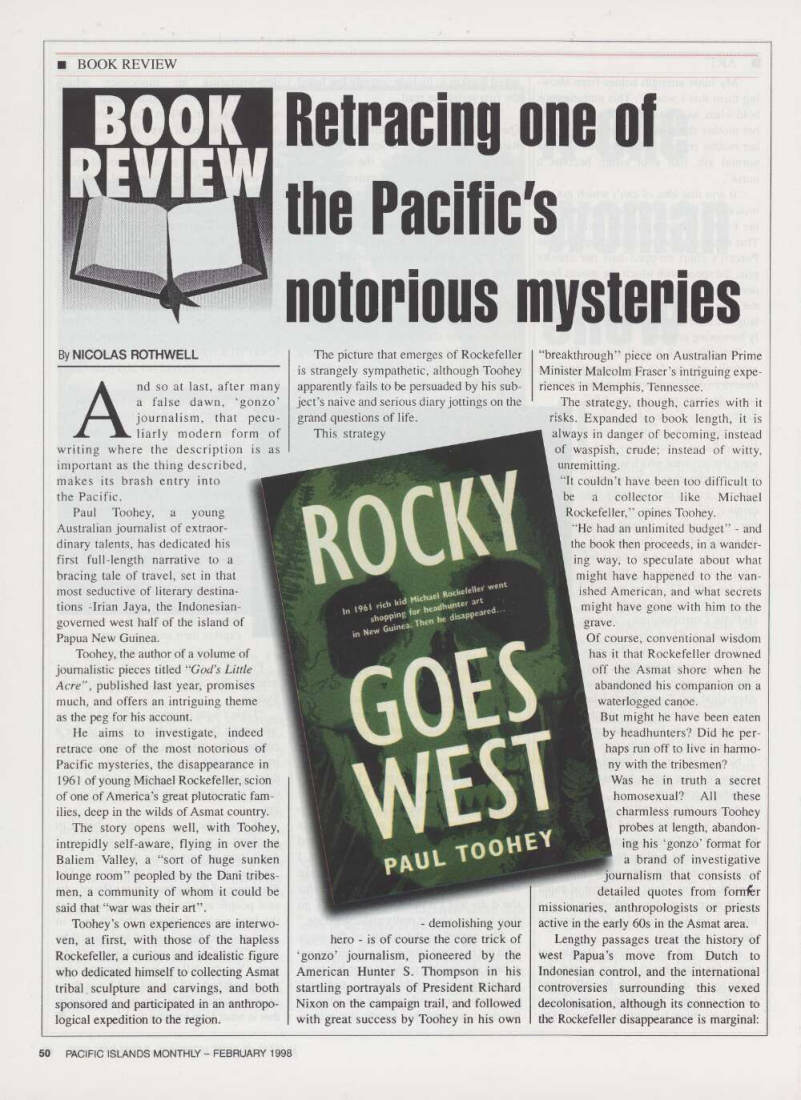
Retracing one of the Pacific's notorious mysteries
The picture that emerges of Rockefeller is strangely sympathetic, although Toohey apparently fails to be persuaded by his sub ject’s naive and serious diary jottings on the grand questions of life.
This strategy
- demolishing your hero - is of course the core trick of
‘gonzo’ journalism, pioneered by the
American Hunter S. Thompson in his startling portrayals of President Richard Nixon on the campaign trail, and followed with great success by Toohey in his own
“breakthrough” piece on Australian Prime Minister Malcolm Fraser’s intriguing expe riences in Memphis, Tennessee.
The strategy, though, carries with it risks. Expanded to book length, it is i anger of becoming, instead i, crude; instead of witty, ’t have been too difficult to collector like Michael ler,” opines Toohey. 1 an unlimited budget” - and c then proceeds, in a wander y, to speculate about what have happened to the van- American, and what secrets have gone with him to the 3urse, conventional wisdom it that Rockefeller drowned the Asmat shore when he ndoned his companion on a terlogged canoe, it might he have been eaten / headhunters? Did he per aps run off to live in harmo ly with the tribesmen?
Was he in truth a secret homosexual? All these charmless rumours Toohey
probes at length, abandon
ing his ‘gonzo’ format for a brand of investigative mrnalism that consists of detailed quotes from forrrfer missionaries, anthropologists or priests active in the early 60s in the Asmat area.
Lengthy passages treat the history of west Papua’s move from Dutch to Indonesian control, and the international controversies surrounding this vexed decolonisation, although its connection to the Rockefeller disappearance is marginal:
Michael had swum from his canoe before the mini-crisis erupted.
What kind of young man was the absent anti-hero at this book’s frustrating centre?
The kind of person, at any rate, who could write in his journals such sentences as this one. “I became immersed in that pent-up excitement that is only contained by the realisation that impetuosity would lead to disaster.”
Toohey, however, fails to find any poise or edge of individual character in the
words he quotes from Rockefeller, or the reminiscences he coaxes from the friends and colleagues still alive to share them.
Nor are the Asmat a strong presence in the pages of Rocky Goes West.
The Papuans who appear stand briefly in the haunting spotlight of Toohey’s prose, only to fall back into oblivion.
Attention is focused rather on the gallery of colonials; misfits and eccentric inves tigators, both private and anthropologi cal, caught up on the fringes of the story - there is the ludicrous Frank Monte, ever keen to strike a deal for the film rights to the Rockefeller saga; there are the scien tists and adventurers of the Asmat world, such as Tobias Schneebaum and Carleton Gajdusek, who are respectively given cameo roles by Toohey as gay and pedophile. Did anyone help our author solve the mystery? Are we any the wiser?
Of course not. The point of ‘gonzo’ jour nalism, and of 'gonzo’ travel writing, is that it mocks its own formulas.
Yet Toohey’s considerable literary and conceptual powers seem, in this book at least, ill-served by his chosen model.
Rocky Goes West is a long book about little, its core sections strung together from unfocused interviews with bit play ers, its oddly conventional narrative relieved only by brief, startling flashes of poetic insight: at one point, a Macassan is sitting unworried at the prow of a long boat, “as if he’s absorbing the sea’s dan gers on your behalf.”
Such moments, though, are rare.
Repeatedly I found myself wearying of the hostile, embittered tone Toohey adopts towards his subject: it is at least arguable that Rockefeller, whatever he may have been, has, through the strange circumstances of his disappearance and the establishment of his art collection at the heart of New York’s greatest muse um, done more to increase the world’s knowledge of the Asmat than any other
well-meaning westerner. This book, then, must go down as a puzzling failure, anoth er of ‘gonzo’ journalism’s missed opportu nities to catch and marvel at the engaging otherness of the far Pacific. There are, in the last pages of Rocky Goes West, tantalis ing glimpses of what might have been, as Toohey returns to his strength, and lets rip with a travel writer’s fantasy of weirdness, modulating from the cargo cult devoted to ABC newsreader Rosemary Church, via some intriguing ideas on Asmat sacrifice,
onto an ironised solution of the Rockefeller mystery - in which Michael meets and runs away with and is eventually killed by Amelia Earhart’s jungle daughter. Who?
Well, that’s another story it would have made a splendid magazine article, but alas, all this joyful lightness comes too late to save Rocky from the lead weight of its own intent.
Rocky Goes West, by Paul Toohey, publ by Duffy and Snellgrove, Sydney Australia, $A 19.95. ■