Caught - In the great Pacific eddy
pp. 52-53 · Read in the full issue
Yatching
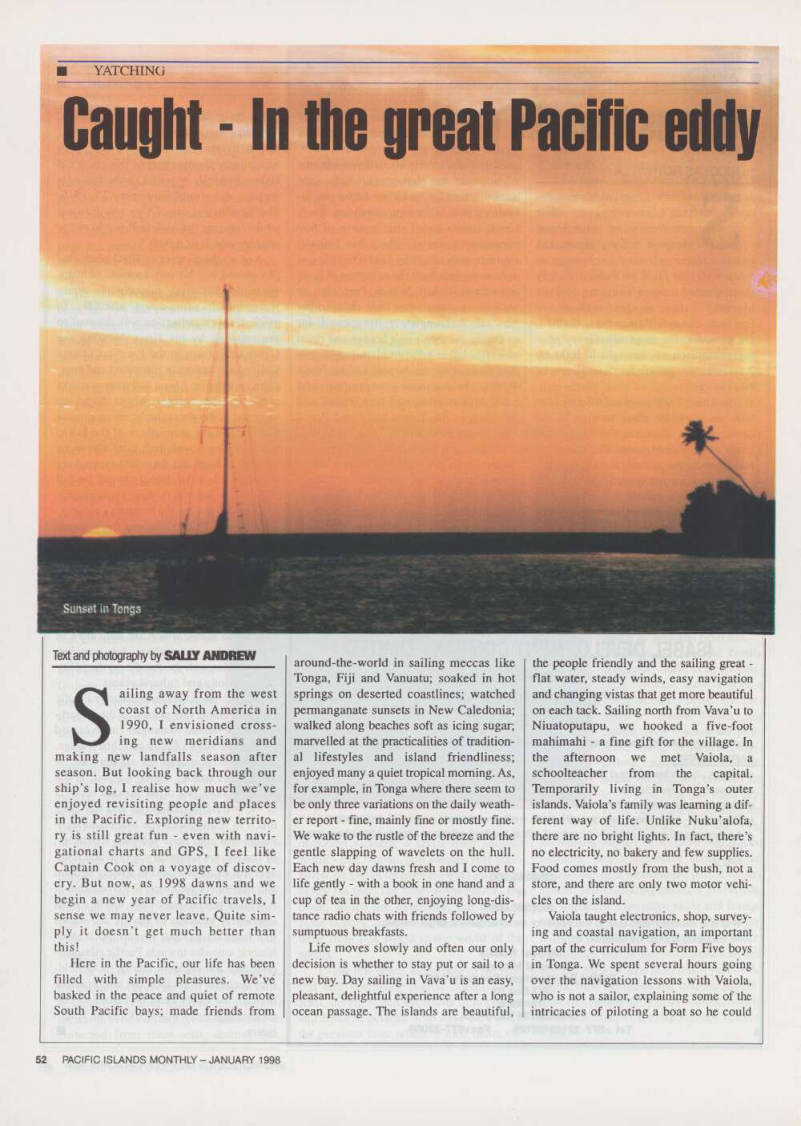
around-the-world in sailing meccas like Tonga, Fiji and Vanuatu; soaked in hot springs on deserted coastlines; watched permanganate sunsets in New Caledonia; walked along beaches soft as icing sugar; marvelled at the practicalities of tradition al lifestyles and island friendliness; enjoyed many a quiet tropical morning. As, for example, in Tonga where there seem to be only three variations on the daily weath er report - fine, mainly fine or mostly fine.
We wake to the rustle of the breeze and the gentle slapping of wavelets on the hull.
Each new day dawns fresh and I come to life gently - with a book in one hand and a cup of tea in the other, enjoying long-dis tance radio chats with friends followed by sumptuous breakfasts.
Life moves slowly and often our only decision is whether to stay put or sail to a new bay. Day sailing in Vava’u is an easy, pleasant, delightful experience after a long ocean passage. The islands are beautiful,
Sailing away from the west coast of North America in 1990, I envisioned cross ing new meridians and making aew landfalls season after season. But looking back through our ship’s log, I realise how much we’ve enjoyed revisiting people and places in the Pacific. Exploring new territo ry is still great fun - even with navi gational charts and GPS, I feel like Captain Cook on a voyage of discov ery. But now, as 1998 dawns and we begin a new year of Pacific travels, I sense we may never leave. Quite sim ply it doesn’t get much better than this!
Here in the Pacific, our life has been filled with simple pleasures. We’ve basked in the peace and quiet of remote South Pacific bays; made friends from
the people friendly and the sailing great flat water, steady winds, easy navigation and changing vistas that get more beautiful on each tack. Sailing north from Vava’u to Niuatoputapu, we hooked a five-foot mahimahi - a fine gift for the village. In the afternoon we met Vaiola, a schoolteacher from the capital.
Temporarily living in Tonga’s outer islands. Vaiola’s family was learning a dif ferent way of life. Unlike Nuku’alofa, there are no bright lights. In fact, there’s no electricity, no bakery and few supplies.
Food comes mostly from the bush, not a store, and there are only two motor vehi cles on the island.
Vaiola taught electronics, shop, survey ing and coastal navigation, an important part of the curriculum for Form Five boys in Tonga. We spent several hours going over the navigation lessons with Vaiola, who is not a sailor, explaining some of the intricacies of piloting a boat so he could
Text and photography by SALIY ANDREW
Sunset in Tonga
better explain the assignment to his stu dents. We wanted to take the class out for a
“practical” fun-cruise aboard Fellowship.
Unfortunately, weather and visas conspired against us.
And in Suva (Fiji), we found the biggest and best food market in the South Pacific. It literally overflows with produce
Both women insisted we visit their home on the weekend.
So, on Sunday we made our way by bumpy bus to the suburbs outside Suva.
The family’s house was little more than a two-room shanty but we were treated like royalty. We sat on mats and ate mountains of curried chicken and rice, and cucumber
and colours; paw paw gold, cucum ber green, pump kin orange, tomato red, lemon yellow, eggshell white, cassava brown, eggplant purple.
The scent of Indian spices and Fijian kava drifts into all the comers of the market and spills into the streets beyond.
Midway between the market and the Royal Suva Yacht Club, we struck up a conversation with two young
Indo-Fijian
women - their long black hair and beautiful pink saris offset by a rare blue Suva sky.
raita. The women explained the secret of a good curry, then dressed me in traditional Indian garments. Off we went, visiting around the neighbourhood. Foster, mean while, helped build and extension for the
growing family, holding sheets of roofing
iron in place and hammering a few nails.
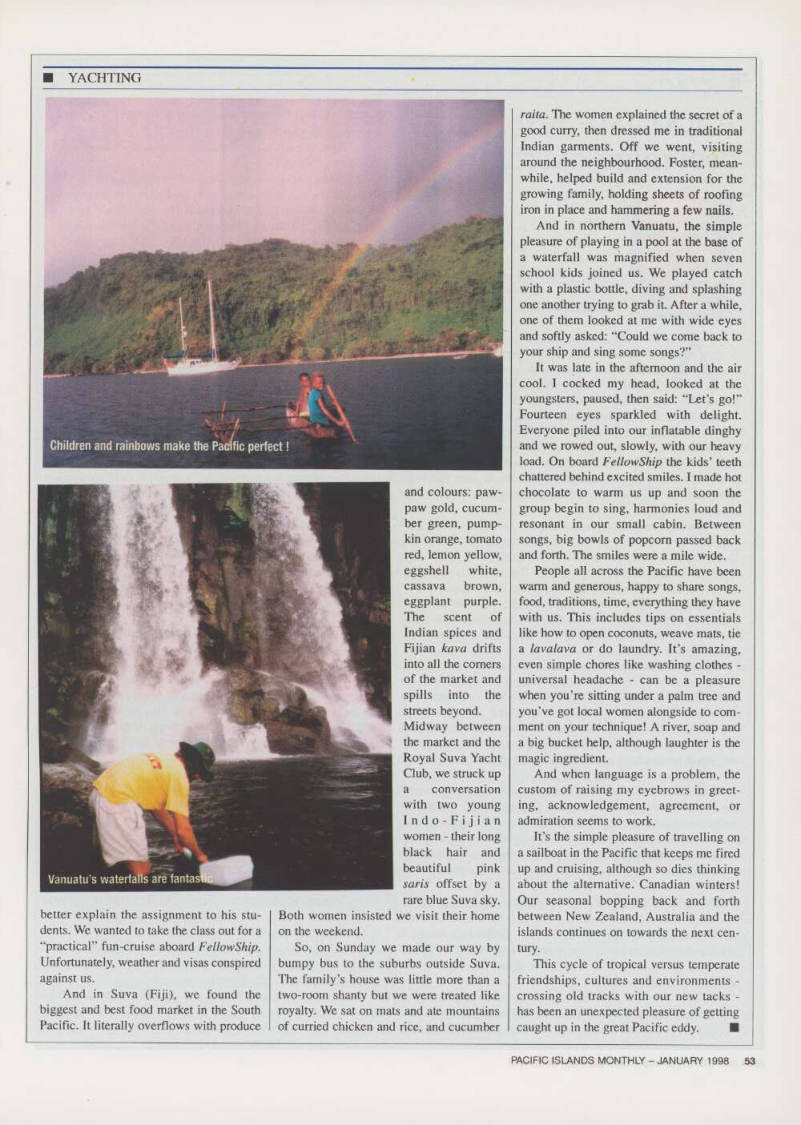
And in northern Vanuatu, the simple pleasure of playing in a pool at the base of a waterfall was magnified when seven school kids joined us. We played catch with a plastic bottle, diving and splashing one another trying to grab it. After a while, one of them looked at me with wide eyes and softly asked: “Could we come back to your ship and sing some songs?”
It was late in the afternoon and the air cool. I cocked my head, looked at the youngsters, paused, then said: “Let’s go!”
Fourteen eyes sparkled with delight.
Everyone piled into our inflatable dinghy and we rowed out, slowly, with our heavy load. On board Fellowship the kids’ teeth chattered behind excited smiles. I made hot chocolate to warm us up and soon the group begin to sing, harmonies loud and resonant in our small cabin. Between songs, big bowls of popcorn passed back and forth. The smiles were a mile wide.
People all across the Pacific have been warm and generous, happy to share songs, food, traditions, time, everything they have with us. This includes tips on essentials like how to open coconuts, weave mats, tie a lavalava or do laundry. It’s amazing, even simple chores like washing clothes universal headache - can be a pleasure when you’re sitting under a palm tree and you’ve got local women alongside to com ment on your technique! A river, soap and a big bucket help, although laughter is the
magic ingredient.
And when language is a problem, the custom of raising my eyebrows in greet
ing, acknowledgement, agreement, or
admiration seems to work.
It’s the simple pleasure of travelling on a sailboat in the Pacific that keeps me fired up and cruising, although so dies thinking about the alternative. Canadian winters!
Our seasonal bopping back and forth between New Zealand, Australia and the islands continues on towards the next cen tury.
This cycle of tropical versus temperate friendships, cultures and environments crossing old tracks with our new tacks has been an unexpected pleasure of getting caught up in the great Pacific eddy. ■
vauatu's waterfalls are fantastic
Childern and rainbows make the Pacific Perfect!