Eanharfs disappearance?
pp. 35-36 · Read in the full issue
History
Does PNG hold the key to Eanharfs disappearance?
By Sam Vulum
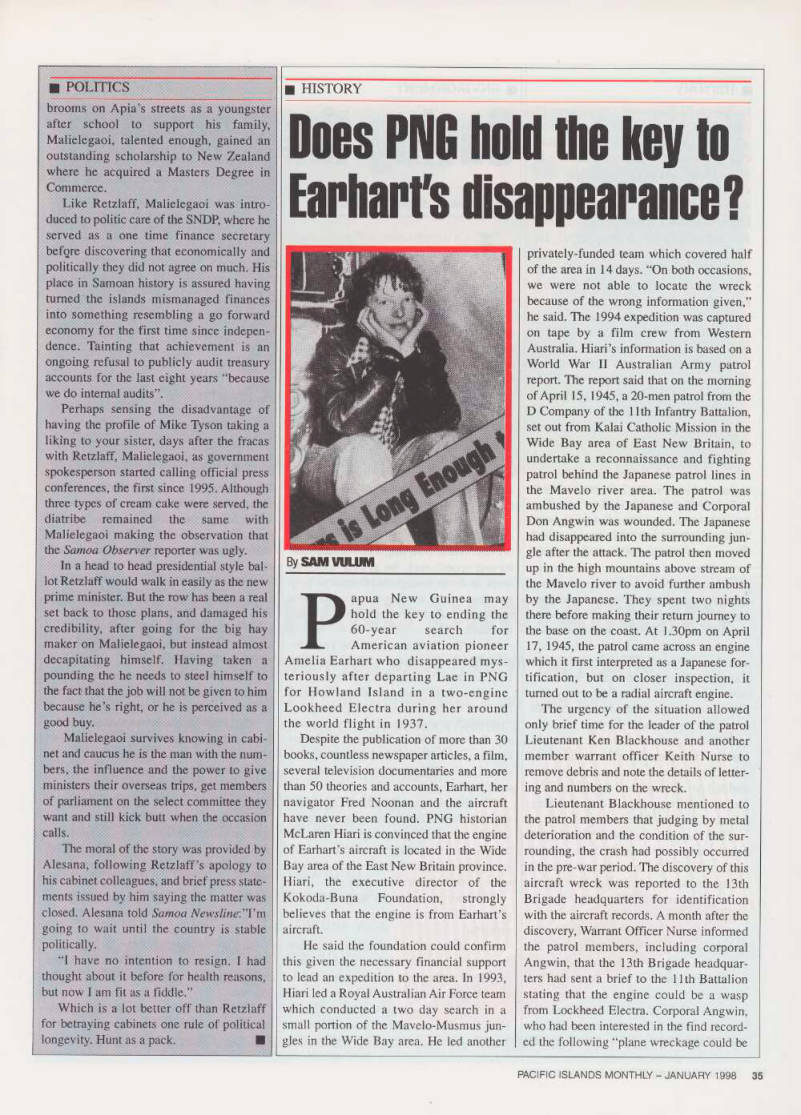
Papua New Guinea may hold the key to ending the 60-year search for American aviation pioneer Amelia Earhart who disappeared mys teriously after departing Lae in PNG for Howland Island in a two-engine Lockheed Electra during her around the world flight in 1937.
Despite the publication of more than 30 books, countless newspaper articles, a film, several television documentaries and more than 50 theories and accounts, Earhart, her navigator Fred Noonan and the aircraft have never been found. PNG historian McLaren Hiari is convinced that the engine of Earhart’s aircraft is located in the Wide Bay area of the East New Britain province.
Hiari, the executive director of the Kokoda-Buna Foundation, strongly believes that the engine is from Earhart’s aircraft.
He said the foundation could confirm this given the necessary financial support to lead an expedition to the area. In 1993, Hiari led a Royal Australian Air Force team which conducted a two day search in a small portion of the Mavelo-Musmus jun gles in the Wide Bay area. He led another
privately-funded team which covered half of the area in 14 days. “On both occasions, we were not able to locate the wreck because of the wrong information given,” he said. The 1994 expedition was captured on tape by a film crew from Western Australia. Hiari’s information is based on a World War II Australian Army patrol report. The report said that on the morning of April 15, 1945, a 20-men patrol from the D Company of the 11th Infantry Battalion, set out from Kalai Catholic Mission in the Wide Bay area of East New Britain, to undertake a reconnaissance and fighting patrol behind the Japanese patrol lines in the Mavelo river area. The patrol was ambushed by the Japanese and Corporal Don Angwin was wounded. The Japanese had disappeared into the surrounding jun gle after the attack. The patrol then moved up in the high mountains above stream of the Mavelo river to avoid further ambush by the Japanese. They spent two nights there before making their return journey to the base on the coast. At 1,30 pm on April 17, 1945, the patrol came across an engine which it first interpreted as a Japanese for tification, but on closer inspection, it turned out to be a radial aircraft engine.
The urgency of the situation allowed only brief time for the leader of the patrol Lieutenant Ken Blackhouse and another member warrant officer Keith Nurse to remove debris and note the details of letter ing and numbers on the wreck.
Lieutenant Blackhouse mentioned to the patrol members that judging by metal deterioration and the condition of the sur rounding, the crash had possibly occurred in the pre-war period. The discovery of this aircraft wreck was reported to the 13th Brigade headquarters for identification with the aircraft records. A month after the discovery, Warrant Officer Nurse informed the patrol members, including corporal Angwin, that the 13th Brigade headquar ters had sent a brief to the 11th Battalion stating that the engine could be a wasp from Lockheed Electra. Corporal Angwin, who had been interested in the find record ed the following “plane wreckage could be
Lockheed El Eng wasp” on a piece of paper and placed it in his waterproof pouch. The pouch is still in his possession today. However, he had forgotten for 45 years that he has in his possession such valuable information until 1990 while watching a television program on Earhart’s aircraft. The programme carried detailed description of the aircraft. He was reminded of the wreck discovered in April 1945, and when going back through his well maintained war documents in his house, he found the description.
Corporal Angwin noted that Earhart’s route to Howland Island took her directly over the position of the discovered radial engine. Further research revealed that Earhart’s plane was a Lockheed Electra.
Although Corporal Angwin freely con cedes that his knowledge of aviation and aerial navigation is scant, he began to wonder if Earhart and her navigator had turned back after failing to find Howland Island and headed for this last land mass sighted, which was PNG. Further research also revealed that his option was very possible although American experts, including TIGHAR, The International Group for Historical Aircraft Recovery, have dismissed the new evidence as “baseless and too far away from Howland Island.” According to historical tradition, Earhard, Noonan and the aircraft van ished in the Pacific and drowned in the sea after running out of fuel. At least that was the official version for public con sumption. Despite faint radio transmis sions picked up from Earhart by the United States Coast Guard hours after, no one really knew where she was.
What most have failed to entertain based on interpretation of her radio trans missions is that Earhart too may have realised her dilemma and turned back for Lae (which is very possible), crashing into the East New Britain jungles.
Hiari said that after the 1993 and 1994 failed attempts, he made further enquiries and confirmed the area recorded in the Australian army patrol map. He said he had already written to Corporal Angwin, pointing out the proper site.
He said the foundation needed funds to help organise a team to take out an expedition to the Wide Bay area. A prop er 20-men expedition team, including six film crew members, four Australian vet erans and 10 local guides is expected to cost K 104,000. A five-men team will cost about K 15,000. ■