Venture to Vanuatu
pp. 52-53 · Read in the full issue
Yatching
Story and photography by SALLY ANDREW
The islands of Vanuatu offer some of the greatest adventures in the world ringside seats at active volcanoes; hot springs and blue hole that bubble out of the bowels of the earth; kastom dancing in the shadow of huge banyan trees; crystal cool waterfalls that splash into remote bays and anchorages; villages where you are swept up in the love that everyone
gives so freely.
No wonder more and more yachts ven ture to Vanuatu each year.
Vanuatu is a very traditional country.
Bride price is still paid in tusked pigs and red mats; wooden slit drums or tamtams sing out strong in custom ceremonies; magic stones cast their spell on sacred dancing grounds; land divers freefall to earth using vines to soften the blow; and pockets of people still wear little more than penis wrappers. Best of all, Vanuatu boasts
the strongest kava in the South Pacific.
In Vanuatu, though malaria is a signifi cant health problem for the population and a consideration for every visitor. The risk is reduced by visiting during the cooler winter months, avoiding the hot and rainy season.
These seasonal fluctuations are ampli fied by the geographical location of islands in the group. Quite simply, it is less tropi cal in the south. As a result there is less malaria in Efate and the southern islands of Tafea province.
When we arrived in Port Vila this year, we checked with public health officials regarding the current situation on the inci dence of malaria.
Dr Kazuyo Ichimori, scientist from the World Health Organisation (WHO) told me that the number of cases of malaria in Vanuatu has been steadily decreasing due to a successful programme which has increased the availability of insecticide impregnated bed nets.
Over 90,000 bed nets have been dis
tributed in the islands which means, taking into account the fact that couples and small children often sleep together, these nets protect more than 125,000 people or 73 percent of the population. These nets are available free to the old, the young, and the sick. They are sold to the general public for 500 vatu (about SUSS).
I immediately purchased one and modi fied to cover all opening port holes, hatch es and companionway. It’s great! Not only does the impregnated bed nets keep mosquitoes out of our living quarters, it discourages them from trying a second time by knocking them dead! Additional bed nets made great trading items.
We had first heard of Vanuatu’s bed nets through Tony Stewart, medical epidemiol ogist and vector-borne disease project leader, at the South Pacific Commission in Noumea.
The programme which started in 1988 has reduced the transmission of the disease by minimising man-mosquito contact.
Tony was a mine of information and had
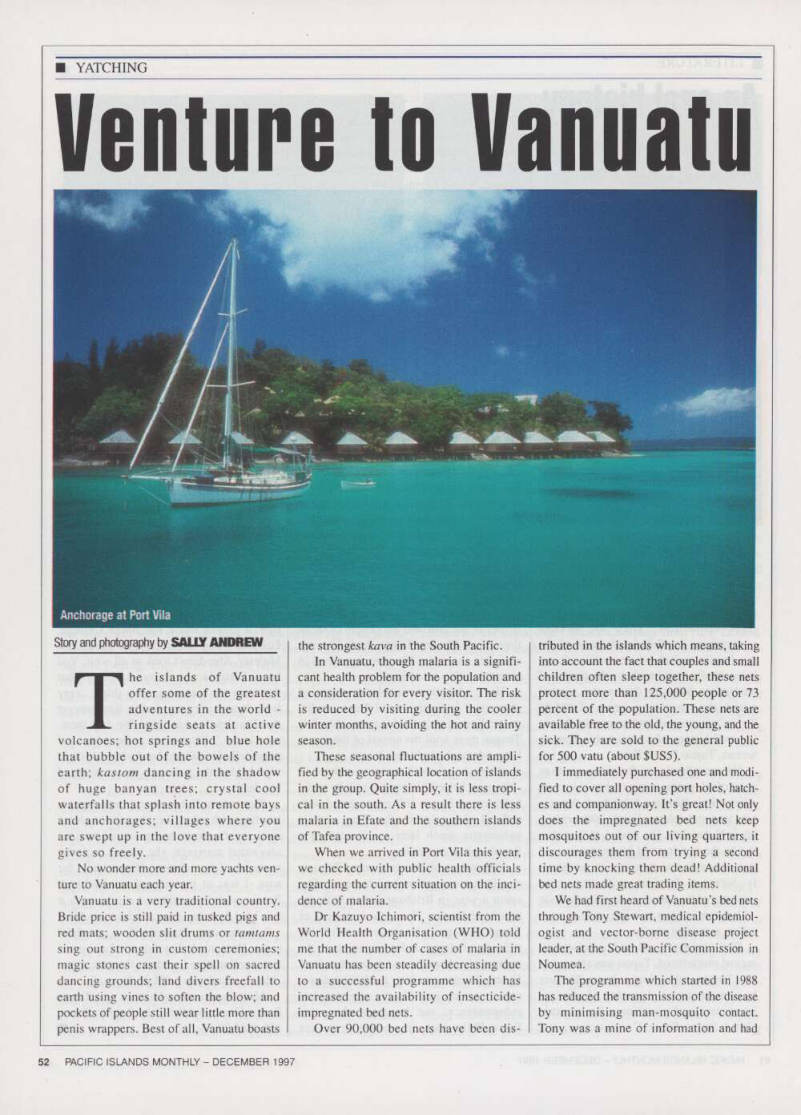
Anchorage at Port Vila
good advice for people cruising in Vanuatu: Know the symptoms of malaria, take precautions to avoid getting bitten, and, if you are cruising away from the main centres, carry a course of treatment.
No prescription is needed for malarial pro
phylactics or treatment doses and the local pharmacies in Port Vila and Santo are a great help. Willing to help in any way we could, I visited George Taleo, head of the Malaria Control Unit of the Department of Health, Port Vila. “Can we help with net
dipping or by delivering bed nets to the more remote islands?” I asked. After out lining our planned passage north towards Santo, George asked if we could deliver a case of permethryn insecticide to the health centre in southwest Ambrym. “It would be a our pleasure,” I replied.
Delivering the goods was easy, but we never imagined that the diversion to Craig Cove would involve two big battles. The first was a skirmish with a giant swordfish that we hooked between Epi and Ambrym Islands. Nearly two metres in length, he was too big to board on our small boat and looked lethal. Sailing at six knots, we could not spit out the hook.
So we slowed the boat down by reduc ing sail. Still no luck. We could have cut and lost our line, but I’m sure the fish did n’t want to tow around several metres of stainless leader and cord for the rest of his natural life. Finally, after a two hour fight, the swordfish threw the hook. We pulled in all our line and lure, and breathed a sigh of relief.
The following day we hooked another fish almost immediately. I couldn’t believe our luck. I gave the line a tug to see what size. It felt like a nice small one, so I hand over-hand pulled it up to the stern of the boat - then looked. Oh my god! It was a black marlin. I fed the line back out quick ly while we thought about our predica ment.
So began another long duel, after which both we and the fish were tired. We towed him close behind the boat for about an hour, then I pushed a looped rope down towards his sword.
Failing that, we decided to pull him alongside and try to get a line around his tail. In the end, Mr Marlin found a wee burst of power and leaped out of the water.
With one terrified twist and a tug, the hook broke away at the crimp in the leader.
This punk marlin now sports a shiny stainless hook in his lip. The next morning, by radio, we learned of instances where billed fish had actually holed two cruising yachts, one was a wooden boat, the other was built of aluminium. Boy, were we for tunate! So if you plan to sail or travel in the South Pacific, don’t let your fear of malaria (or fish) keep you from visiting Vanuatu. During the dryer winter season our battles have been with fish, not mosquitoes. And unlike us, maybe you’ll be lucky enough to land a big fish and have more than a tale about the one that got away... ■
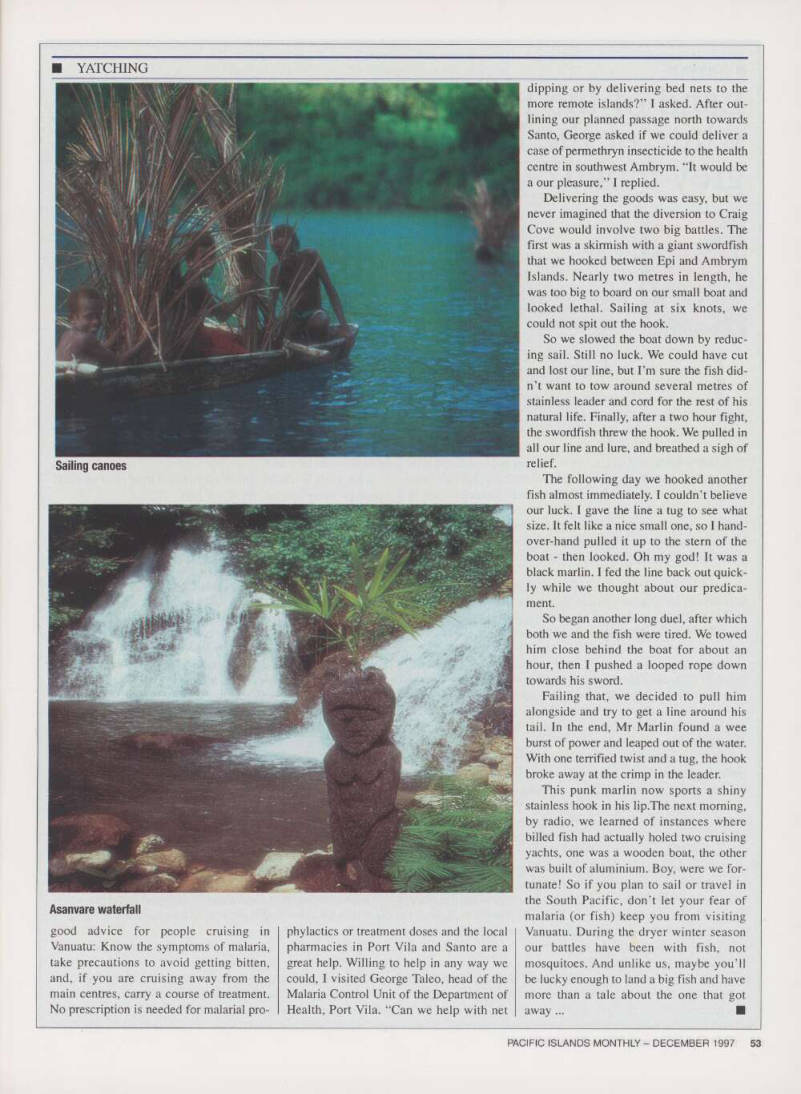
Sailing canoes
Asanvare waterfall