Community and hopes
pp. 17-18 · Read in the full issue
Special Report
SPC becomes Pacific Community and hopes for a new start
By Florence de Changy
Three unusual things happened at the 37th South Pacific Conference in Canberra. It was the 50th anniversary meeting of the South Pacific Commission (SPC) and the first odd thing was that Britain, less than two years after it left, announced it was coming back. Then this old organisation (one of the oldest of its kind) changed name to the more inspiring Pacific Community. And, to complete a hat-trick of surprising events, the director-general Bob Dun presented the account books showing a solid financial situa
tion.
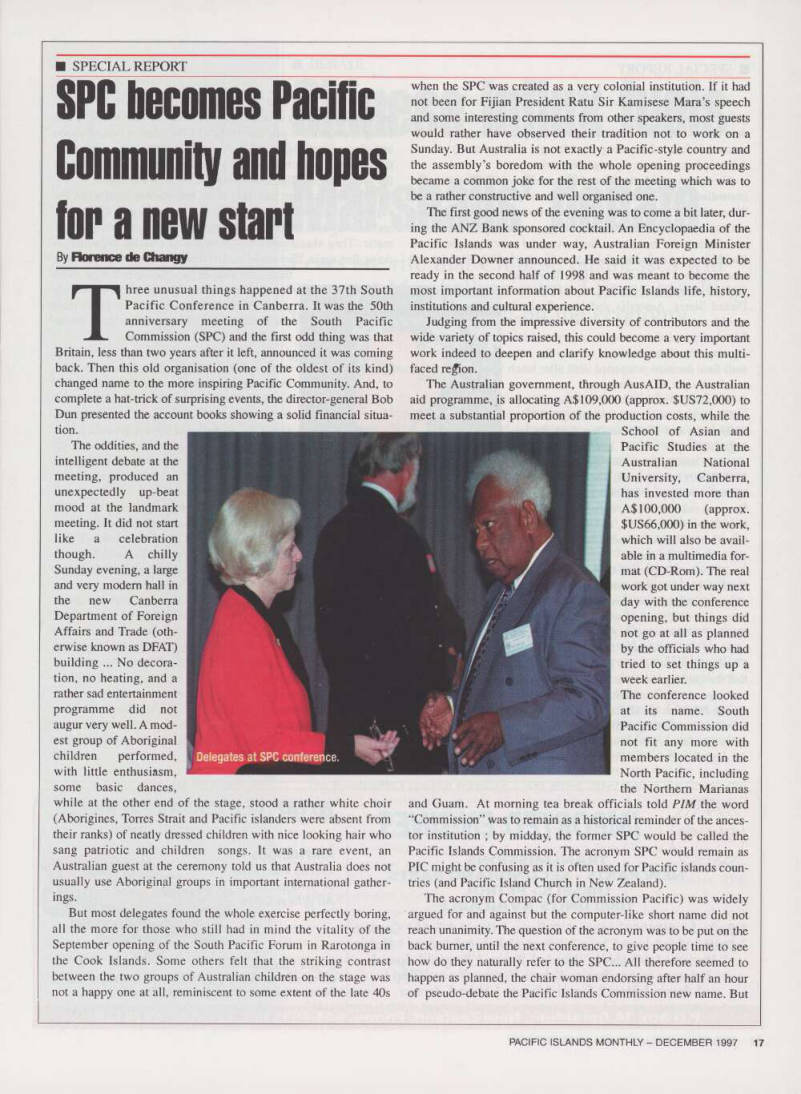
The oddities, and the intelligent debate at the meeting, produced an unexpectedly up-beat mood at the landmark meeting. It did not start like a celebration though. A chilly Sunday evening, a large and very modem hall in the new Canberra Department of Foreign Affairs and Trade (oth erwise known as DFAT) building ... No decora tion, no heating, and a rather sad entertainment programme did not augur very well. A mod est group of Aboriginal
children performed,
with little enthusiasm, some basic dances,
while at the other end of the stage, stood a rather white choir (Aborigines, Torres Strait and Pacific islanders were absent from their ranks) of neatly dressed children with nice looking hair who sang patriotic and children songs. It was a rare event, an Australian guest at the ceremony told us that Australia does not usually use Aboriginal groups in important international gather ings.
But most delegates found the whole exercise perfectly boring, all the more for those who still had in mind the vitality of the September opening of the South Pacific Forum in Rarotonga in the Cook Islands. Some others felt that the striking contrast between the two groups of Australian children on the stage was not a happy one at all, reminiscent to some extent of the late 40s
when the SPC was created as a very colonial institution. If it had not been for Fijian President Ratu Sir Kamisese Mara’s speech and some interesting comments from other speakers, most guests would rather have observed their tradition not to work on a Sunday. But Australia is not exactly a Pacific-style country and the assembly’s boredom with the whole opening proceedings became a common joke for the rest of the meeting which was to be a rather constructive and well organised one.
The first good news of the evening was to come a bit later, dur ing the ANZ Bank sponsored cocktail. An Encyclopaedia of the Pacific Islands was under way, Australian Foreign Minister Alexander Downer announced. He said it was expected to be ready in the second half of 1998 and was meant to become the most important information about Pacific Islands life, history, institutions and cultural experience.
Judging from the impressive diversity of contributors and the wide variety of topics raised, this could become a very important work indeed to deepen and clarify knowledge about this multi
faced region.
The Australian government, through AusAID, the Australian aid programme, is allocating A$ 109,000 (approx. $U572,000) to meet a substantial proportion of the production costs, while the
School of Asian and Pacific Studies at the Australian National University, Canberra, has invested more than A$ 100,000 (approx. $U566,000) in the work, which will also be avail able in a multimedia for mat (CD-Rom). The real work got under way next day with the conference opening, but things did not go at all as planned by the officials who had tried to set things up a week earlier.
The conference looked at its name. South Pacific Commission did not fit any more with members located in the North Pacific, including the Northern Marianas
and Guam. At morning tea break officials told PIM the word “Commission” was to remain as a historical reminder of the ances tor institution ; by midday, the former SPC would be called the Pacific Islands Commission. The acronym SPC would remain as PIC might be confusing as it is often used for Pacific islands coun tries (and Pacific Island Church in New Zealand).
The acronym Compac (for Commission Pacific) was widely argued for and against but the computer-like short name did not reach unanimity. The question of the acronym was to be put on the back burner, until the next conference, to give people time to see how do they naturally refer to the SPC... All therefore seemed to happen as planned, the chair woman endorsing after half an hour of pseudo-debate the Pacific Islands Commission new name. But
in came Fiji’s foreign affairs minister Berenado Vunibobo apolo gising for his momentous absence. He had had to take his presi dent to the airport. I would have lost my job otherwise he com mented before relaunching the (thought to be closed) name’s debate, giving it an unexpected new twist.
He came up with the idea of community which struck a cord immediately as members came to accept how institutional “Commission” sounded. Vunibobo also declared that islanders did not like to be called islanders. Not only patronising, the reference to islanders did not make much sense as every people in the Pacific are by definition islanders. Further more, Kiribati and other members had earlier said they did not see
why the founding members, such as France, United States, Australia and New Zealand, would not be referred to as in the Pacific Islands Commission name. In a very convinc ing way, Vunibobo managed to have the (sec ond) final decision postponed until after lunch and finally got his idea adopted.
The irony was that this spontaneous debate and its achievement were so unexpected that 6000 maps and 15,000 leaflets with the pre organised new name had been printed, AusAID having provided A 526,000 (approx.
SUS 17,000) for the work. The presentation of a framed version of the bilingual map to Bob Dun was cancelled. And, even though the map
is still an excellent tool, as first of its kind, its reference to the nonexistent Pacific Islands Commission, makes it an embarrass
ing promotion product.
The director-general later suggested the maps be distributed for free in schools around the region. Much ado about a name some may think, but it was surprising to sfce how enthusiastic most delegates were once it was decided that the community of the Pacific (“Communaut du Pacifique ” in French) should be the new name of their old lady friend, as Roch Wamytan, from New Caledonia, put it “It was as if every thing could start again now that the country were part of a formal Community even though nothing of the institution itself, apart from its name, was changed”. Some could not help draw a parallel with the European Community and the possibility of further regional integration in a not-so-far future. Optimism had actually begun to spread earlier in the day when Britain announced its comeback to the organisation,
less than two years after its withdrawal. By the early 1990’5, we became increasingly concerned by the way in which the SPC was being managed. We perceived a lack of direction, a lack of vision and clear objectives, and in our view, an alarming proportion of the members contributions being spent on management declared the acting British High Commissioner, Andrew Pocock. ‘’We felt that fate had dealt us an unfortunate hand when the expiry of our notice coincided with the appointment of Bob Dun and his very able deputies”. But other delegates were not so diplo matic. They abandoned ship when it was sinking. Now that is doing fine again, they come back. There is nothing to be proud of
there, said a Papua New Guinean delegate who thought Britain had been given an extremely good deal when they withdrew but put in their seat Pitcairn Island, home to 47 people, whose contribution is thus very modest.
Aid recipient countries were nevertheless hopeful that the British move should translate into more money for the SPC budget - London’s last contribution was USsl.lmillion.
Incidentally, several delegates expressed pri vately the feeling that the big powers which had distanced themselves from the Pacific with the end of the cold war were showing signs of a renewed interest but it was certainly too early to bank on it.
SPC deputy director-general Lourdes
Pangelinan said no one knew yet how much was England ready to contribute. Dun himself acknowledged Britain’s comeback as a clear vote of confidence. Pangelinan reported to the conference that for the first time in six years, the independent auditors had given the SPC a clean bill of health with no qualifications and said the financial news was comforting and reassuring in time of scarce resources. The splendid performance in Pitcairn’s words, with administrative costs already down at 13.6 percent and still to be reduced to 10 percent, was one of the reason for the re appoint ment of Dun as director-general. He suggested his second term be reduced to two instead of three years, to make it coincide with the biennial conference cycle. French Polynesia has offered to wel come the next conference, in late 1999. The minister for health, Patrick Howell, modestly promised to the new Pacific Community the best conference ever held to celebrate the entry into the next millennium. Looking forward to it! ■
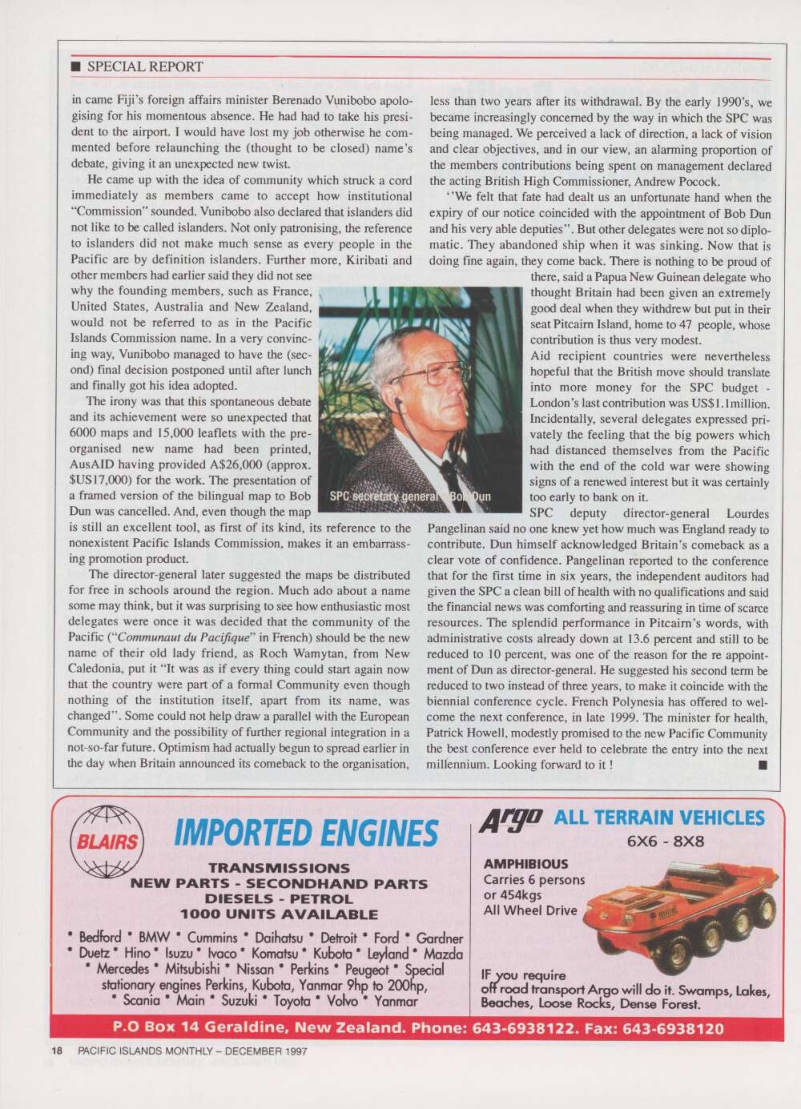
SPC secretary general Bob Dun