Pearl farming suffers
p. 15 · Read in the full issue
because of cyclone
By Florence Syme-Buchanan
The people of the northern Cook Islands are used to hardship and isolation and they are tough. So when they say they will rebuild their homes and their livelihoods, count on it. But they have all taken a heavy blow.
Cyclone Martin has savaged their lucra tive pearl farming industry.
Although a glamorous industry down at the retail end, in Manihiki they had to work hard and long with fierce dedication to produce what was becoming a SNZ4
million (approximately SUS 2 million) a
year enterprise.
“It’s gone from the people who were earning very little from copra and govern ment jobs and a little bit more from diving for wild shells to a million dollar indus try,” says Marine Resources secretary Raymond Newnham.
Newnham says it could take the indus try a year to recover if the underwater pearl shell lines are okay, five years if they are damaged. Willie Katoa lost his seven year old daughter, Maureen, (see previous story), a new home and about $200,000 (Approx. $US118) worth of farm equip ment and buildings.
“I’m going to go back, rebuild and carry on ... that’s no
problem.”
Like a few other pearl farmers, Katoa will leave his family on the main island of Rarotonga, go back and start again.
Separation could run for months. Sue Woonton says Manihiki pearls which make four percent of the world’s black pearls, were just becoming accepted around the
world. “We were just beginning to get a firm foothold in the world markets. We had good grades, colour, volumes were increasing and the industry was really up and running,” she said.
“The black pearls have been taken up by Tiffany’s, Aspry’s and Harry Winston, all big names.” Her husband, Robert Woonton, the Manihiki member of parlia ment, and his brother Hurihia invested $600,000 (approx. SUS3S3) into their farm. Their future is 10 metres down, the remains of the pearl farms. Everything on land associated with pearl farms - the seed ing huts, boats, diving equipments, com pressors are gone.
None of the farmers had insurance, nobody would cover such a high hurricane risk. “But I don’t believe the industry is dead, unless there has been massive pollu tion of the lagoon and every oyster is dead,” Sue said.
Tou Unuia who has been involved with the industry from the outset fears the lagoon could be polluted from fuel, chem icals, fridges and vegetation dragged into it by the cyclone. He says the huge amount of floating vegetation is prevent ing the lagoon from flushing properly.
The industry which is the Island’s eco nomic lifeline and crucial to the financial
well-being of the entire country, has taken a backseat with search and rescue opera tions and rebuilding of Manihiki foremost in recovery plans. Once the recovery of Manihiki is well established. Marine Resources will be assessing what damage may have occurred to the oysters.
Just about every farmer has a loan to repay, most with the state-owned Cook Islands Development Bank. Calls are being made on the government by the business sector for CIDB to issue soft loans so pearl farmers can rebuild an industry the financially stricken country desperately needs to get back on its feet.
Two hundred pearl farming permits have been issued by the Manihiki Island Council over the years. Not all permits are active but there were enough farms dotting the 48 square kilometre lagoon to raise concerns of the Marine resources that there could be an over population of pearl shells.
One recent survey estimated that the lagoon contained 12 million pearl shells including wild stocks which had quickly multiplied after a ban was placed on har vesting them by the Island Council some years ago.
Sue is confident. “People won’t give up. There will be a dip and some changes in the way things are redone but they won’t give up. We have put everything into the industry, people won’t walk away from that.” ■
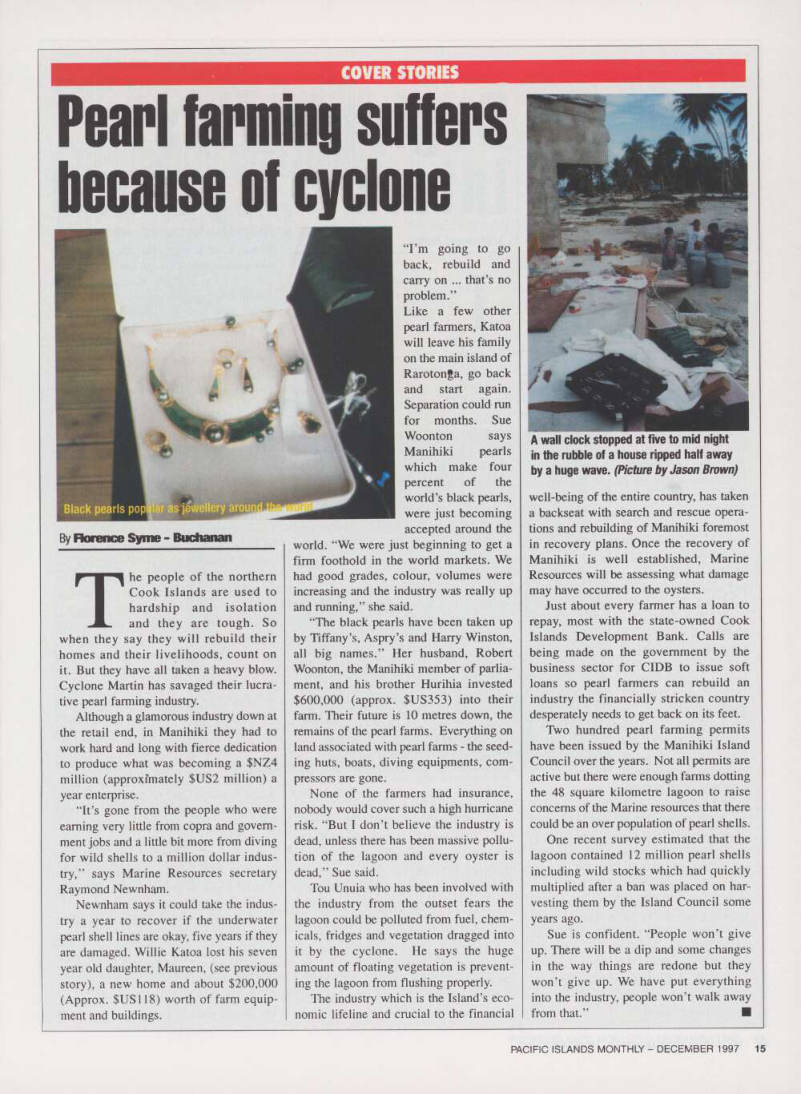
A wall clock stopped at five to mid night in the rubble of a house ripped half away by a huge wave. (Picture by Jason Brown)
Black pearls popular as jewellery around the world