wake of Cyclone Marlin
pp. 11-12 · Read in the full issue
Cover Stories
Islands devastated In the wake of Cyclone Marlin
By Florence Syme-Buchanan
Martin was a huge, hun gry animal who in a terrifying couple of days, devoured sever al defenceless islands, destroying lives and forever changing the lives of the shell-shocked survivors.
It was the worst cyclone to hit the South Pacific this century, snarling 2400 kilome tres across the Pacific, wiping up huge waves which destroyed everything.
When it had gone, the Pacific was lit tered with bodies.
On Manihiki in the Cook Islands 20 people were left dead. Tragically, in a cul ture where the body is central to the griev
ing process, many of the bodies have gone completely. Another nine were swept away in French Polynesia. It was also a story of remarkable miracles, of survival. There is also a terrifying familiarity about the sto ries.
The Pacific, heated by the El Nino, rose and in a blink, wiped away atolls. This was the grim reality of sea-level rising that only three months ago the Pacific’s leaders met and debated on on Aitutaki just to the south of Manihiki.
Pukapuka in the northern Cook Islands was the first victim. At 2pm on Friday, October 31, the battering began.
Fortunately for the 600 or so Pukapukans, Cyclone Martin had not reached its intensity and only a few build
ings were lost. There were no deaths.
Martin rampaged on, veering south east.
Situated 160 kilometres south west of Manihiki and further still from Rakahanga in the late afternoon of Saturday November I, Cyclone Martin was fero cious enough to wreck havoc on both islands.
All deaths and missing people in the Cooks are from Manihiki.
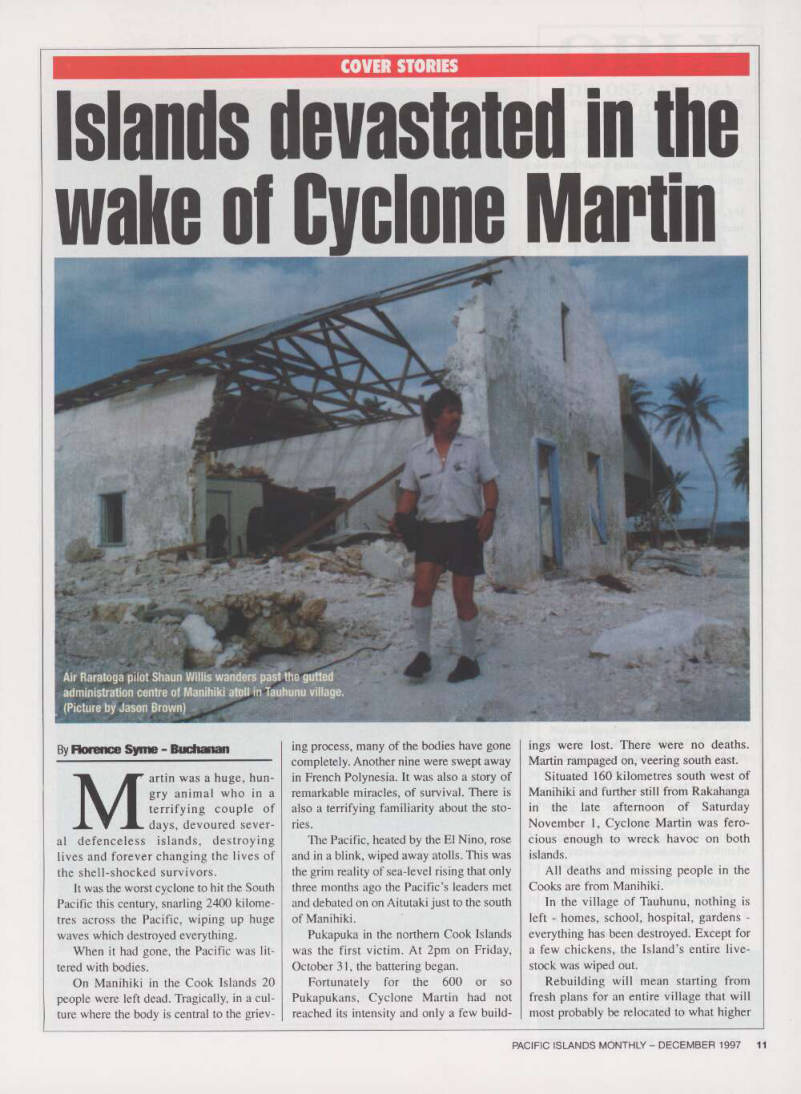
In the village of Tauhunu, nothing is left - homes, school, hospital, gardens everything has been destroyed. Except for a few chickens, the Island’s entire live stock was wiped out.
Rebuilding will mean starting from fresh plans for an entire village that will most probably be relocated to what higher
Air Raratoga pilot Shaun Willis wanders past the gutted administration centre of Manihiki atoll in Tauhunu village. (Picture by Jason Brown)
ground is available. Manihiki lies just five metres above sea level.
Chief meteorological officer Arona Ngari said had the cyclone actually struck Manihiki, the devastation would have been unimaginable.
“Nothing would have been left stand ing, not one tree, the death toll would have been much, much higher”.
Just one massive 10 metre wave totally swamped Tauhunu village in a terrifying chaos of broken homes, vegetation and bodies which were then dragged into the normally picturesque lagoon.
An aching scene of destruction for the lucky ones who for hours huddled in fish ing boats praying. The unlucky ones floun dered in the dark, heaving lagoon, battered by wind tossed debris, trying to save loved ones, trying to save themselves, seven not succeeding. Three were children.
They had been given little warning by main island Rarotonga, where officials dithered for hours before finally setting up a hurricane centre at 5.45 pm Saturday. But by that time Manihiki was already engulfed in Mother Nature’s terrifying madness.
Communications with the Island were cut off at 4pm and for two days relatives all over the Cooks agonised, feared and prayed for their loved ones in Manihiki.
When communications were partially restored two days later, the news that three were dead, 20 missing and untold devasta tion was worse than what most Cook Islanders safe and dry in their homes could fathom.
Cyclone Martin continued to veer south east on November 1 travelling towards French Polynesia .
By November 4, Cyclone Martin reached the colder waters of the Austral Islands. He will never be forgotten. The Catholic Church recognises three Saint Martins and two of them are honoured with November feast days.
November 3 - the day the people of Manihiki were beginning to receive help from the outside world - is the feast day of St Martin de Porres.
Bom in Peru in 1579 he spent his life in a Dominican Friary where he is reputed to have devoted himself to ceaseless and severe penances.
He is reputed to have been able to fly.
St. Martin of Tours is the better known of the Martins, the patron saint of soldiers.
Born in 315 in what is now Hungary he was one of the first saints, ending up in France. His feast day is November 11.
Blessedly for their distant memory, there will never be another Pacific cyclone named Martin. ■
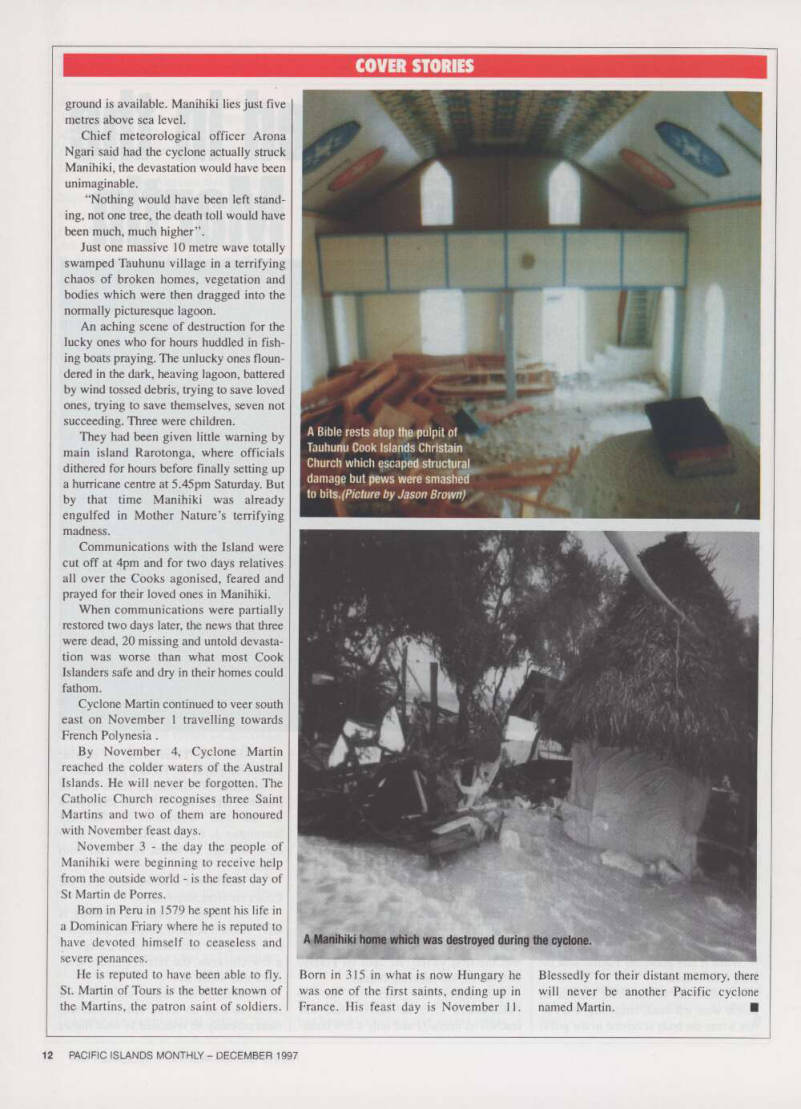
A Bible rests atop the pulpit of Tauhunu Cook Islands Christain Church which escaped structural damage but pews were smashed to bits. (Picture by Jason Brown)
A Manihiki home which was destroyed during the cyclone.