Parliamentary debate
pp. 32-33 · Read in the full issue
Politics
In the wake of public service cuts, the Cooks’ 25-member parliament is considered too large
By Florence Syme-Buhchanan
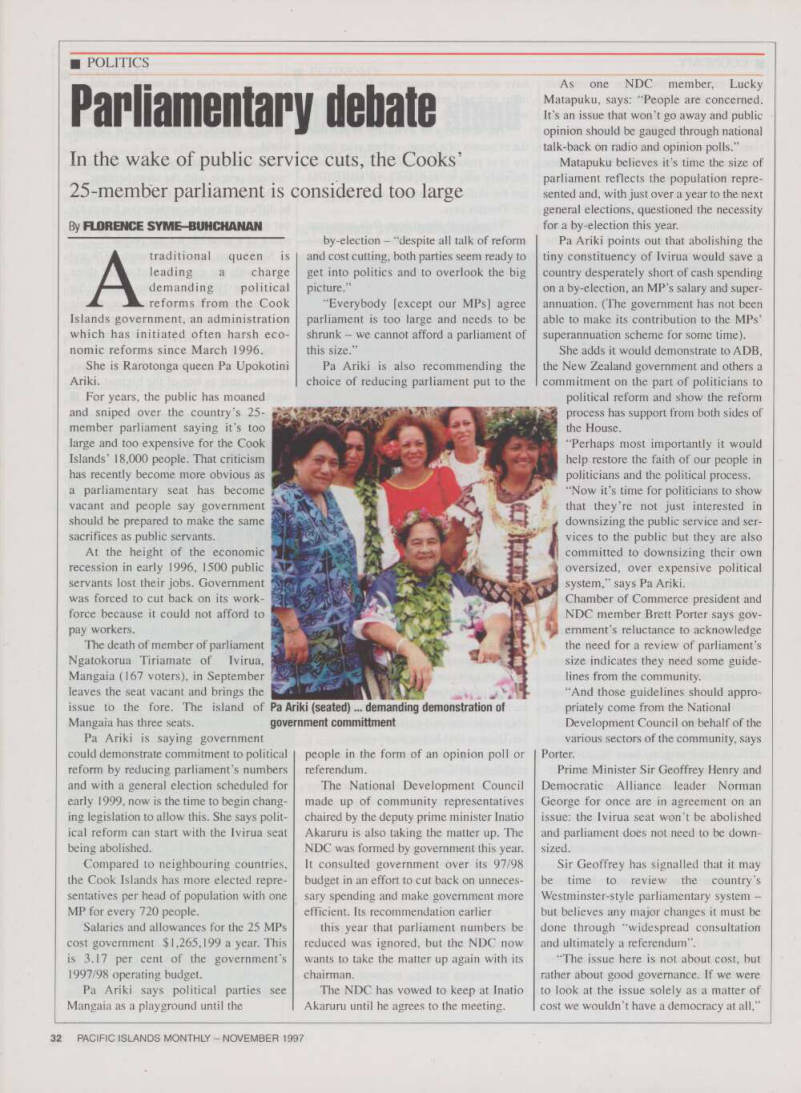
A traditional queen is leading a charge demanding political reforms from the Cook Islands government, an administration which has initiated often harsh eco nomic reforms since March 1996.
She is Rarotonga queen Pa Upokotini Ariki.
For years, the public has moaned and sniped over the country’s 25member parliament saying it’s too large and too expensive for the Cook Islands’ 18,000 people. That criticism has recently become more obvious as a parliamentary seat has become vacant and people say government should be prepared to make the same sacrifices as public servants.
At the height of the economic recession in early 1996, 1500 public servants lost their jobs. Government was forced to cut back on its work force because it could not afford to pay workers.
The death of member of parliament Ngatokorua Tiriamate of Ivirua, Mangaia (167 voters), in September leaves the seat vacant and brings the issue to the fore. The island of Mangaia has three seats.
Pa Ariki is saying government
could demonstrate commitment to political reform by reducing parliament’s numbers and with a general election scheduled for early 1999, now is the time to begin chang ing legislation to allow this. She says polit ical reform can start with the Ivirua seat being abolished.
Compared to neighbouring countries, the Cook Islands has more elected repre sentatives per head of population with one MP for every 720 people.
Salaries and allowances for the 25 MPs cost government $1,265,199 a year. This is 3.17 per cent of the government’s 1997/98 operating budget.
Pa Ariki says political parties see Mangaia as a playground until the
by-election - “despite all talk of reform and cost cutting, both parties seem ready to get into politics and to overlook the big picture.”
“Everybody [except our MPs] agree parliament is too large and needs to be shrunk - we cannot afford a parliament of this size.”
Pa Ariki is also recommending the choice of reducing parliament put to the
people in the form of an opinion poll or referendum.
The National Development Council made up of community representatives chaired by the deputy prime minister Inatio Akaruru is also taking the matter up. The NDC was formed by government this year.
It consulted government over its 97/98 budget in an effort to cut back on unneces sary spending and make government more efficient. Its recommendation earlier this year that parliament numbers be reduced was ignored, but the NDC now wants to take the matter up again with its chairman.
The NDC has vowed to keep at Inatio Akaruru until he agrees to the meeting.
As one NDC member, Lucky Matapuku, says; “People are concerned.
It’s an issue that won’t go away and public opinion should be gauged through national talk-back on radio and opinion polls.”
Matapuku believes it’s time the size of parliament reflects the population repre sented and, with just over a year to the next general elections, questioned the necessity for a by-election this year.
Pa Ariki points out that abolishing the tiny constituency of Ivirua would save a country desperately short of cash spending on a by-election, an MP’s salary and super annuation. (The government has not been able to make its contribution to the MPs’ superannuation scheme for some time).
She adds it would demonstrate to ADB, the New Zealand government and others a commitment on the part of politicians to
political reform and show the reform process has support from both sides of the House.
“Perhaps most importantly it would help restore the faith of our people in politicians and the political process.
"Now it’s time for politicians to show that they’re not just interested in downsizing the public service and ser vices to the public but they are also committed to downsizing their own oversized, over expensive political system,” says Pa Ariki.
Chamber of Commerce president and NDC member Brett Porter says gov ernment’s reluctance to acknowledge the need for a review of parliament’s size indicates they need some guide lines from the community.
"And those guidelines should appro priately come from the National Development Council on behalf of the
various sectors of the community, says Porter.
Prime Minister Sir Geoffrey Henry and Democratic Alliance leader Norman George for once are in agreement on an issue: the Ivirua seat won't be abolished and parliament does not need to be down sized.
Sir Geoffrey has signalled that it may be time to review the country's Westminster-style parliamentary system but believes any major changes it must be done through "widespread consultation and ultimately a referendum”.
"The issue here is not about cost, but rather about good governance. If we were to look at the issue solely as a matter of cost we wouldn't have a democracy at all,”
Pa Ariki (seated) ... demanding demonstration of government committment
says Sir Geoffrey.
Norman George insists there's "no need to strip parliament to the bare bones” and that MPs are essential at village level given the stage of the country’s political and economic development.
But both have been accused of shelter ing behind the rights of constituents and constitutional difficulties to avoid Pa Ariki’s recommendation. Neither Sir Geoffrey nor Norman George acknowl edged in press statements whether attempts should be made at political reform.
“Nor did they come up with alterna tives in support of the need for political reform,” says a former politician.
Cook Islands scholar John Herrmann's views on the subject published in the University of the South Pacific's quarter ly Cook Islands journal Search have been applauded by many, particularly the busi ness sector.
Herrmann states if the Cooks is “indeed serious about implementing cost saving measures, it would appear that a reduced membership of parliament would be a good starting point.”
He asks whether the country really needs 25 members for fair representation and how the Cooks compares with others in terms of the number of elected repre sentatives.
Herrmann points out that representa tion has been based on two considerations: the population of each settled island; and by incorporating tradi tional boundaries.
He says both considerations can be achieved just as effectively if parliament membership were to be reduced to less than 15, referably 12 to 13 members.
"Despite the reduction, it is contended that representation would be just as fair as the current membership,” says Herrmann.
It has been the practice of Sir Geoffrey's administration to repeatedly ignore the advice of the country's NDC, Chamber of Commerce and other groups and individuals.
However, in this instance, the govern ment and opposition cannot lightly dis miss these concerns which have been brought to the fore by a traditional leader.
Her stance and the views of leading aca demics on the matter have brought the issue of parliamentary size to the fore ground. ■