Dredging profits
pp. 24-26 · Read in the full issue
Economy
Cooks bank on undersea manganese mining
By Michael Feld
About a million years ago, eons before we people happened upon these waters, a small organic fragment, a shark’s tooth or perhaps a squid beak, fell to the bottom of the immensely deep Pacific Ocean.
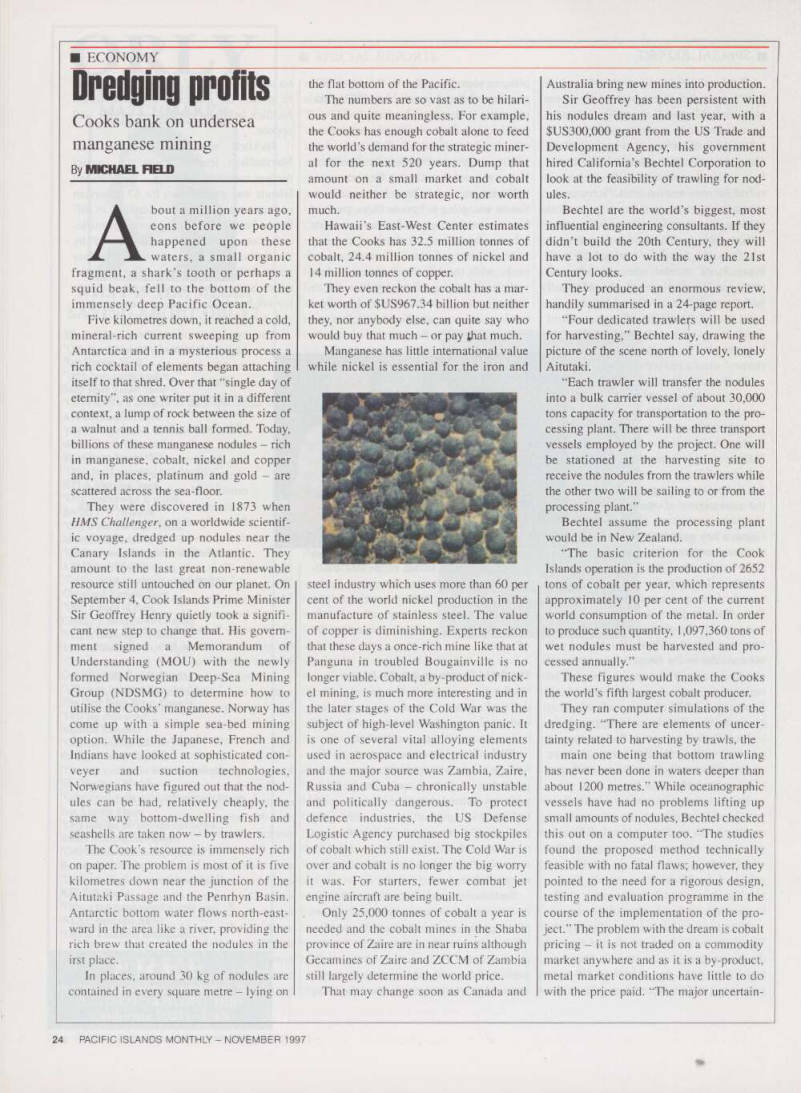
Five kilometres down, it reached a cold, mineral-rich current sweeping up from Antarctica and in a mysterious process a rich cocktail of elements began attaching itself to that shred. Over that “single day of eternity”, as one writer put it in a different context, a lump of rock between the size of a walnut and a tennis ball formed. Today, billions of these manganese nodules - rich in manganese, cobalt, nickel and copper and, in places, platinum and gold - are scattered across the sea-floor.
They were discovered in 1873 when HMS Challenger, on a worldwide scientif ic voyage, dredged up nodules near the Canary Islands in the Atlantic. They amount to the last great non-renewable resource still untouched on our planet. On September 4, Cook Islands Prime Minister Sir Geoffrey Henry quietly took a signifi cant new step to change that. His govern ment signed a Memorandum of Understanding (MOU) with the newly
formed Norwegian Deep-Sea Mining
Group (NDSMG) to determine how to utilise the Cooks’ manganese. Norway has come up with a simple sea-bed mining option. While the Japanese, French and Indians have looked at sophisticated con veyer and suction technologies, Norwegians have figured out that the nod ules can be had, relatively cheaply, the same way bottom-dwelling fish and seashells are taken now - by trawlers.
The Cook's resource is immensely rich on paper. The problem is most of it is five kilometres down near the junction of the Aitutaki Passage and the Penrhyn Basin.
Antarctic bottom water flows north-east ward in the area like a river, providing the rich brew that created the nodules in the irst place.
In places, around 30 kg of nodules are contained in every square metre - lying on
the flat bottom of the Pacific.
The numbers are so vast as to be hilari ous and quite meaningless. For example, the Cooks has enough cobalt alone to feed the world’s demand for the strategic miner al for the next 520 years. Dump that amount on a small market and cobalt would neither be strategic, nor worth much.
Hawaii’s East-West Center estimates that the Cooks has 32.5 million tonnes of cobalt, 24.4 million tonnes of nickel and 14 million tonnes of copper.
They even reckon the cobalt has a mar ket worth of $U5967.34 billion but neither they, nor anybody else, can quite say who would buy that much - or pay £hat much.
Manganese has little international value while nickel is essential for the iron and
steel industry which uses more than 60 per cent of the world nickel production in the manufacture of stainless steel. The value of copper is diminishing. Experts reckon that these days a once-rich mine like that at Panguna in troubled Bougainville is no longer viable. Cobalt, a by-product of nick el mining, is much more interesting and in the later stages of the Cold War was the subject of high-level Washington panic. It is one of several vital alloying elements used in aerospace and electrical industry and the major source was Zambia, Zaire, Russia and Cuba - chronically unstable and politically dangerous. To protect defence industries, the US Defense
Logistic Agency purchased big stockpiles
of cobalt which still exist. The Cold War is over and cobalt is no longer the big worry it was. For starters, fewer combat jet engine aircraft are being built.
Only 25,000 tonnes of cobalt a year is needed and the cobalt mines in the Shaba province of Zaire are in near ruins although Gecamines of Zaire and ZCCM of Zambia still largely determine the world price.
That may change soon as Canada and
Australia bring new mines into production.
Sir Geoffrey has been persistent with his nodules dream and last year, with a SUS3OO,OOO grant from the US Trade and Development Agency, his government hired California’s Bechtel Corporation to look at the feasibility of trawling for nod ules.
Bechtel are the world’s biggest, most influential engineering consultants. If they didn’t build the 20th Century, they will have a lot to do with the way the 21st
Century looks.
They produced an enormous review, handily summarised in a 24-page report.
“Four dedicated trawleys will be used for harvesting,” Bechtel say, drawing the picture of the scene north of lovely, lonely Aitutaki.
“Each trawler will transfer the nodules into a bulk carrier vessel of about 30,000 tons capacity for transportation to the pro cessing plant. There will be three transport vessels employed by the project. One will be stationed at the harvesting site to receive the nodules from the trawlers while the other two will be sailing to or from the processing plant.”
Bechtel assume the processing plant would be in New Zealand.
“The basic criterion for the Cook Islands operation is the production of 2652 tons of cobalt per year, which represents approximately 10 per cent of the current world consumption of the metal. In order to produce such quantity, 1,097,360 tons of wet nodules must be harvested and pro cessed annually.”
These figures would make the Cooks the world’s fifth largest cobalt producer.
They ran computer simulations of the dredging. “There are elements of uncer tainty related to harvesting by trawls, the main one being that bottom trawling has never been done in waters deeper than about 1200 metres.” While oceanographic vessels have had no problems lifting up small amounts of nodules, Bechtel checked this out on a computer too. “The studies found the proposed method technically feasible with no fatal flaws; however, they pointed to the need for a rigorous design, testing and evaluation programme in the course of the implementation of the pro ject.” The problem with the dream is cobalt pricing - it is not traded on a commodity market anywhere and as it is a by-product, metal market conditions have little to do with the price paid. “The major uncertain
ties for cobalt pricing exist on the supply side,” says Bechtel in a commentary straight out of high school economics classes. “If supply increases faster than demand, prices will fa 11... Cobalt prices have been historically volatile and difficult to predict, particularly over the past few years.” Bechtel’s report, completed last year, was circulated worldwide and attract ed the attention of Oslo’s Fridtjof Nansen Institute. Nansen was a polar explorer with interests in oceanography and the institute
which honours his memory is engaged in applied social science research on interna tional issues concerning energy, resource management and the environment. They liked what they saw in Bechtel’s report and formed NDSMG made up of companies active in offshore production, shipbuilding and marine electronics. The MOU signed with the Cooks government has been the cause of celebration in Avarua.
"Deep-sea mining seems to have been a grand joke amongst our resident cynics,”
Sir Geoffrey wrote in his Cook Islands Press column recently.
Mindful though of the way the world has wearied of Pacific schemes and dreams, he has taken on a more modest tone; putting out the MOU was not cause just yet for excitement, but rather a signal of possible excitement to come. ‘This is not the billion-dollar bonanza that some would wish for but, as a start, additional government revenue of SNZ2I million (SUS 12.4 million) per annum by, say, 2004 is better than a poke in the eye.”
The operation would be relatively easi ly done, and with little trouble to the envi ronment. “Since the trawls are fitted with ski-like runners, they are intended to slide on the seabed surface, allowing the nod ules to be scraped up with very little dis turbance of the bottom itself. Since each trawl is hauled to the surface at a speed of two metres per second, any mud would be washed away in the first kilometre of trav el, leaving nothing but 120 tons of small rock to.pass through the surface into the trawler’s hold.”
He says production is at best four or five years off, given that the Norwegian scheme involves the building of four trawlers, three ore carriers and single pro cessing plant. “However, there is some good news built into that delay for, once an investor/operator is committed to proceed, that time could be well used to train as many Cook Islanders as possible for the many good jobs involved.”
The Suva-based South Pacific Applied Geoscience Commission (SOPAC) has sounded a warning though, saying signifi cant marketing and engineering problems were still ahead.
"It is not so much that I am sceptical but at first thought I am doubtful it will hap pen; we need to know so much more,”
SOPAC director Philip Muller said. Muller said the idea of bottom trawling for nod ules at such depths involved "monstrous draglines” with major engineering implica tions alone. It was not known because it had not been done, whether such lines would even work. Muller does not dismiss the notion of mining the Pacific.
It will happen; when is the major vari able. His fear is the Norway-Cooks scheme will proceed too rapidly and will collapse in the face of the immense difficulties of mining so deep. Then nobody will be inter ested in coming back into the Pacific for a long time. ■