Reality of paedophilia
pp. 17-19 · Read in the full issue
Cover Stories
Reality of paedophilia shocks island nation
By Bernadette Hussein
Th e x plo ita tion of children
through prostitution
and pornography is a global growth
industry driven largely by poverty.
The increasing demand on families to feed, clothe and educate children becomes so overbearing that they stop caring. And this is the sort of neglect which causes children from such backgrounds to become vulnerable causing them to be lured by money, clothes and promises of a better life.
People who offer these ‘luxuries’, lis ten to children, are caring, show that they understand and come across as the perfect person to bring up a child because he can support the child and its family. But their help has strings attached and in many cases children are sexually assaulted and molested.
Sadly, this situation has emerged in our part of the world where resources are scarce and money very hard to come by.
With the economy on the downturn in the region, poverty is rife and many people cannot afford even the basics of life.
Society’s attitude to child sexual abuse and exploitation can be summed up in one word - denial.
Most people do not want to hear about it and would prefer to think that child sex ual victimisation does not occur. In today’s society, however, it is difficult to pretend that it does not happen. Stories and reports about child sexual victimisation are daily occurrences.
The fact that children are being used for sexual purposes is enough to worry any one who cares and looks to them as the future of the world.
While countries overseas are looking at and setting up legislation to stop this sort of thing from happening, Fiji has recently been faced with the truth of such an
exploitation.
A society where family values, tradi tion and culture has a strong bearing, it has come as a shock for everyone to leam about the alleged existence of paedophilia in this tropical paradise.
Allegations which have appeared in the media range from a six-year-old in sex movies to pornographic pictures of chil dren appearing on the internet.
The case was discovered purely through co-incidence. Police have also charged a former expatriate civil servant
with the alleged crimes.
Police believe this to be part of a pae dophilia racket ring in which local girls were being used in the production of pornographic pictures which were sent overseas through the internet.
Fiji’s police commissioner Isikia Savua said his department had sought the help of the International Police Organisation (Interpol) to establish people and places where the pornographic pictures were sent.
He said a computer used by one of the suspects had been sent to Australia for repair where the repair company found pornographic pictures of young girls in the computer system. The matter was then referred to the Victoria police who contact ed Fiji for further investigation.
In earlier media reports, Savua was quoted as saying that the police intelli gence unit had been aware of the racket since 1994 but could not lay charges because of lack of evidence.
Since the expatriate’s arrest, more chil dren, his alleged victims, have come for ward.
The stories which these children told shocked the nation.
Police picked up on expatriates and locals after their photographs appeared on the internet with the children.
Interpol was helping in the search for people and places where the pornographic pictures of the young local girls and boys were sent.
Savua said police were also working closely with Telecom Fiji’s internet depart ment to find out where the pornographic pictures were sent. The case of the expatri ate who has been arrested and charged is still in court and police and prosecution are gathering evidence. He has pleaded not guilty to all the charges of defilement and abuse against him. While this is happening the question which has now cropped up is whether the laws are sufficient to prosecute such offenders.
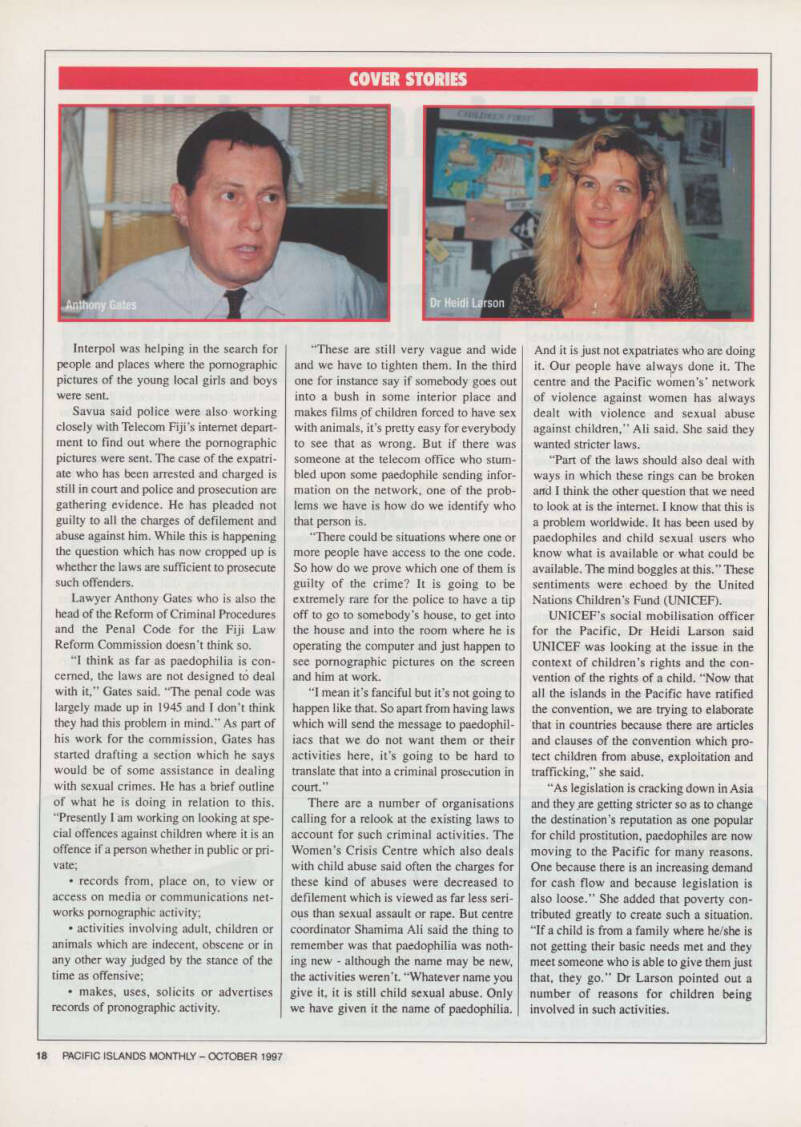
Lawyer Anthony Gates who is also the head of the Reform of Criminal Procedures and the Penal Code for the Fiji Law Reform Commission doesn’t think so.
“I think as far as paedophilia is con cerned, the laws are not designed to deal with it,” Gates said. “The penal code was largely made up in 1945 and I don’t think they had this problem in mind.” As part of his work for the commission, Gates has started drafting a section which he says would be of some assistance in dealing with sexual crimes. He has a brief outline of what he is doing in relation to this.
“Presently I am working on looking at spe cial offences against children where it is an offence if a person whether in public or pri vate; • records from, place on, to view or access on media or communications net
works pornographic activity;
• activities involving adult, children or animals which are indecent, obscene or in any other way judged by the stance of the time as offensive; • makes, uses, solicits or advertises
records of pronographic activity.
“These are still very vague and wide and we have to tighten them. In the third one for instance say if somebody goes out into a bush in some interior place and makes films of children forced to have sex with animals, it’s pretty easy for everybody to see that as wrong. But if there was someone at the telecom office who stum bled upon some paedophile sending infor mation on the network, one of the prob lems we have is how do we identify who that person is.
“There could be situations where one or more people have access to the one code.
So how do we prove which one of them is guilty of the crime? It is going to be extremely rare for the police to have a tip off to go to somebody’s house, to get into the house and into the room where he is operating the computer and just happen to see pornographic pictures on the screen and him at work.
“I mean it’s fanciful but it’s not going to happen like that. So apart from having laws which will send the message to paedophil iacs that we do not want them or their activities here, it’s going to be hard to translate that into a criminal prosecution in court.”
There are a number of organisations calling for a relook at the existing laws to account for such criminal activities. The Women’s Crisis Centre which also deals with child abuse said often the charges for these kind of abuses were decreased to defilement which is viewed as far less seri ous than sexual assault or rape. But centre coordinator Shamima Ali said the thing to remember was that paedophilia was noth ing new - although the name may be new, the activities weren’t. “Whatever name you give it, it is still child sexual abuse. Only we have given it the name of paedophilia.
And it is just not expatriates who are doing it. Our people have always done it. The centre and the Pacific women’s’ network of violence against women has always dealt with violence and sexual abuse against children,” Ali said. She said they wanted stricter laws.
“Part of the laws should also deal with ways in which these rings can be broken and I think the other question that we need to look at is the internet. I know that this is a problem worldwide. It has been used by paedophiles and child sexual users who know what is available or what could be available. The mind boggles at this.” These sentiments were echoed by the United Nations Children’s Fund (UNICEF).
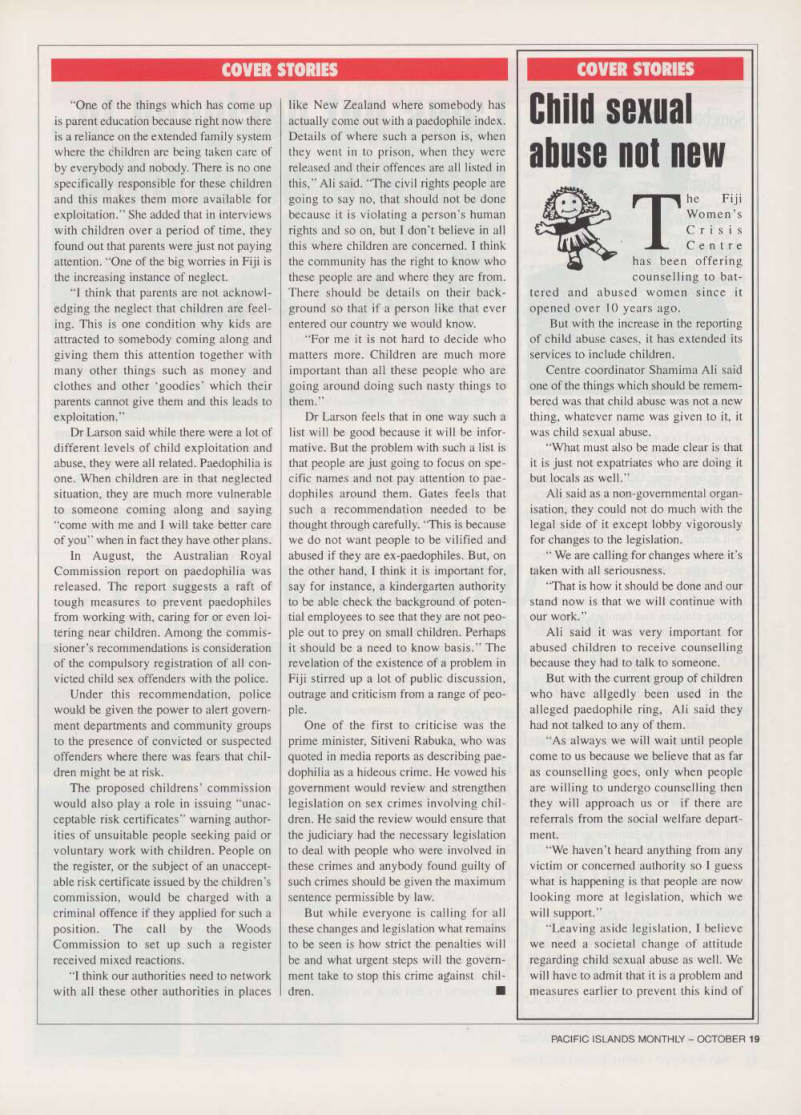
UNICEF’s social mobilisation officer for the Pacific, Dr Heidi Larson said UNICEF was looking at the issue in the context of children’s rights and the con vention of the rights of a child. “Now that all the islands in the Pacific have ratified the convention, we are trying to elaborate that in countries because there are articles and clauses of the convention which pro tect children from abuse, exploitation and trafficking,” she said.
“As legislation is cracking down in Asia and they are getting stricter so as to change the destination’s reputation as one popular for child prostitution, paedophiles are now moving to the Pacific for many reasons.
One because there is an increasing demand for cash flow and because legislation is also loose.” She added that poverty con tributed greatly to create such a situation.
“If a child is from a family where he/she is not getting their basic needs met and they meet someone who is able to give them just that, they go.” Dr Larson pointed out a number of reasons for children being involved in such activities.
Anthony Gates
Dr Heidi Larson
“One of the things which has come up is parent education because right now there is a reliance on the extended family system where the children are being taken care of by everybody and nobody. There is no one specifically responsible for these children and this makes them more available for exploitation.” She added that in interviews with children over a period of time, they found out that parents were just not paying attention. “One of the big worries in Fiji is the increasing instance of neglect.
“I think that parents are not acknowl edging the neglect that children are feel ing. This is one condition why kids are attracted to somebody coming along and giving them this attention together with many other things such as money and clothes and other ‘goodies’ which their parents cannot give them and this leads to
exploitation.”
Dr Larson said while there were a lot of different levels of child exploitation and abuse, they were all related. Paedophilia is one. When children are in that neglected situation, they are much more vulnerable to someone coming along and saying “come with me and I will take better care of you” when in fact they have other plans.
In August, the Australian Royal Commission report on paedophilia was released. The report suggests a raft of tough measures to prevent paedophiles from working with, caring for or even loi tering near children. Among the commis sioner’s recommendations is consideration of the compulsory registration of all con victed child sex offenders with the police.
Under this recommendation, police would be given the power to alert govern ment departments and community groups to the presence of convicted or suspected offenders where there was fears that chil dren might be at risk.
The proposed childrens’ commission would also play a role in issuing “unac ceptable risk certificates” warning author ities of unsuitable people seeking paid or voluntary work with children. People on the register, or the subject of an unaccept able risk certificate issued by the children’s commission, would be charged with a criminal offence if they applied for such a position. The call by the Woods Commission to set up such a register received mixed reactions.
“I think our authorities need to network with all these other authorities in places
like New Zealand where somebody has actually come out with a paedophile index.
Details of where such a person is, when they went in to prison, when they were released and their offences are all listed in this,” Ali said. “The civil rights people are going to say no, that should not be done because it is violating a person’s human rights and so on, but I don’t believe in all this where children are concerned. I think the community has the right to know who these people are and where they are from.
There should be details on their back ground so that if a person like that ever entered our country we would know.
“For me it is not hard to decide who matters more. Children are much more important than all these people who are going around doing such nasty things to them.”
Dr Larson feels that in one way such a list will be good because it will be infor mative. But the problem with such a list is that people are just going to focus on spe cific names and not pay attention to pae dophiles around them. Gates feels that such a recommendation needed to be thought through carefully. “This is because we do not want people to be vilified and abused if they are ex-paedophiles. But, on the other hand, I think it is important for, say for instance, a kindergarten authority to be able check the background of poten tial employees to see that they are not peo ple out to prey on small children. Perhaps it should be a need to know basis.” The revelation of the existence of a problem in Fiji stirred up a lot of public discussion, outrage and criticism from a range of peo
ple.
One of the first to criticise was the prime minister, Sitiveni Rabuka, who was quoted in media reports as describing pae dophilia as a hideous crime. He vowed his government would review and strengthen legislation on sex crimes involving chil dren. He said the review would ensure that the judiciary had the necessary legislation to deal with people who were involved in these crimes and anybody found guilty of such crimes should be given the maximum sentence permissible by law.
But while everyone is calling for all these changes and legislation what remains to be seen is how strict the penalties will be and what urgent steps will the govern ment take to stop this crime against chil dren. ■