Recipe for conflict
pp. 14-16 · Read in the full issue
Special Report
Washington’s concern over trade-immigration-labour anomalies vs Marianas desire to maintain status quo
By Susan Prokop
Take a United States government concerned about the global economy’s impact on its workers and domestic industries. Combine it with a small territory’s efforts to assert its self governance and promote its economic development.
Overlay this with philosophical arguments about the degree
to which “American” values of fair play and equal treatment and opportu nity take precedence over a country’s desire to preserve its unique culture and society and manage its own affairs.
Add in heightened partisanship that accompanies a divided US government along with impending local elections in the territory. All these ingredients provide the recipe for the current volatile relationship between the Commonwealth of the Northern Mariana Islands and the United States.
Twenty years ago, CNMI and the US entered into a political union which estab lished the Islands as a Commonwealth under US sovereignty. The agreement that established this partnership, called the Covenant, granted US citizenship to the indigenous people and applied US laws to the Island, with two major exceptions.
CNMI negotiators won concessions exempting them from US immigration and minimum wage laws.
The immigration provision was meant to protect the Marianas’ native population from the fate that had just befallen their neighbour, Guam, which was flooded with Vietnamese refugees after the fall of Saigon. The minimum wage exemption was intended as a temporary measure to spur economic growth in the Island.
Ironically, the immigration and wage law exceptions were used by the Island’s lead ers to open the doors to thousands of low
paid foreign workers to serve as an inducement to companies to establish businesses in CNMI. Rather than promoting a higher quality of life for the islanders, these policies caused an explosion in the immigrant population so that, today, foreigners constitute approximately half the population. Alien workers represent nearly three quarters of the labour force.
While the open immigration policy has helped businesses pro cure cheap labour, it has also led to overcrowded schools, strained public health and safety infrastructures, and led to a 14 percent unemployment rate among native Marianas Islanders. Lack of
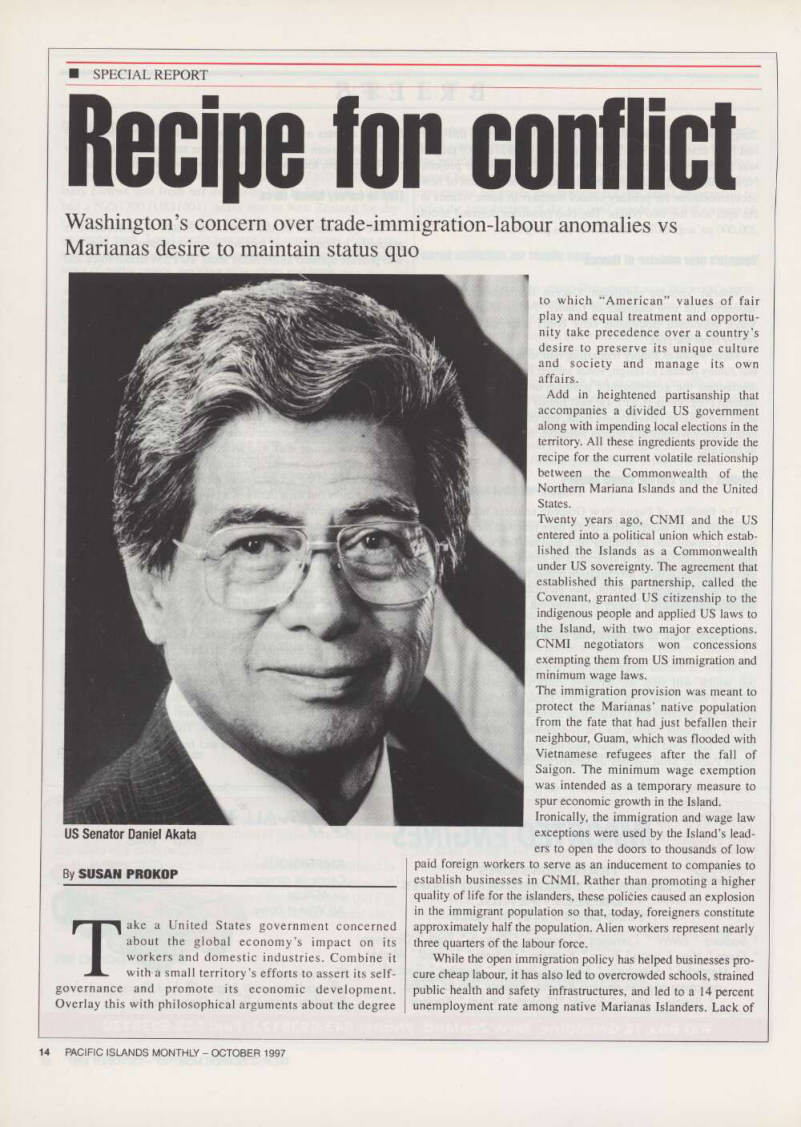
US Senator Daniel Akata
immigration enforcement has also opened CNMI to an influx of organised crime and drug training with all the accompanying adverse effects on its citizens.
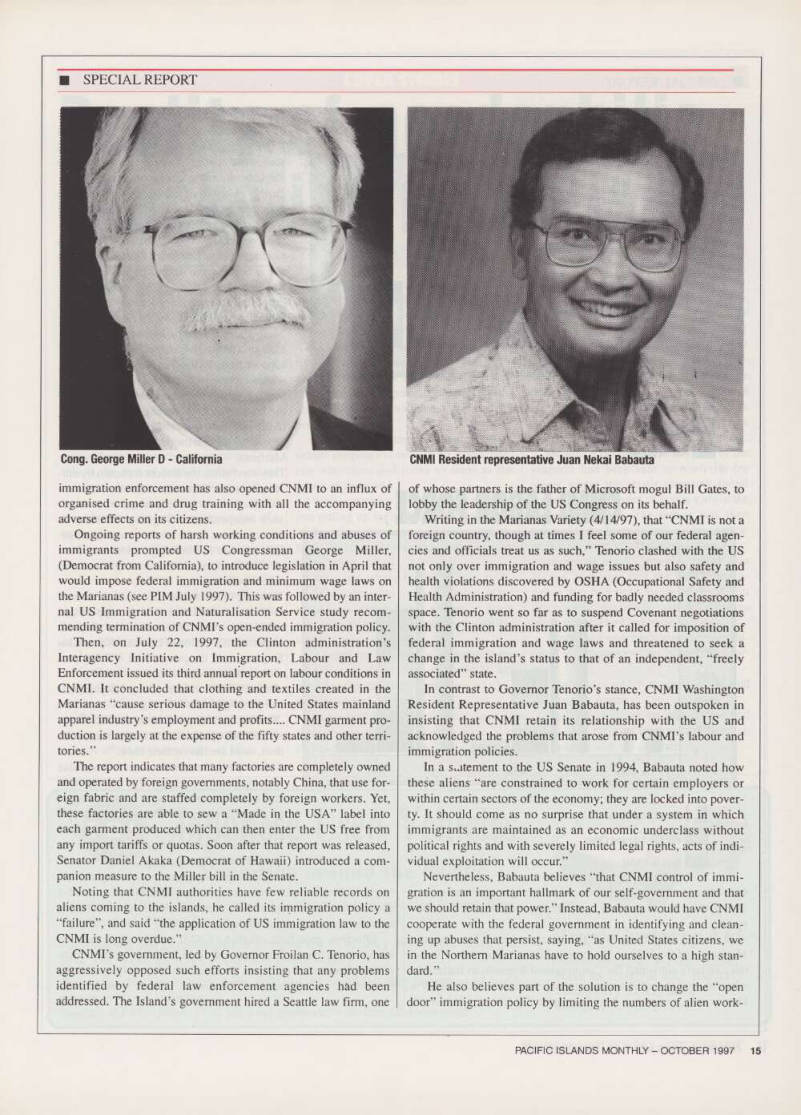
Ongoing reports of harsh working conditions and abuses of immigrants prompted US Congressman George Miller, (Democrat from California), to introduce legislation in April that would impose federal immigration and minimum wage laws on the Marianas (see PIM July 1997). This was followed by an inter nal US Immigration and Naturalisation Service study recom mending termination of CNMI’s open-ended immigration policy.
Then, on July 22, 1997, the Clinton administration’s Interagency Initiative on Immigration, Labour and Law Enforcement issued its third annual report on labour conditions in CNMI. It concluded that clothing and textiles created in the Marianas “cause serious damage to the United States mainland apparel industry’s employment and profits... CNMI garment pro duction is largely at the expense of the fifty states and other terri tories.”
The report indicates that many factories are completely owned and operated by foreign governments, notably China, that use for eign fabric and are staffed completely by foreign workers. Yet, these factories are able to sew a “Made in the USA” label into each garment produced which can then enter the US free from any import tariffs or quotas. Soon after that report was released, Senator Daniel Akaka (Democrat of Hawaii) introduced a com panion measure to the Miller bill in the Senate.
Noting that CNMI authorities have few reliable records on aliens coming to the islands, he called its immigration policy a “failure”, and said "the application of US immigration law to the CNMI is long overdue.”
CNMI’s government, led by Governor Froilan C. Tenorio, has aggressively opposed such efforts insisting that any problems identified by federal law enforcement agencies had been addressed. The Island’s government hired a Seattle law firm, one
of whose partners is the father of Microsoft mogul Bill Gates, to lobby the leadership of the US Congress on its behalf.
Writing in the Marianas Variety (4/14/97), that “CNMI is not a foreign country, though at times I feel some of our federal agen cies and officials treat us as such,” Tenorio clashed with the US not only over immigration and wage issues but also safety and health violations discovered by OSHA (Occupational Safety and Health Administration) and funding for badly needed classrooms space. Tenorio went so far as to suspend Covenant negotiations with the Clinton administration after it called for imposition of federal immigration and wage laws and threatened to seek a change in the island’s status to that of an independent, “freely associated” state.
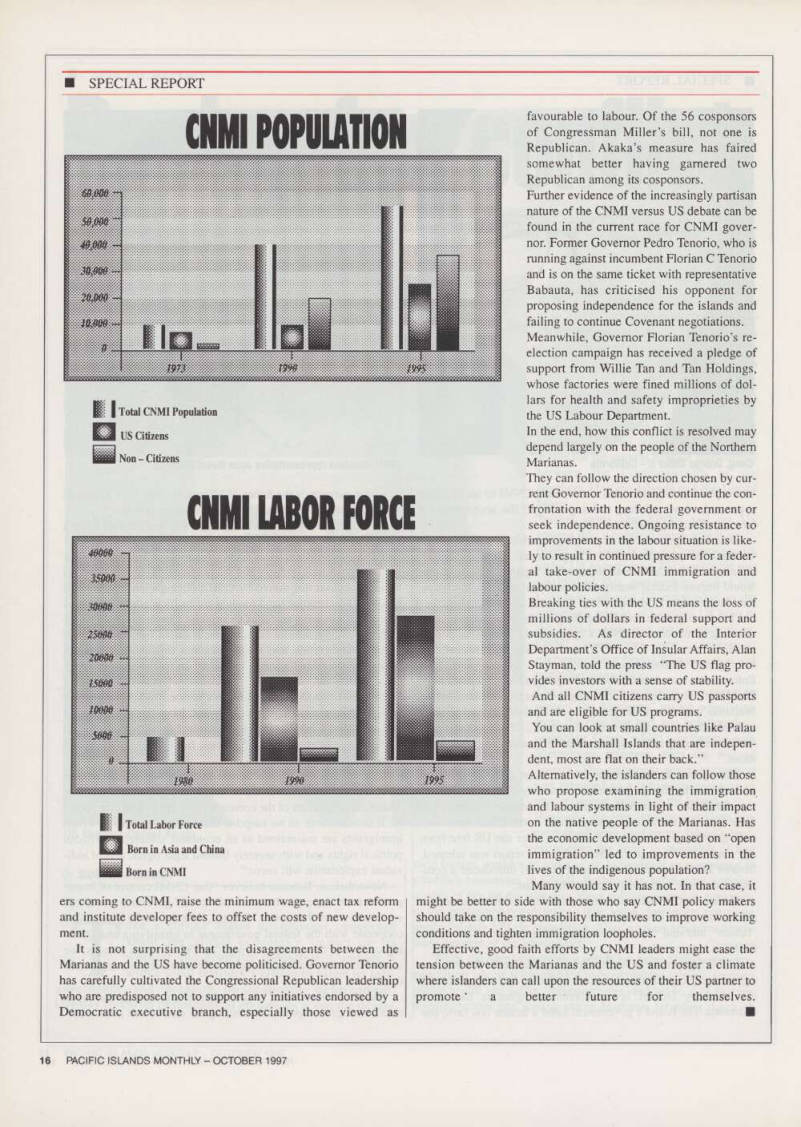
In contrast to Governor Tenorio’s stance, CNMI Washington Resident Representative Juan Babauta, has been outspoken in insisting that CNMI retain its relationship with the US and acknowledged the problems that arose from CNMI’s labour and
immigration policies.
In a statement to the US Senate in 1994, Babauta noted how these aliens “are constrained to work for certain employers or within certain sectors of the economy; they are locked into pover ty. It should come as no surprise that under a system in which immigrants are maintained as an economic underclass without political rights and with severely limited legal rights, acts of indi vidual exploitation will occur.”
Nevertheless, Babauta believes “that CNMI control of immi gration is an important hallmark of our self-government and that we should retain that power.” Instead, Babauta would have CNMI cooperate with the federal government in identifying and clean ing up abuses that persist, saying, “as United States citizens, we in the Northern Marianas have to hold ourselves to a high stan dard.”
He also believes part of the solution is to change the “open door” immigration policy by limiting the numbers of alien work-
Cong. George Miller D-California
CNMI Resident representative Juan Nekai Babauta
ers coming to CNMI, raise the minimum wage, enact tax reform and institute developer fees to offset the costs of new develop ment.
It is not surprising that the disagreements between the Marianas and the US have become politicised. Governor Tenorio has carefully cultivated the Congressional Republican leadership who are predisposed not to support any initiatives endorsed by a Democratic executive branch, especially those viewed as
favourable to labour. Of the 56 cosponsors of Congressman Miller’s bill, not one is Republican. Akaka’s measure has faired somewhat better having garnered two Republican among its cosponsors.
Further evidence of the increasingly partisan nature of the CNMI versus US debate can be found in the current race for CNMI gover nor. Former Governor Pedro Tenorio, who is running against incumbent Florian C Tenorio and is on the same ticket with representative Babauta, has criticised his opponent for proposing independence for the islands and failing to continue Covenant negotiations.
Meanwhile, Governor Florian Tenorio’s re election campaign has received a pledge of support from Willie Tan and Tan Holdings, whose factories were fined millions of dol lars for health and safety improprieties by the US Labour Department.
In the end, how this conflict is resolved may depend largely on the people of the Northern Marianas.
They can follow the direction chosen by cur rent Governor Tenorio and continue the con frontation with the federal government or seek independence. Ongoing resistance to improvements in the labour situation is like ly to result in continued pressure for a feder al take-over of CNMI immigration and
labour policies.
Breaking ties with the US means the loss of millions of dollars in federal support and subsidies. As director of the Interior Department’s Office of Insular Affairs, Alan Stayman, told the press “The US flag pro vides investors with a sense of stability.
And all CNMI citizens carry US passports and are eligible for US programs.
You can look at small countries like Palau and the Marshall Islands that are indepen dent, most are flat on their back.”
Alternatively, the islanders can follow those who propose examining the immigration and labour systems in light of their impact on the native people of the Marianas. Has the economic development based on “open immigration” led to improvements in the lives of the indigenous population?
Many would say it has not. In that case, it
might be better to side with those who say CNMI policy makers should take on the responsibility themselves to improve working
conditions and tighten immigration loopholes.
Effective, good faith efforts by CNMI leaders might ease the tension between the Marianas and the US and foster a climate where islanders can call upon the resources of their US partner to promote ’ a better future for themselves. ■