Contemporary Pacific sound
pp. 48-49 · Read in the full issue
By Atama Raganivatu
Te Vaka, a New Zealand based band which sings in the Tokelauan language, are, according to several respected international contemporary music reviewers, destined to become the next sensation to emerge in "eth nic music” and bring to the world’s attention the sounds of the Pacific, just as Enya popularised Irish music and Ladysmith Black Mambazo opened the eyes (and ears) of millions to South Africa’s rich musical her itage.
Their first album, simply called Te Vaka , has been released in 50 countries and they are currently on a four-month European tour which includes a concert at London’s prestigious Royal Festival Hall.
These are, indeed, thrilling times for the
group of musicians and dancers from west Auckland’s humble suburbs.
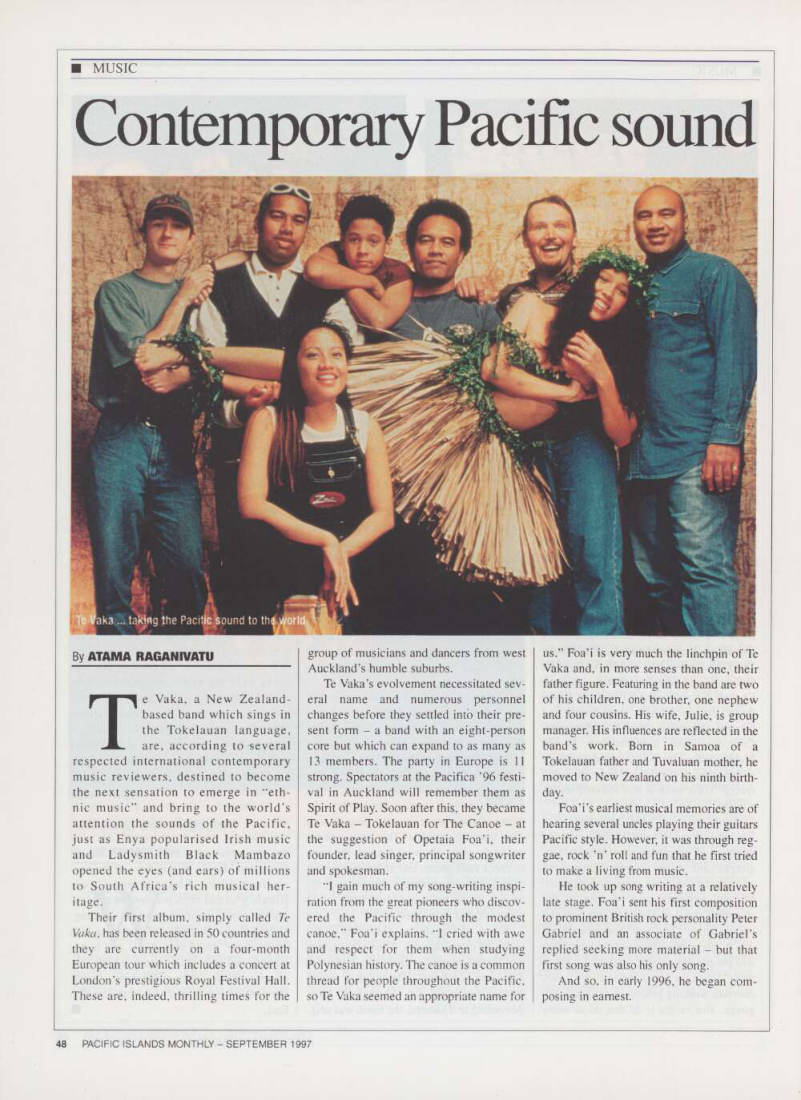
Te Vaka’s evolvement necessitated sev eral name and numerous personnel changes before they settled into their pre sent form - a band with an eight-person core but which can expand to as many as 13 members. The party in Europe is 11 strong. Spectators at the Pacifica ’96 festi val in Auckland will remember them as Spirit of Play. Soon after this, they became Te Vaka - Tokelauan for The Canoe - at the suggestion of Opetaia Foa’i, their founder, lead singer, principal songwriter and spokesman.
"I gain much of my song-writing inspi ration from the great pioneers who discov ered the Pacific through the modest canoe,” Foa’i explains. "I cried with awe and respect for them when studying Polynesian history. The canoe is a common thread for people throughout the Pacific, so Te Vaka seemed an appropriate name for
us.” Foa’i is very much the linchpin of Te Vaka and, in more senses than one, their father figure. Featuring in the band are two of his children, one brother, one nephew and four cousins. His wife, Julie, is group manager. His influences are reflected in the band’s work. Born in Samoa of a Tokelauan father and Tuvaluan mother, he moved to New Zealand on his ninth birth day.
Foa’i’s earliest musical memories are of hearing several uncles playing their guitars Pacific style. However, it was through reg gae, rock V roll and fun that he first tried to make a living from music.
He took up song writing at a relatively late stage. Foa’i sent his first composition to prominent British rock personality Peter Gabriel and an associate of Gabriel's replied seeking more material - but that first song was also his only song.
And so, in early 1996, he began com posing in earnest.
Te vaka ... taking the Pacific sound to the world
Of the initial crop of songs Foa’ia wrote, just one was in Tokelauan, but as this gained far more acclaim than any of the others, he decided, henceforth, all would have Tokelauan lyrics.
Although acoustic guitars and the flute are conspicuous in Te Vaka’s music, the heaviest emphasis is on traditional drums, particularly the pates or log drums. These are made from the Puapua or Fetau tree and are complemented by conga and bass drums which, traditionalists argue, should be made from shark skin. Te Vaka, howev er, are content with the now more popular goat or cow hide.
Guitars were introduced to Tokelau by European whalers a century ago. The Tokelauans, though, discarded the method of guitar playing favoured by the whalers and opted for the “open tuning” style that is unique to the Pacific islands. It is the lat ter tradition which Te Vaka are continuing.
Tradition is very important to Foa’i and Polynesian history features regularly in his songs. The havoc created by Peruvian slave traders in the Pacific is the theme of one of his most poignant compositions.
The gifted singer-songwriter is also mindful of the role that song and dance have always played as a means of commu nications for Polynesians. He notes: “In European society, they use pen and paper to record things. In the Pacific, things have been passed down through song. I know there have been Europeans in the 1600 s recorded going in to ask questions of Pacific islanders and being frustrated because they were always answered by
someone jumping up and singing and dancing but, of course, they weren’t aware that they were trying to tell them
something.”
Foa’i likes to regard himself as an ambassador for music throughout the Pacific and one of the very few ways of mildly annoying this most affa ble of men is to describe Te Vaka as “a Tokelauan Band”.
“We are not a Tokelauan band,” he explains patiently. “We sing in the Tokelauan language because it’s the language 1 was brought up with, but the music is not exclusively Tokelauan. The music belongs to the whole Pacific area; the elements are
from all over the Pacific - Tahiti, Samoa, New Zealand, Tuvalu and other islands, as well as Tokelau. Also, three members of the band are Palangi (European New Zealanders).”
Foa’i, one suspects, finds history far more absorbing than geography. He contin ues: “Our music is a contemporary Pacific sound taken from a long line of tradition.
The traditional side is what really inspires what we are doing. The music we have come up with puts all music from the indi vidual islands together and presents it in a contemporary manner and makes it into something all cultures can enjoy.”
His interest in history makes Foa’i appreciate the irony of Te Vaka’s mission ary work, as they bring the delights of Pacific music to the “Old World”.
“They’re hungry for our music overseas because they have never heard anything like us previously,” he enthuses.
“The music is original and unlike other bands, so you can’t say you’ve heard it before or that it’s been copied from any where.” ‘Km Te Vaka have been given the chance to take their act to a hungry European audi ence by ARC Music, a British recording company which has invested a great deal of money into promoting the band and it is ARC’S director of media, Jesse Reuben Wilson, who best summarised Te Vaka’s potential to make a universal impact. He said; “The infectious beauty of their music deserves nothing but extreme worldwide appraisal and they surely will receive noth ing less.” ■
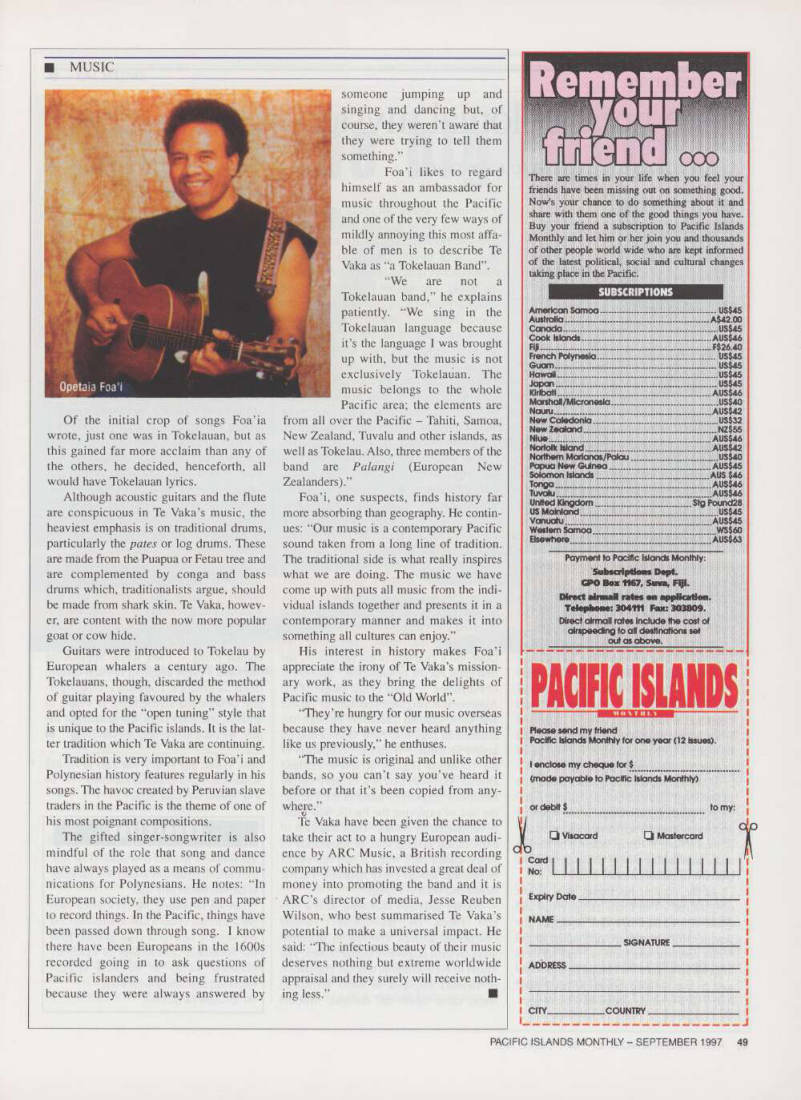
Opetaia Foa’i