The top end of music
pp. 46-47 · Read in the full issue
Music
By Liz Thompson
Whenever I turn the radio onto Triple J these days, it seems they are playing Bartpa, which means waves in Am barra language. The song is by Letterstick, an Aboriginal band from
Maningrida who are singing in the the local language Birrarra. Bartpa is just one compilation of wonderful songs that have been put together to form the Meinmuk album. Meinmuk is inter preted as "good” or "OK” in Gumatj.
Recently released, the album gives voice to a number of excellent bands from all over the top end of Australia
who have collaborated with a handful of non-Aboriginal musicians and tech nicians. One of the key players in the
production was Alan Murphy, previ
ously a drummer for The Village People in New York. Murphy arrived in Australia whilst touring with The Village People in 1983. He sits in as drummer on several of the recordings that have been released on Meinmuk and it is his relationships, established over a number of years whilst living and working with a variety of top-end communities, which have formed the basis of the network of musical rela tionships that went to produce the album.
Murphy’s introduction to indigenous Australia came when he was asked to fill in on a couple of gigs with the Warumpi Band. This resulted in a Bush Tour which he says marked his introduction to
Aboriginal community life. Murphy ended
up moving to Darwin and began running drumming and music workshops. There were, he says, huge numbers of people wanting to play but most of them had hard ly any gear.
Murphy concentrated on speaking to the community council and applying for grants to try and get together the basics to set up a structure within which these groups could actually produce music.
Recording a collaborative album with a collection of top-end musicians was an idea which, according to Murphy, had been thrown around for some time. However, it was when Chris Thompson and Phillip McKellar came up to record at the Barunga Festival that the idea took on greater form.
Thompson and McKellar record all Triple J’s live music and were visiting the Barunga Music Festival in the top end when, according to Murphy, they brought up the idea of doing a compilation album.
Tony Collins, a Triple J presenter, was also involved and responsible for raising the money which made the project possible.
Finances came from the Australian Broadcasting Commission (ABC). Collins took the role of executive producer and approached Alan Murphy to coordinate the
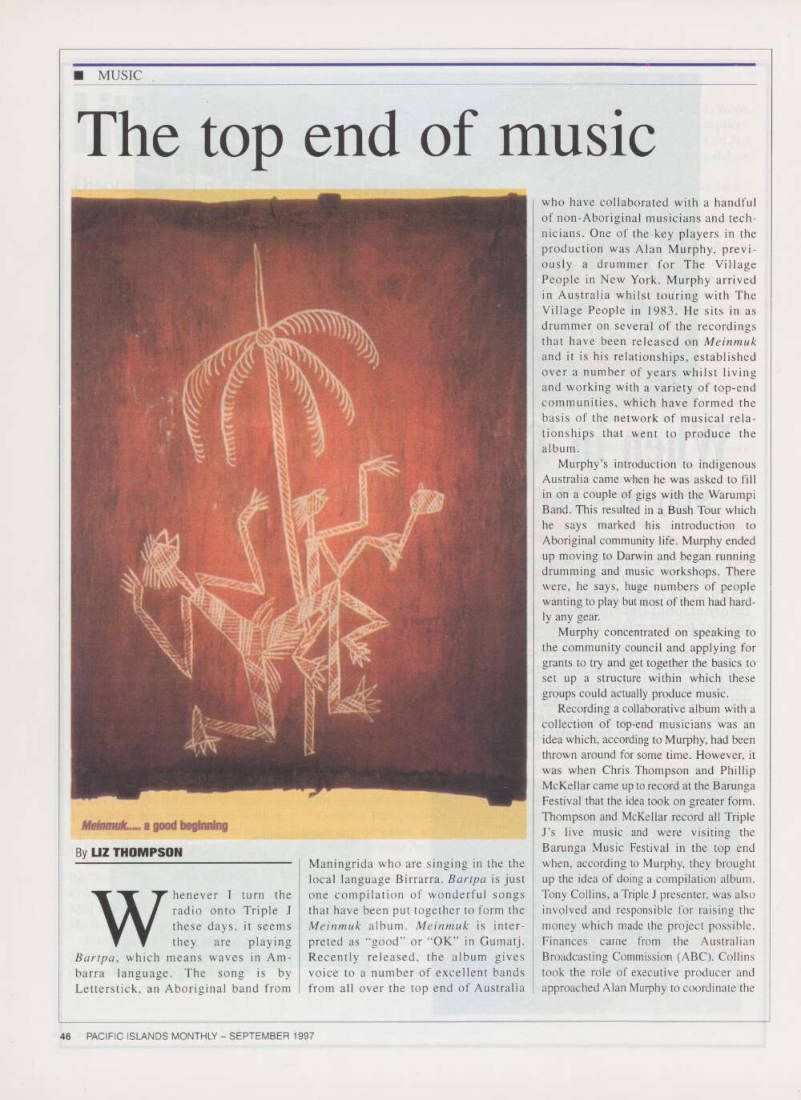
Meinmuk... a good beginning
project. The initial idea was to move a portable studio around from one communi ty to another but it was soon recognised that this might become a logistical night mare and instead Maningrida community was chosen as the gathering place. It is a central area located in North East Amhem land.
Half the studio came from Sydney, half from Melbourne and it was brought to Amhem land by Thompson and McKellar.
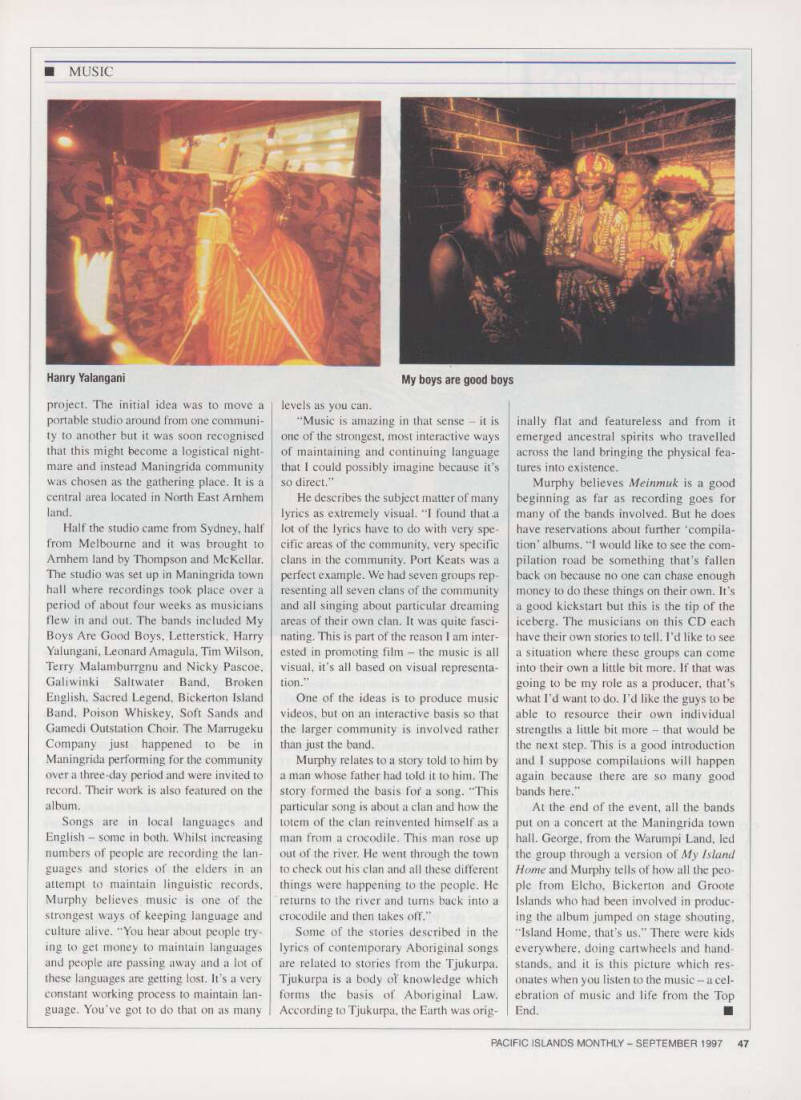
The studio was set up in Maningrida town hall where recordings took place over a period of about four weeks as musicians flew in and out. The bands included My Boys Are Good Boys, Letterstick, Harry Yalungani, Leonard Amagula, Tim Wilson, Terry Malamburrgnu and Nicky Pascoe, Galiwinki Saltwater Band, Broken English. Sacred Legend, Bickerton Island Band, Poison Whiskey, Soft Sands and Gamedi Outstation Choir. The Marrugeku Company just happened to be in Maningrida performing for the community over a three-day period and were invited to record. Their work is also featured on the album.
Songs are in local languages and English - some in both. Whilst increasing numbers of people are recording the lan guages and stories of the elders in an attempt to maintain linguistic records, Murphy believes music is one of the strongest ways of keeping language and culture alive. "You hear about people try ing to get money to maintain languages and people are passing away and a lot of these languages are getting lost. It's a very constant working process to maintain lan guage. You've got to do that on as many
levels as you can.
“Music is amazing in that sense - it is one of the strongest, most interactive ways of maintaining and continuing language that I could possibly imagine because it’s so direct.”
He describes the subject matter of many lyrics as extremely visual. “I found that .a lot of the lyrics have to do with very spe cific areas of the community, very specific clans in the community. Port Keats was a perfect example. We had seven groups rep resenting all seven clans of the community and all singing about particular dreaming areas of their own clan. It was quite fasci nating. This is part of the reason I am inter ested in promoting film - the music is all visual, it’s all based on visual representa tion.”
One of the ideas is to produce music videos, but on an interactive basis so that the larger community is involved rather than just the band.
Murphy relates to a story told to him by a man whose father had told it to him. The story formed the basis for a song. “This particular song is about a clan and how the totem of the clan reinvented himself as a man from a crocodile. This man rose up out of the river. He went through the town to check out his clan and all these different things were happening to the people. He returns to the river and turns back into a crocodile and then takes off.”
Some of the stories described in the lyrics of contemporary Aboriginal songs are related to stories from the Tjukurpa.
Tjukurpa is a body of knowledge which forms the basis of Aboriginal Law.
According to Tjukurpa, the Earth was orig
inally flat and featureless and from it emerged ancestral spirits who travelled across the land bringing the physical fea tures into existence.
Murphy believes Meinmuk is a good beginning as far as recording goes for many of the bands involved. But he does have reservations about further ‘compila tion’ albums. “I would like to see the com pilation road be something that’s fallen back on because no one can chase enough money to do these things on their own. It’s a good kickstart but this is the tip of the iceberg. The musicians on this CD each have their own stories to tell. I’d like to see a situation where these groups can come into their own a little bit more. If that was going to be my role as a producer, that’s what I’d want to do. I’d like the guys to be able to resource their own individual strengths a little bit more - that would be the next step. This is a good introduction and I suppose compilations will happen again because there are so many good bands here.”
At the end of the event, all the bands put on a concert at the Maningrida town hall. George, from the Warumpi Land, led the group through a version of My Island Home and Murphy tells of how all the peo ple from Elcho, Bickerton and Groote Islands who had been involved in produc ing the album jumped on stage shouting, "Island Home, that's us.” There were kids everywhere, doing cartwheels and hand stands, and it is this picture which res onates when you listen to the music - a cel ebration of music and life from the Top End. ■
Hanry Yalangani
My boys are good boys