Speaking to the PM
pp. 19-21 · Read in the full issue
Interview
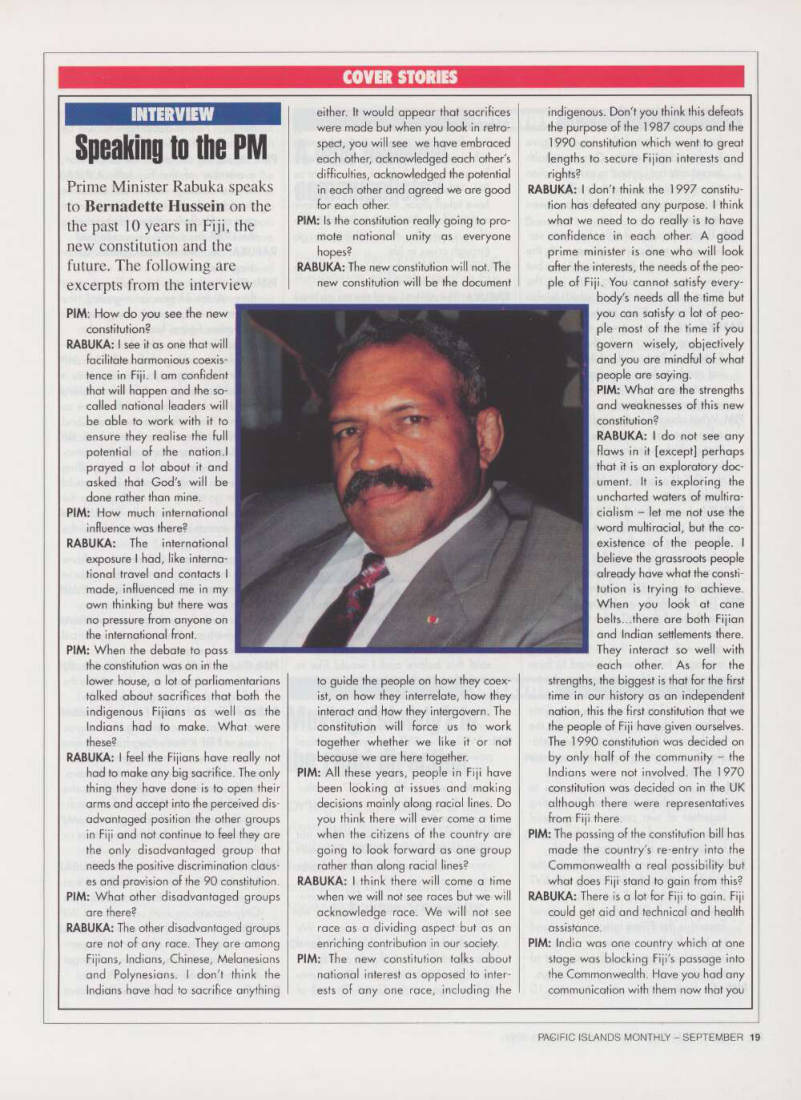
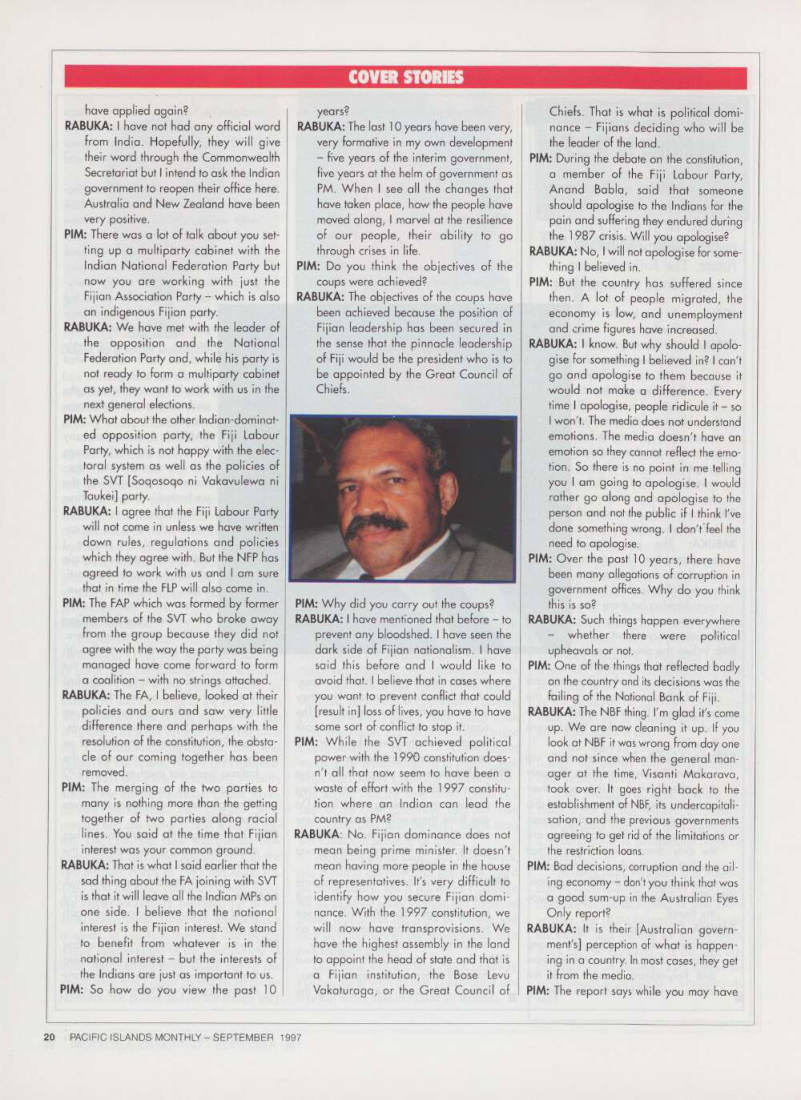
Prime Minister Rabuka speaks to Bernadette Hussein on the the past 10 years in Fiji, the new constitution and the future. The following are excerpts from the interview
PIM: How do you see the new constitution?
RABUKA: I see it as one that will facilitate harmonious coexis tence in Fiji. I am confident that will happen and the so called national leaders will be able to work with it to ensure they realise the full
potential of the nation.l
prayed a lot about it and asked that God's will be done rather than mine.
PIM: How much international influence was there?
RABUKA: The international exposure I had, like interna tional travel and contacts I made, influenced me in my own thinking but there was no pressure from anyone on the international front.
PIM; When the debate to pass the constitution was on in the
lower house, a lot of parliamentarians talked about sacrifices that both the indigenous Fijians as well as the Indians had to make. What were these?
RABUKA: I feel the Fijians have really not had to make any big sacrifice. The only thing they have done Is to open their arms and accept Into the perceived dis advantaged position the other groups In Fiji and not continue to feel they are the only disadvantaged group that needs the positive discrimination claus es and provision of the 90 constitution.
PIM: What other disadvantaged groups are there?
RABUKA: The other disadvantaged groups are not of any race. They are among Fijians, Indians, Chinese, Melanesians and Polynesians. I don't think the Indians have had to sacrifice anything
either. It would appear that sacrifices were made but when you look in retro spect, you will see we have embraced each other, acknowledged each other's difficulties, acknowledged the potential in each other and agreed we are good for each other.
PIM: Is the constitution really going to pro mote national unity as everyone hopes?
RABUKA: The new constitution will not. The new constitution will be the document
to guide the people on how they coex ist, on how they interrelate, how they interact and how they intergovern. The constitution will force us to work together whether we like it or not because we are here together.
PIM: All these years, people in Fiji have been looking at issues and making decisions mainly along racial lines. Do you think there will ever come a time when the citizens of the country are going to look forward as one group rather than along racial lines?
RABUKA: I think there will come a time when we will not see races but we will acknowledge race. We will not see race as a dividing aspect but as an enriching contribution in our society.
PIM: The new constitution talks about national interest as opposed to inter ests of any one race, including the
indigenous. Don't you think this defeats the purpose of the 1 987 coups and the 1990 constitution which went to great lengths to secure Fijian interests and rights?
RABUKA: I don't think the 1997 constitu tion has defeated any purpose. I think what we need to do really is to have confidence in each other. A good prime minister is one who will look after the interests, the needs of the peo ple of Fiji. You cannot satisfy every
body's needs all the time but you can satisfy a lot of peo ple most of the time if you govern wisely, objectively and you are mindful of what people are saying.
PIM: What are the strengths and weaknesses of this new constitution?
RABUKA: I do not see any flaws in it [except] perhaps that it is an exploratory doc ument. It is exploring the uncharted waters of multira cialism - let me not use the word multiracial, but the co existence of the people. I believe the grassroots people already have what the consti tution is trying to achieve.
When you look at cane belts...there are both Fijian and Indian settlements there.
They interact so well with each other. As for the
strengths, the biggest is that for the first time in our history as an independent nation, this the first constitution that we the people of Fiji have given ourselves.
The 1 990 constitution was decided on by only half of the community - the Indians were not involved. The 1970 constitution was decided on in the UK although there were representatives from Fiji there.
PIM: The passing of the constitution bill has made the country's re-entry into the Commonwealth a real possibility but what does Fiji stand to gain from this?
RABUKA: There is a lot for Fiji to gain. Fiji could get aid and technical and health assistance.
PIM: India was one country which at one stage was blocking Fiji's passage into the Commonwealth. Have you had any communication with them now that you
have applied again?
RABUKA: I have not had any official word from India. Hopefully, they will give their word through the Commonwealth Secretariat but I intend to ask the Indian government to reopen their office here.
Australia and New Zealand have been very positive.
PIM: There was a lot of talk about you set ting up a multiparty cabinet with the Indian National Federation Party but now you are working with just the Fijian Association Party - which is also an indigenous Fijian party.
RABUKA: We have met with the leader of the opposition and the National Federation Party and, while his party is not ready to form a multiparty cabinet as yet, they want to work with us in the next general elections.
PIM: What about the other Indian-dominat ed opposition party, the Fiji Labour Party, which is not happy with the elec toral system as well as the policies of the SVT [Soqosoqo ni Vakavulewa ni Taukei] party.
RABUKA: I agree that the Fiji Labour Party will not come in unless we have written down rules, regulations and policies which they agree with. But the NFP has agreed to work with us and I am sure that in time the FLP will also come in.
PIM: The FAP which was formed by former members of the SVT who broke away from the group because they did not agree with the way the party was being managed have come forward to form a coalition - with no strings attached.
RABUKA: The FA, I believe, looked at their policies and ours and saw very little difference there and perhaps with the resolution of the constitution, the obsta cle of our coming together has been removed.
PIM: The merging of the two parties to many is nothing more than the getting together of two parties along racial lines. You said at the time that Fijian interest was your common ground.
RABUKA: That is what I said earlier that the sad thing about the FA joining with SVT is that it will leave all the Indian MPs on one side. I believe that the national interest is the Fijian interest. We stand to benefit from whatever is in the national interest - but the interests of the Indians are just as important to us.
PIM: So how do you view the past 10
years?
RABUKA: The last 10 years have been very, very formative in my own development - five years of the interim government, five years at the helm of government as PM. When I see all the changes that have taken place, how the people have moved along, I marvel at the resilience of our people, their ability to go through crises in life.
PIM: Do you think the objectives of the coups were achieved?
RABUKA: The objectives of the coups have been achieved because the position of Fijian leadership has been secured in the sense that the pinnacle leadership of Fiji would be the president who is to be appointed by the Great Council of Chiefs.
PIM: Why did you carry out the coups?
RABUKA: I have mentioned that before - to prevent any bloodshed. I have seen the dark side of Fijian nationalism. I have said this before and I would like to avoid that. I believe that in cases where you want to prevent conflict that could [result in] loss of lives, you have to have some sort of conflict to stop it.
PIM: While the SVT achieved political power with the 1 990 constitution does n't all that now seem to have been a waste of effort with the 1 997 constitu tion where an Indian can lead the country as PM?
RABUKA: No, F ijian dominance does not mean being prime minister. It doesn't mean having more people in the house of representatives. It's very difficult to identify how you secure Fijian domi nance. With the 1997 constitution, we will now have transprovisions. We have the highest assembly in the land to appoint the head of state and that is a Fijian institution, the Bose Levu Vakaturaga, or the Great Council of
Chiefs. That is what is political domi nance - Fijians deciding who will be the leader of the land.
PIM: During the debate on the constitution, a member of the Fiji Labour Party, Anand Babla, said that someone should apologise to the Indians for the pain and suffering they endured during the 1 987 crisis. Will you apologise?
RABUKA: No, I will not apologise for some thing I believed In.
PIM: But the country has suffered since then. A lot of people migrated, the economy is low, and unemployment and crime figures have increased.
RABUKA: I know. But why should I apolo gise for something I believed in? I can't go and apologise to them because it would not make a difference. Every time I apologise, people ridicule it - so I won't. The media does not understand emotions. The media doesn't have an emotion so they cannot reflect the emo tion. So there is no point in me telling you I am going to apologise. I would rather go along and apologise to the person and not the public if I think I've done something wrong. I don't’feel the need to apologise.
PIM; Over the past 10 years, there have been many allegations of corruption in government offices. Why do you think this is so?
RABUKA: Such things happen everywhere - whether there were political upheavals or not.
PIM: One of the things that reflected badly on the country and its decisions was the failing of the National Bank of Fiji.
RABUKA: The NBF thing. I'm glad it 's come up. We are now cleaning it up. If you look at NBF it was wrong from day one and not since when the general man ager at the time, Visanti Makarova, took over. It goes right back to the establishment of NBF, its undercapitali sation, and the previous governments agreeing to get rid of the limitations or the restriction loans.
PIM: Bad decisions, corruption and the ail ing economy - don't you think that was a good sum-up in the Australian Eyes Only report?
RABUKA; It is their [Australian govern ment's] perception of what is happen ing in a country. In most cases, they get It from the media.
PIM: The report says while you may have
managed a compromise between Fijians and Indians for now, Fijian nationalism has the potential to derail it if it does not satisfy the grassroots.
RABUKA: These comments just show the limitations of the report because these people who put the report together go to cocktail parties where the grassroots are not represented, where we have opposition representatives of my regime and of those who are opposed to my views - the so-called well-to-do Fijians - who might be talking about these grassroots people when they are not even a part of it. It is a very limited, one-sided tunnel-visioned report.
PIM: There have been some calls to declare Fiji a Christian state.
RABUKA: If these people can tell me where in the Bible God says he wants a Christian world, I wi II do it.
PIM: During the Sandl ine problem in Papua New Guinea, you called up General Singirok and quoted a passage from the Bible to him which talked about not opposing authority. Why?
RABUKA: I just wanted to encourage him to view his own relationship with the then prime minister. Sir Julius Chan, and told him to talk to Chan rather than openly defy orders.
PIM: But didn't you break procedures when you carried out the coups?
RABUKA: I was trying to prevent something from getting worse. I was trying to pre vent any form of bloodshed.
PIM: Shouldn't you have talked to the PM in 1987 and other people in authority before carrying out such an action?
RABUKA: How? I spoke to the governor general at the time - it didn't work. I had no line with the PM as the security adviser to the commander. I could only advise the governor-general... It was something which had to be done to stop people from becoming rebellious.
PIM: But they did. A lot of people were beaten up and tortured at the time dur ing the coups.
RABUKA: These people did the wrong thing. Violence is an individual choice.
Nobody told them to do what they did.
PIM: How do you think people view you?
RABUKA: I don't think about these things and I don't care. What people think of me has never worried me because I know that they think of me worse than they will ever say. ■