Conservation consensus
pp. 28-29 · Read in the full issue
Fisheries
Fisheries conference surprises with agreement from all parties
Reports and photography by
Giff Johnson
It started off with everyone
agreeing and, remarkably,
finished with agreement from all participants in the second high-level Conference on the Conservation and Management of Highly Migratory Fish Stocks in the Pacific. There were a few bumps dur ing the week-long meeting in Majuro, Marshall Islands, in mid- June.
But no serious disagreements blocked the major distant water fishing nations and Pacific Island countries from approving an unprecedented
three-year timetable
for action to draft a
conservation regime
for the region.
Although fishing
nations and Pacific Island countries are often at odds when it comes to the price
of access fees and licenses, the Majuro meeting confirmed they share the same interest in the SUS2-billion annual tuna industry: safeguarding its sustainability to avoid the dramatic declines seen in many fisheries worldwide.
Virtually every Pacific nation and ter ritory met with officials from the United States, Japan, China, Korea and Taiwan.
Fisheries officials from 24 nations and territories unanimously agreed both to “establish a mechanism for conservation and management of highly migratory fish stocks of the region” and to make it hap pen by the year 2000.
“We thought that the multilateral treaty with the Americans [purse seiners] was big,” said a fisheries official in Majuro referring to the broad access accord that brought peace in the mid
1980 s to fisheries relations with the US tuna fleet after years of confrontation over illegal fishing. “But what we’ve done here is of much greater signifi cance.”
Marshall Islands President Imata Kabua expressed the sentiments of many in the region in opening the conference when he said the adversarial approach between fishing nations and island coun tries may have worked in the past, but it
was time to see if there was a better way to confront pressing conservation issues.
“The Atlantic and Indian Ocean tuna fisheries have been harvested at or beyond their maximum sustainable lev els,” Kabua said. Though the Pacific tuna stocks are considered strong, “we cannot be complacent; we must take precau tions”.
The Forum Fisheries Agency con vened the conference and selected Satya Nandan to chair the meeting, a move that drew praise from and reassured the dis tant water fishing nations (DWFN) some of whom (the Asians, in particular) often feel the FFA is trying to ram island fishing policies down their throats.
“Before coming here, we were some what pessimistic about what could be accomplished,” said Taisuo Saito, special
adviser to Japan’s minister of agriculture and head of the Japanese delegation.
But, he added, given the excellent chair [Nandan] and their talks with island delegations, their view had changed.
Nandan was a central participant in early Law of the Sea negotiations, drafting the brief that led to the Suva Declaration in 1976 under which Pacific Islands agreed not only on the 200-mile exclusive eco nomic zone concept, but to take a coordi nated regional approach to fisheries access negotiations with DWFN.
“WeTl be satisfied if we can identify areas of agreement and have a frank dis cussion and exchange on the issues where we disagree,” said one FFA official at the outset of the meeting.
By week’s end, both FFA and DWFN officials were basking in the euphoria of the plan to hammer out details of surveil
lance, catch
reporting, stock
assessment, financial assis tance and related fishing manage ment details.
Conference chairman Nandan said he doubted such a
far-reaching
accord could have been reached earlier.
Although the FFA, when
formed 20 years ago, called for coopera tion for management of tuna, it could not happen then “because some of the impor tant distant water fishing nations were not ready to recognise the sovereign rights of coastal states over highly migratory species in their exclusive economic zones”, he said.
The long delay in negotiating a coop erative arrangement, however, “may have worked to the advantage of both sides”, Nandan said.
“Both sides know each other well and this creates a very good atmosphere [for the discussions].”
The agreement is all the more startling for the fact that the islands themselves have disparate interests - ranging from the lucrative fishing grounds of the Federated States of Micronesia and Papua
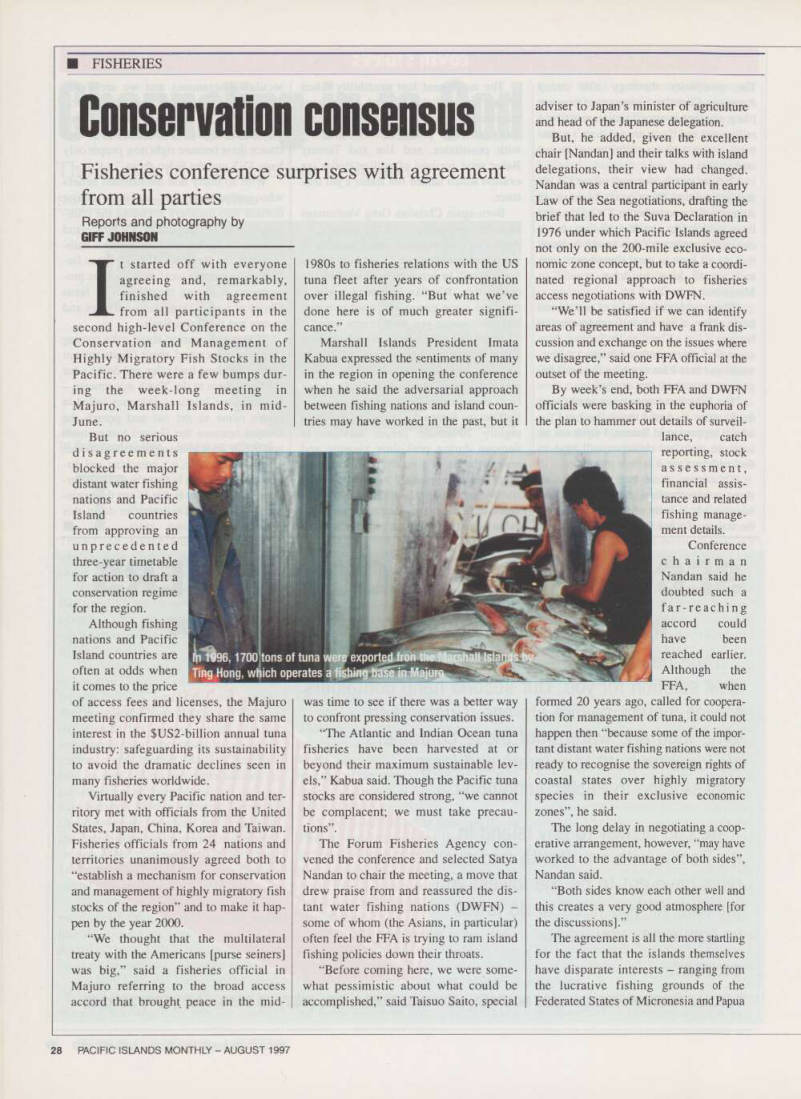
In 1996, 1700 tons of tuna were exported fron the Marshall Islands by Ting Hong, which operates a fishing base in Majuro
New Guinea to the somewhat less valued areas of the Marshall Islands or Tonga.
“This shows that not only fishing nations but also Pacific Island countries are serious about conserving tuna, “ said
Marshalls Foreign Secretary Robert
Muller.
“We thought initially that we’d get a watered-down document [at the end of the week’s meetings]. Instead, we have agree ment on an aggressive three-year timetable for action.”
The plan of action commits the coun tries to cooperate in collecting and sharing accurate fisheries data, and provides that fishing nations are committed to providing “financial, scientific and technical assis tance to Pacific Island developing states and territories to enhance their ability to conserve, manage and sustainably use the highly migratory fish stocks of the region”.
A number of island participants had said at the outset of the conference that they expected more disagreement from Asian fishing nations, principally Japan.
But the Japanese delegation joined in
approving the plan. “If there is a clear
agreement on a legal framework that binds everyone, we are more than willing to par ticipate because it’s essential [for manage ment of the resources],” Saito explained.
Muller added: “It was a much greater accomplishment than we expected. There was a real spirit of cooperation and com promise at the conference.”
A three-year limit for negotiating an agreement was set by the conference, with follow-up conference sessions planned for 1998 and 1999, and technical meetings to take place in between.
While conference participants were generally ecstatic over the result of the week, all acknowledge the difficult negoti ations that lie ahead.
“This doesn’t mean it will be easy to get agreement [on a specific management regime],” said Brian Hallman, deputy director of the state department’s office of marine conservation and head of the US delegation in Majuro.
But he expressed optimism the commit ments made in Majuro would lead to future agreement. “We’re anxious to get [man agement] arrangements in place for the
Pacific,” said Hallman. “The time to do it is now because the tuna stocks are not over-fished. It’s much harder to get togeth er and make rules when the area is over fished.”
Similarly, FFA deputy director lan Cartwright observed there “may be storms down the road” as they try to get the dis parate fishing nations of Asia and the US to agree with the equally independent minded island countries. But no one was allowing this speculation to hinder the cel ebration over the Majuro accords.
“This is an historic turn of events,”
Hallman said. “This is the one region in the world that doesn’t have an international mechanism for conserving fisheries and yet it’s the world’s richest fishing ground.”
He credited island nations for the con servation initiative. “They’ve seen the necessity and importance of making a mul tilateral agreement,” Hallman said.
“They’ve made a commitment to it.”
Cartwright said the agreement on a plan of action for fisheries management by 24 participating nations and territories was a “first for the world”. ■