From the pulpit
pp. 19-20 · Read in the full issue
As Fiji prepared for its
new constitution, the
politics-versus-religion
debate gathered a lot of
momentum with the
hint of a split within the
Methodist Church.
General secretary of the
church the Reverend
Kanailagi expresses his
personal views to
Bernadette Hussein on
the subject
Religion plays a major role in Pacific Island nations and Fiji is no exception. But with a population more multireligious than its island neighbours’, the issue of religion versus politics becomes a more contentious affair. And as the country braced itelf for the passage of a new constitution, the issue generat ed even more debate. The new Constitution Amendment Bill was passed last month by Fiji’s parliament.
But the state-versus-religion debate continues.
In Fiji, the majority are Christians, with Methodism being the largest denomina tion. Hindus and Muslims form a substan tial part of the remaining population.
According to the 1986 census, 52.9 per cent of the population is Christian, 38.1 per cent Hindu and 7.8 per cent Muslim.
Prior to the tabling of the Constitution Amendment Bill in Fiji’s House of Representatives, the bill received the approval of the country’s Great Council of Chiefs - but with two requests. Ignoring many of the more politically controversial provisions, the council asked that its appointees in the senate consider the coun cil’s views when voting on issues concern ing entrenched indigenous Fijian legisla-
tion. The other request was that the gov ernment continue negotiations with other political parties to declare Fiji a Christian state. During the review of Fiji’s constitu tion, when the public was called on to make submissions to the review commis sion, the president of the Methodist Church in Fiji, the Reverend Dr Ilaitia Tuwere, presented a paper titled The Christian - Community within the Human Community.
The Rev Dr Tuwere, who is seen as more tolerant in his views than his prede cessor, stated in his paper that declaring Fiji a Christian state would go against the principles of religious freedom, qualifying his comment by adding it was more impor tant for people to live by the principles of the Christian faith than to declare Fiji a Christian State. People wanted to make Fiji a better place to live in, he said in the paper, but he did not believe the declara tion of Fiji as a Christian state in the con stitution would achieve this.
As the media took hold of this line of the argument prior to the voting on the bill in parliament, the general secretary of the church, the Rev Tomasi Kanailagi, dissoci ated the Methodist Church from the com ment, saying that the paper was still being discussed by the church’s standing com mittee. The church’s stand on the issue would be announced by the committee; he added. The Rev Dr Tuwere was away at the time of writing and was unable to elaborate on his views.
Personally, the Rev Kanailagi told Pacific Islands Monthly, he supported the idea of making Fiji a Christian state.
Stressing that the following views are his own and not necessarily those of the church, the Rev Kanailagi said a Christian state would be one always emphasising Christian principles. “One of the things it emphasises is the inclusiveness of other races and religions. No one is excluded.”
While agreeing that the present consti tution allowed for such principles without declaring Fiji a Christian state, the Rev Kanailagi felt that “being a Christian state would mean that these things will be taken seriously and will also make the country a better place to live in”.
“I can see no other humanitarian grounds which can bring people together.”
As for the Rev Dr Tuwere’s paper, the Rev Kanailagi said it had not been accept ed at the last meeting of the standing com mittee. “I think the general feeling among the indigenous Fijians is that yes, Fiji should be declared a Christian state. When the Rev Dr Tuwere’s comment appeared in the media, I received a lot of calls from people who strongly objected to it and wanted to know if that was the official stand of the church. I told them, ‘No, it was the Rev Dr Tuwere’s personal paper to the
Crc.’”
Quick to allay the fears of Fiji’s other religious groups and their concerns over freedom of worship, the Rev Kanailagi assured: “No, they will not lose it. This is a free country and there is freedom of expression and religion here. Why should people have to give that up? People should not feel that this freedom is under threat because we, as Christians, have to give
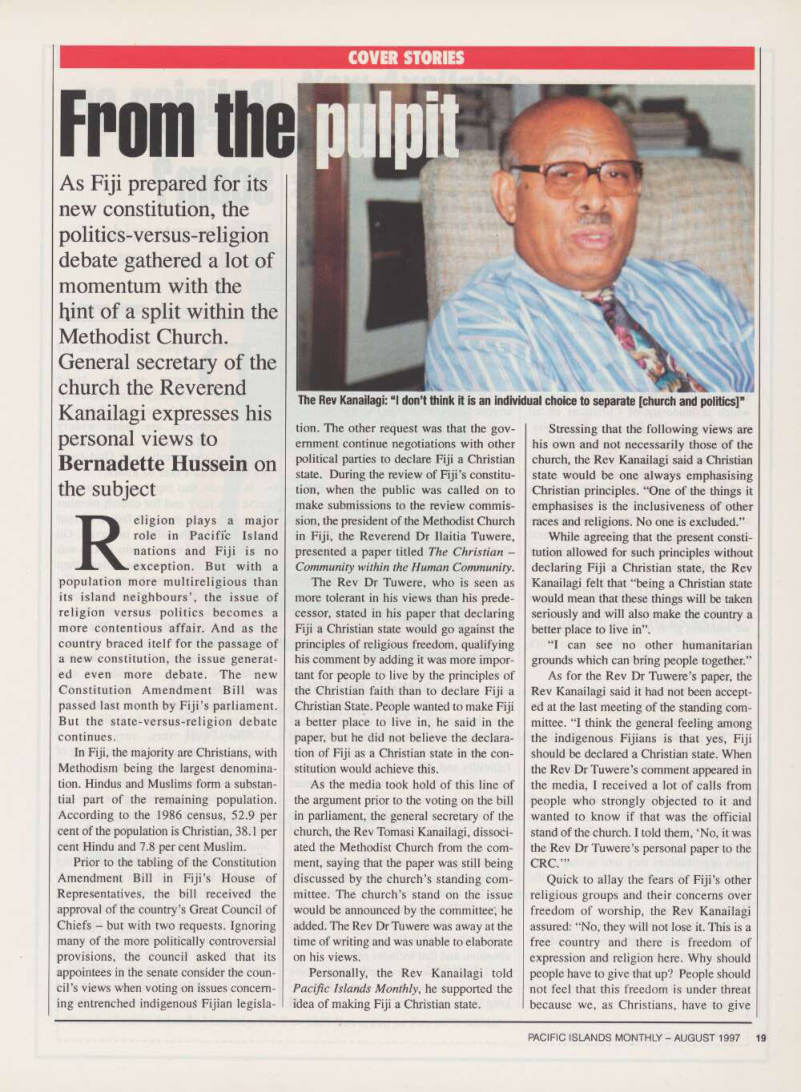
The Rev Kanailagi: “I don’t think it is an individual choice to separate [church and politics]”
people the freedom to worship as they want and whenever they want. Even after the country is declared a Christian state, I am sure there will be no pressure on them.”
Last year saw the lifting of the Sunday ban in Fiji which had been imposed - with varying degrees of force - since the 1987 military coups. The ban was put in place after a call from the Methodist Church in Fiji, which had at its helm at the time the more right-wing Rev Manasa Lasaro. The ban was opposed by many church members at the time but the motion was passed by the House of Representatives and the Senate.
According to the Rev Kanailagi, the Sunday ban issue no longer figures in the equation. “You see, there are some Christians who want to impose this ban but there are many who are against it. We have a body called the Fiji Council of Churches which is made up of Christians of all denominations. It is the stand of this coun cil that there not be a Sunday ban. People should realise that things like the Sunday ban will not happen just because one group feels it should. If the majority think that it is not such a good idea, then that’s how it should be. Once Fiji is declared a Christian state, it will run according to general Christian principles and not principles of one denomination. It will be based on inter denominational or general Christian beliefs. The Methodist Church is the largest Christian denomination in the country but we still have great respect for other denom inations and religions. We have to work hand in hand with them to make the coun try a better place.”
But he expressed his concern over the number of religious sects he said were coming into the Pacific.
“The problem is that governments are allowing these sects to come in. They tell people that their church will send people overseas for training or studies or will help them out financially. Human nature is such that when they are shown things like this, they turn towards it. Everybody wants the best in life and when they see and hear of such opportunities they turn in that direc tion. I think this is the trend in most Pacific Islands. These things are caused by Western influences.
“You see, our people, the Pacific peo ple, do not have enough resources and any opportunity they see of getting [more], they go for it.” But he dismissed suggestions that there could be more breakaway groups in the future.
“No, I don’t think so. You see the main stream churches are getting stronger. They are providing better education and training facilities to help their members.”
But religious tolerance is not necessari ly one of Fiji’s stronger suits.
Desecration of holy sites is being
reported with alarming regularity, with
Hindu temples being the prime target for vandals and arsonists.
One incident last year, saw a man destroy a Hindu temple and then com mence to sit on the spot and recite verses from the Bible. When arrested, he explained he was following instructions from God. But the Rev Kanailagi sees the declaration of Fiji as a Christian state as the cure for such goings-on. “People who are doing this are frustrated and do this as a way to show their feelings... I’m not saying it’s OK. What they are doing is wrong and anyone who does things like this deserves to be severely punished.”
But the crux of the controversy is whether religion and politics should mix.
The Rev Kanailagi thinks they should.
“As a citizen of a country, you should be involved in politics because politics affects every citizen. I don’t believe that religion and politics have their own places.
If the two are separated, the country will not function well. They are closely linked.
“Religion is the conscience of the state.
The two have their role to play - in some cases separate. But if the state is wrong, then the church has every right to come in and speak directly to the state.
“Politics is very important to every per son, and so is religion. These two interests are in one person. Why should they be sep arated? They play different roles in the same human being. I have my political and religious roles. They are both important and I think I should play both these roles faithfully and diligently. If I fail in one of these areas, then I am not a good human being.”
Does this mean taking politics into church? “Yes,” he replies. “I can stand at the pulpit and talk politics,” he said, dis missing concerns that the church may not be the right forum to talk politics. “Why isn’t [the church not the right forum to talk politics]? That is what many people say but that is not what the Bible says. The Bible says God’s word is for every man in every situation, and that includes politics.
“I don’t think it is an individual choice to separate the two. It is a responsibility to keep the two together.” ■