The Forum
pp. 14-15 · Read in the full issue
While credited with improving relations between the Pacific and the world, the secretariat is also bedevilled with allegations of inconsistent and poor administrative practices
By the time the 28th sum mit of the South Pacific Forum is over in September, a new secre
tary-general for the regional organisa
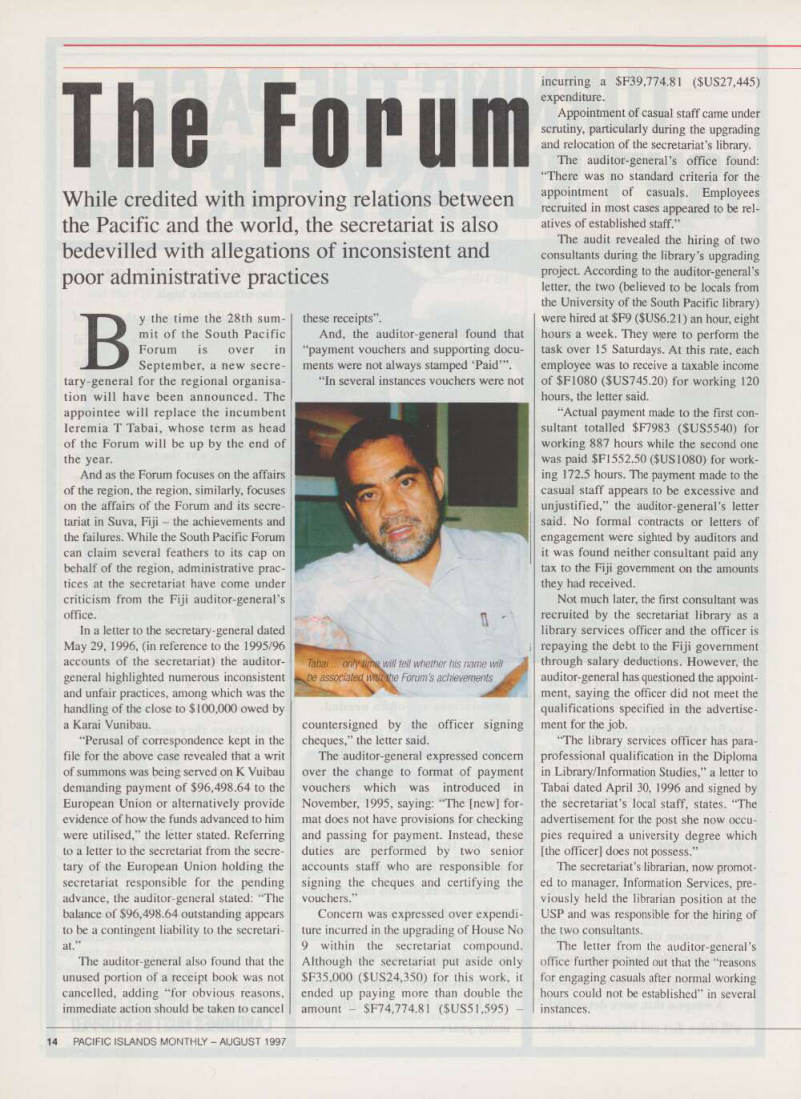
tion will have been announced. The appointee will replace the incumbent leremia T Tabai, whose term as head of the Forum will be up by the end of the year.
And as the Forum focuses on the affairs of the region, the region, similarly, focuses on the affairs of the Forum and its secre tariat in Suva, Fiji - the achievements and the failures. While the South Pacific Forum can claim several feathers to its cap on behalf of the region, administrative prac tices at the secretariat have come under criticism from the Fiji auditor-general’s office.
In a letter to the secretary-general dated May 29, 1996, (in reference to the 1995/96 accounts of the secretariat) the auditor
general highlighted numerous inconsistent
and unfair practices, among which was the handling of the close to $lOO,OOO owed by a Karai Vunibau.
“Perusal of correspondence kept in the file for the above case revealed that a writ of summons was being served on K Vuibau demanding payment of $96,498.64 to the European Union or alternatively provide evidence of how the funds advanced to him were utilised,” the letter stated. Referring to a letter to the secretariat from the secre tary of the European Union holding the secretariat responsible for the pending advance, the auditor-general stated; “The balance of $96,498.64 outstanding appears to be a contingent liability to the secretari at.”
The auditor-general also found that the unused portion of a receipt book was not cancelled, adding “for obvious reasons, immediate action should be taken to cancel
these receipts”.
And, the auditor-general found that “payment vouchers and supporting docu ments were not always stamped ‘Paid’”.
“In several instances vouchers were not
countersigned by the officer signing
cheques,” the letter said.
The auditor-general expressed concern over the change to format of payment vouchers which was introduced in November, 1995, saying; “The [new] for mat does not have provisions for checking and passing for payment. Instead, these duties are performed by two senior accounts staff who are responsible for signing the cheques and certifying the vouchers.”
Concern was expressed over expendi ture incurred in the upgrading of House No 9 within the secretariat compound.
Although the secretariat put aside only $F35,000 ($U524,350) for this work, it ended up paying more than double the amount - $F74,774.81 ($U551,595) -
incurring a $F39,774.81 ($U527,445)
expenditure.
Appointment of casual staff came under
scrutiny, particularly during the upgrading
and relocation of the secretariat’s library.
The auditor-general’s office found: “There was no standard criteria for the
appointment of casuals. Employees
recruited in most cases appeared to be rel atives of established staff.”
The audit revealed the hiring of two consultants during the library’s upgrading
project. According to the auditor-general’s
letter, the two (believed to be locals from the University of the South Pacific library) were hired at SF9 (SUS6.2I) an hour, eight hours a week. They \yere to perform the task over 15 Saturdays. At this rate, each employee was to receive a taxable income of SFIOBO ($U5745.20) for working 120 hours, the letter said.
“Actual payment made to the first con sultant totalled $F7983 (SUSSS4O) for working 887 hours while the second one was paid $F1552.50 ($US1080) for work ing 172.5 hours. The payment made to the casual staff appears to be excessive and unjustified,” the auditor-general’s letter said. No formal contracts or letters of engagement were sighted by auditors and it was found neither consultant paid any tax to the Fiji government on the amounts they had received.
Not much later, the first consultant was recruited by the secretariat library as a library services officer and the officer is repaying the debt to the Fiji government through salary deductions. However, the auditor-general has questioned the appoint ment, saying the officer did not meet the qualifications specified in the advertise ment for the job.
“The library services officer has para professional qualification in the Diploma in Library/Information Studies,” a letter to Tabai dated April 30, 1996 and signed by the secretariat’s local staff, states. “The advertisement for the post she now occu
pies required a university degree which
[the officer] does not possess.”
The secretariat’s librarian, now promot ed to manager, Information Services, pre viously held the librarian position at the USP and was responsible for the hiring of the two consultants.
The letter from the auditor-general’s office further pointed out that the “reasons for engaging casuals after normal working hours could not be established” in several instances.
Tabai...only time, will tell whether his name will be associated with the Forum’s achievements
“The hours worked by them [casual staff] without any breaks appear to be excessive, unusual and unrealistic.”
The auditor-general expressed concern that despite an earlier letter (dated June 7, 1995) suggesting stock cards for each item in stock to monitor stock levels and peri odic checks, this had not been done. And, the letter pointed out, “entries in request forms were made in pencil instead of ink”.
In response to the allegations, Tabai wrote to the auditor-general’s office explaining steps being taken to address the issues.
Under payment vouchers, Tabai wrote: “It is a requirement of our system of inter nal control that vouchers are to be stamped ‘Paid’ to reduce the likelihood of double payment. Staff have been reminded of the need to comply with these formal proce dures.”
On upgrading House No 9, Tabai said the initial budget figure was based on the removal of the hill at the back of the house.
After this was done, he said, the architect recommended that the roof be lifted and a master bedroom be added upstairs to make the house habitable. The secretariat’s Reserve Fund would be used to pay for this overexpenditure and rent collected from the property would be used to repay the Reserve Fund.
On the question of the appointment of the library services officer, Tabai said he “reserves the right to make appointments based on his total understanding of the qualification and experience of a particular
applicant”.
In response to the appointment of casu al staff, Tabai said no procedures had exist ed in the secretariat at the time.
“Procedures are now being developed,” he said. “The decision on appointment of casual professional staff was made by senior staff who had no relationship to those persons,” Tabai said in his letter dated June 28.
The non-payment of provisional tax, Tabai said, had been omitted in error.
“However, the omission has been rectified and we are in the process of recovering the taxes from the two persons concerned.”
The only former head of state to occupy the prestigious post, the Kiribati accoun
tant-tumed-politician will have completed
six years at the helm of the Suva-based
regional organisation this year.
Appointed by the South Pacific Forum in Pohnpei, Federated States of Micronesia, in 1991, Tabai couldn’t have
wished for the appointment at a better time.
Globally, states began realigning in the face of the inevitable collapse of commu nism in the former Soviet Union. With the realignment in motion, the veneer of the so-called the Cold War began to peel off layer by layer, resulting in a new world order.
To Tabai’s credit, he has helped put the region on the international landscape. For instance, it was during his administration that the Forum obtained observer status at the United Nations General Assembly and
Apec.
It was also during his time that the
tedious, often time-consuming procedures
involved in securing European Union funding were somewhat streamlined, resulting in a speedier release of funds for regional projects in the South Pacific.
There was a vast improvement in media relations with the Forum. Until his time, the South Pacific Forum was a closed doors affair as far as media access to South Pacific leaders was concerned.
In the past six years, inaccessibility to leaders has become a thing of the past.
Only time will tell whether or not Tabai’s name will be associated with these achievements.
Asked by Pacific Islands Monthly whether he would be seeking another term as secretary-general, Tabai replied that the appointment of secretary-general was made by the Forum in closed session.
Fiji was badly embarrassed in 1994 when Tabai decided at the last minute that he wanted to stay on for a second term. Fiji had been lobbying strongly for the top regional spot for its foreign minister, Filipe Bole, prior to and during the South Pacific Forum in Brisbane, Australia.
Tabai’s reappointment, spearheaded by Australia, drew the ire of Fijian Prime Minister Sitiveni Rabuka who reportedly said the South Pacific Forum should con sider moving its secretariat away from Suva, and perhaps to outer space.
Bole is once again vying for the posi tion which carries a basic, tax-free salary of well over SFIIO,OOO ($U575,900), free
housing, car, SF6OOO (SUS4I7O)-a-year
representational allowance as well as first class air travel.
The position also carries an education allowance of SF6OOO (SUS4I7O) a year per child for up to three children and a maid, whose salary is included in the secretari at’s annual regular budget. ■