Race debate or gutter fight?
pp. 8-10 · Read in the full issue
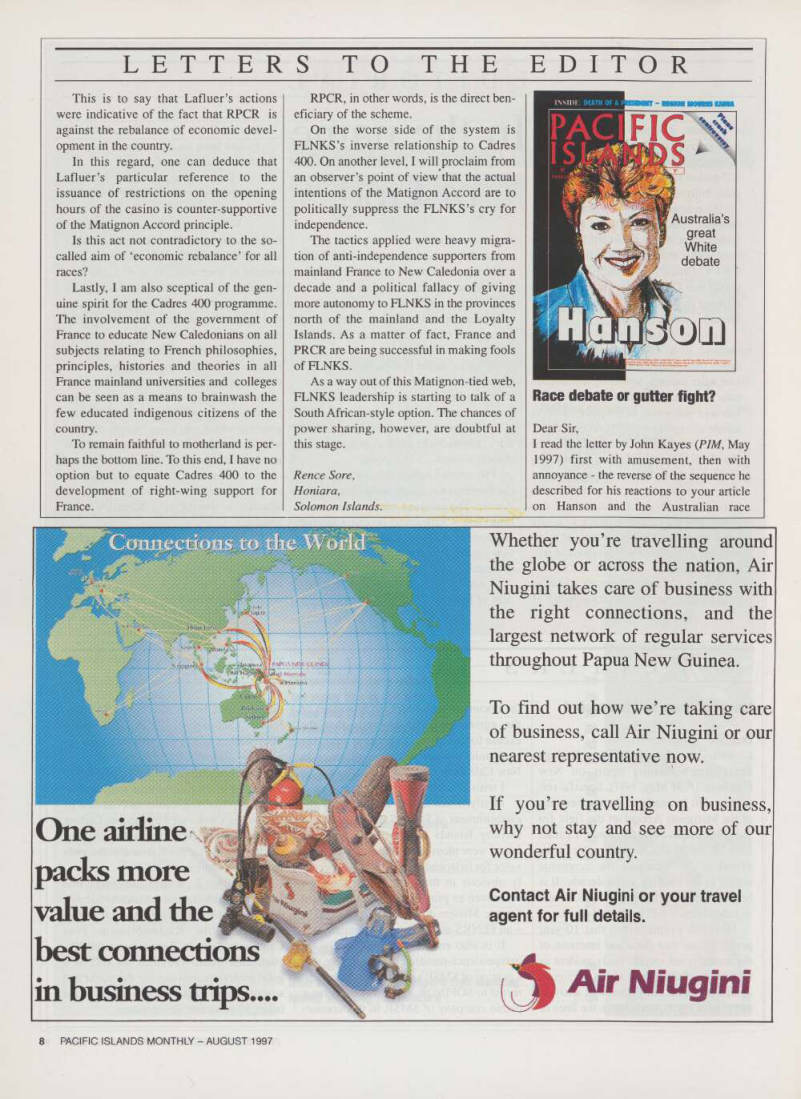
Dear Sir, I read the letter by John Kayes ( PIM , May 1997) first with amusement, then with annoyance - the reverse of the sequence he described for his reactions to your article on Hanson and the Australian race
“debate” as it is constantly and erroneous ly called. In fact, there has been little debate.
What is happening is a gutter fight because that is where it started and where it has, unfortunately, been left - even exac erbated - by the Australian government.
Kayes presented many of the slogans of the Hanson camp as facts.
Slogans depend on having the superfi cial appearance of fact and common sense,
while actually avoiding any critical analy
sis.
It should never be forgotten that Pauline Hanson’s entry into political life in 1996 and her being dropped from Liberal Party endorsement was not to do with multicul turalism. Standing in a seat with a large and visible Aboriginal population, which attracts the amount of racist attention that is (sadly) normal in Australia, she mounted a vicious, totally ill-informed and unwar ranted attack on them, claiming they were being feather-bedded by the system and should have to “do it tough” like other Australians.
Had she ever taken the trouble to read a little of the freely available information on this most consistently discriminated against and disadvantaged sector of Australia’s society, even she should have found the ludicrousness of her position untenable.
But that would suggest a respect for logic and a concern for truth, and those were not relevant - she saw a chance for a lot of votes from people just like her, and went for them. Got them, too.
The spin-offs of that attack continue, for it took the scab off a carbuncle on the backside of Australian society, a small but aggressive sector of the Australian commu nity that ever since has been pouring out racial intolerance, neo-colonialism and good old-fashioned bullying.
This resonates through the current Wik issue and the Liberal/National coalition’s attempts to find ways to convert Wik into wicked, to use it as a pretext to construct ‘legal’ devices to reverse the direction established by the Mabo decision and to dispossess the original, and already terri bly wronged, indigenous people of this land.
The prime minister’s Ten Point Plan is a real politician’s solution - he is trying to present it to each faction as something that delivers what they want. That is clearly impossible, and what the majority (not the
self-serving minority) of Australians have a right to expect from the leader of the country is that he not look for the political ly smartest and trickiest solution, but the solution that is moral and decent, that will allow Australians to walk tall in the inter
national community instead of being pari
ahs. The Aboriginal community is quite right to reject his plan, as a massive three shell trick.
It was recently pointed out by one observer that there has been an extraordi nary conjuring trick performed, whereby the Aboriginal land claimants are being represented as the opportunistic outsiders attempting to rob the wealthy pastoralists of their birthright and confident feelings of security.
Aren’t-the 50,000-year owners of the land entitled to even share those feelings of security? Apparently not. And let us be clear that the pastoralists we are speaking of are not battling farmers trying to grub out a living for the little wife and six kids on 20 barren acres.
The inclusion of immigrants in Hanson’s target range came after she was elected - I suspect to her own surprise and certainly to the surprise, and horror, of the many Australians who despise and totally reject her attack on Aboriginal people.
Buoyed and encouraged by this evi dence that there must be a lot more out there who were as keen to find hapless tar gets on whom to blame the ills of late 20th century economic woes, she homed in on the next most vulnerable group - again already victims of racism mistrust and intolerance - migrants. Her maiden speech in parliament identified migrants as the next group of “others” who should be brought into line.
It is to the government’s lasting shame that they did nothing to counter her attacks on Aborigines, nor initially her attacks on migrants (which must have sounded very familiar to John Howard, who had been mumbling about immigration for years, trying to find a way to curtail it without
committing political suicide).
It is interesting that the mood Hanson created has encouraged him to move to reduce immigration, despite his extraordi nary efforts to insist that the “credit” go to him.
But it took the government a full year to make the first utterances assuring the world it did not support the racism of Hanson, and that was only when they realised our
Asian neighbours were not taking kindly to people of their ethnicity being victimised and vilified in Australia, and were likely to direct their dollars (and ringgit and yen) away from Australia in response.
In other words, the government acted not morally as they should have the day after Hanson’s maiden speech in parlia ment but pragmatically - and the lack of passion in their statements has not gone unnoticed among the people whom they were supposed to appease, as the Asian press shows.
They are very used to politicians’ dou ble speak in their own countries; of course they recognise it even if it does have an Aussie accent. It is naive to imagine any one will believe that such attacks on “other” groups are justified by some cur rent crisis emerging in Australia.
They are as ancient as the human race, and are called tribalism. This is when groups isolate themselves, and those of a different colour or creed or geographical location are perceived as “the other” and are then blamed for everything because of their difference.
While tribes are prepared under certain circumstances to initiate others into their tribe, this involves a total recanting of all previous tribal allegiances. That is what has caused the conflicts in the long list of places Kayes mentions. It is hatred that causes wars, and it is hatred that Hanson has been peddling. Sadly, it finds as ready a street market as drugs do, and is far more dangerous.
People not speaking English don’t
cause bloodshed - only people’s hostility
toward them because they don’t speak English does. The tragedy in Yugoslavia was not because of a lack of integration.
What caused that awful bloodbath was the very insistence that people must be the same in every respect.
If Australians are unable to rise above that sort of animal instinct for savaging any animal that is different, Kayes would be right, and the future would probably involve bloodshed.
I don’t agree the only way to avoid this is to insist everyone become the same that’s just reiterating the base cause of the
problem.
I believe most Australians are now bet ter than that - indeed, for 20 years we have been showing the world that we were right up until March 1996.
The whole point of multiculturalism is
that societies can be textured of different components, each of which is sufficiently civilised to accord others the respect and dignity their heritage deserves, and be enriched themselves by doing so.
Integration was the policy of the Australian authorities responsible for the Lost Generations of Aboriginal children taken to be “integrated” into a “better way of life”. Kaye’s demand, that anyone who wants to share in what Australia has to offer has to give up their birthright and become pseudo-Anglo/Celtic, comes from the same blinkered thinking, the same “tribal initiation” instincts mentioned above.
As long as the ribe can control every one within its own sanctions, it will never have to expand its own traditions, question its own assumptions or values. Far easier all round, really - you can seen why it appeals if you are not too strong in the data-processing department or if you just
enjoy beating up on others who don’t, or can’t, comply.
I note Kayes’s reference to “my coun try” and “our” this and that. He, of course, has the right to do so, as a settled immi grant (or descendent of immigrants) in another people’s country, just as I am.
Perhaps he is, as I am, descended from immigrants who came here a lot longer ago than this present bunch from whom he reckons all the problems are coming. Ah, yes, if only they could be ‘good’ immi grants like our lot. The very earliest of “us”, and therefore best by such reasoning, were of course certainly all selected by the government of their day, and by pretty tough criteria, even though a lot of them couldn’t read or write, and though the skills for which they were selected seem to have been theft and murder.
Perhaps, after all, they “should never have been selected for migration” - I’m sure the Aborigines would have felt that.
Since they were the very first immi grants, surely they should have had the last say.
Finally, if all these “others” (which would certainly include me as I don’t want to be identified with Hanson or her ilk) were able to be brought into line, initiated into the tribe, Australia would be like one great big community of male and female Pauline Hansons.
Now there’s something to frighten the kiddies with when they won’t eat their broccoli. Or spaghetti. Or curry. Or satay.
Or taro. Or ...
Rod Ewins Tasmania,
Australia
Letters to the Editor should be addressed to: The Editor Pacific Islands Monthly PO 80x1167 Suva