Letters To The Editor
pp. 8-11 · Read in the full issue

Setting the record straight
Dear Sir, The Death of His Excellency President Amata Kabua in December was a tragedy from which this young nation continues to recover.
In the aftermath of the state funeral, though, it was gratifying to see the exten sive coverage of both the funeral and President Amata Kabua’s distinguished and illustrious life, as contained in the February issue of Pacific Islands Monthly.
However, on behalf of the government of the Republic of the Marshall Islands, I am obligated to request that your publica tion correct the following misstatements in the two articles: • In the article Entitled “A region in mourning”, it is stated that the Compact of Free Association “provides the Marshall Islands with SUSI billion as compensation for nuclear testing”.
While the total economic benefits pack age provided to the Marshall Islands under the Compact is estimated to be approxi mately $1 billion, the fact is that only $l5O million of that total is provided as compen sation for the damages caused by the US nuclear tesing programme. • In the article entitled “Kabua dies, Olter replaced”, it is stated that before President Kabua’s death, “the Nitijela had selected Transportation Minister Kunio Lemari to serve as acting president”.
The fact is that President Kabua himself had appointed Minister Lemari as acting president prior to his departure from Majuro for medical treatment.
That appointment remained in effect until the president’s death, at which time, in accordance with the Constitution of the Marshall Islands (Article V, Section 9),
Nitijela Speaker Kessai Note appointed
Minister Lemari to continue as acting
president.
• Also in “Kabua dies, Olter replaced”, it is stated that, after President Kabua’s
death, “parliament appeared to ignore a
contitutional provision that would have seemed to make the speaker of the senate, Kessai Note, the acting president”.
In fact, there is no such constitutional
provision.
As explained above, the constitutional authority of the speaker in such situations is limited to appointing an acting president to serve until election by a majority of the
total membership of the Nitijela.
Robert Muller,
Secretary of Foreign Affairs, Republic of the Marshall Islands
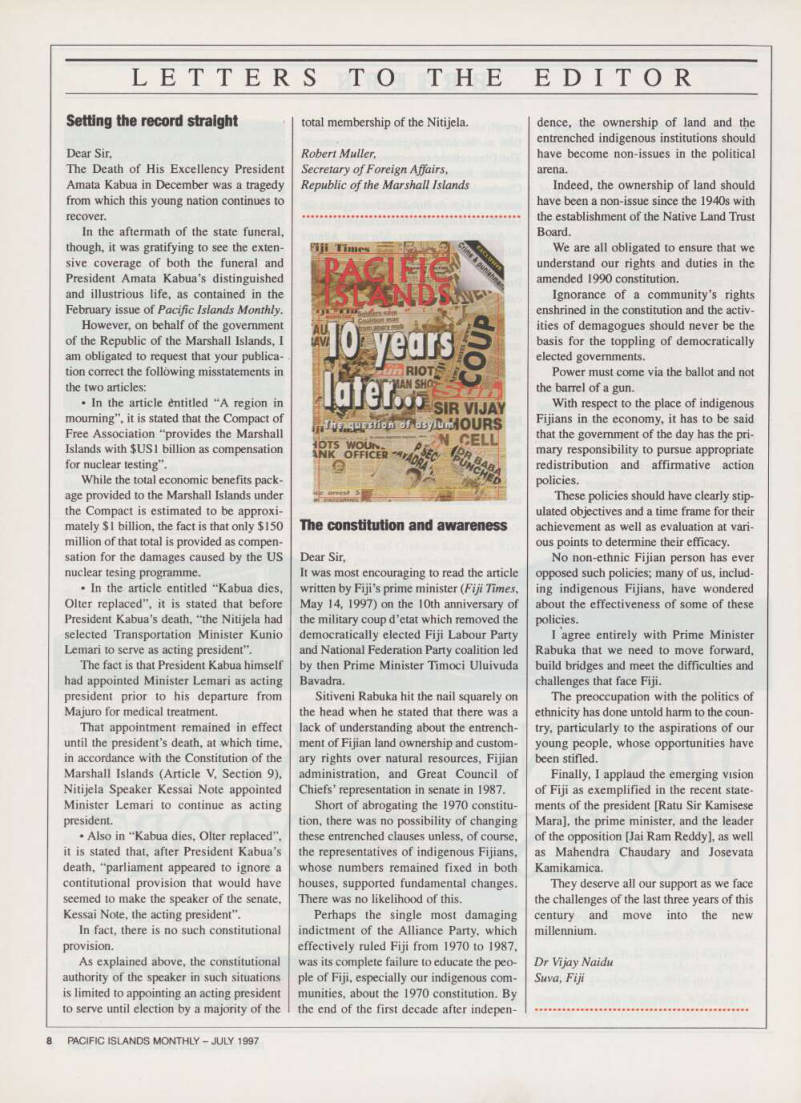
The constitution and awareness Dear Sir, It was most encouraging to read the article written by Fiji’s prime minister (Fiji Times, May 14, 1997) on the 10th anniversary of the military coup d’etat which removed the democratically elected Fiji Labour Party and National Federation Party coalition led by then Prime Minister Timoci Uluivuda Bavadra.
Sitiveni Rabuka hit the nail squarely on the head when he stated that there was a lack of understanding about the entrench ment of Fijian land ownership and custom ary rights over natural resources, Fijian administration, and Great Council of Chiefs’ representation in senate in 1987.
Short of abrogating the 1970 constitu tion, there was no possibility of changing these entrenched clauses unless, of course,
the representatives of indigenous Fijians,
whose numbers remained fixed in both
houses, supported fundamental changes.
There was no likelihood of this.
Perhaps the single most damaging indictment of the Alliance Party, which effectively ruled Fiji from 1970 to 1987, was its complete failure to educate the peo ple of Fiji, especially our indigenous com munities, about the 1970 constitution. By the end of the first decade after indepen
dence, the ownership of land and the entrenched indigenous institutions should have become non-issues in the political arena.
Indeed, the ownership of land should have been a non-issue since the 1940 s with the establishment of the Native Land Trust Board.
We are all obligated to ensure that we understand our rights and duties in the amended 1990 constitution.
Ignorance of a community’s rights
enshrined in the constitution and the activ ities of demagogues should never be the basis for the toppling of democratically elected governments.
Power must come via the ballot and not the barrel of a gun.
With respect to the place of indigenous Fijians in the economy, it has to be said that the government of the day has the pri mary responsibility to pursue appropriate redistribution and affirmative action
policies.
These policies should have clearly stip
ulated objectives and a time frame for their achievement as well as evaluation at vari ous points to determine their efficacy.
No non-ethnic Fijian person has ever opposed such policies; many of us, includ
ing indigenous Fijians, have wondered
about the effectiveness of some of these
policies.
I agree entirely with Prime Minister Rabuka that we need to move forward, build bridges and meet the difficulties and challenges that face Fiji.
The preoccupation with the politics of ethnicity has done untold harm to the coun try, particularly to the aspirations of our young people, whose opportunities have been stifled.
Finally, I applaud the emerging vision of Fiji as exemplified in the recent state ments of the president [Ratu Sir Kamisese Mara], the prime minister, and the leader of the opposition [Jai Ram Reddy], as well as Mahendra Chaudary and Josevata Kamikamica.
They deserve all our support as we face the challenges of the last three years of this century and move into the new millennium.
Dr Vijay Naidu
Suva, Fiji
French testing
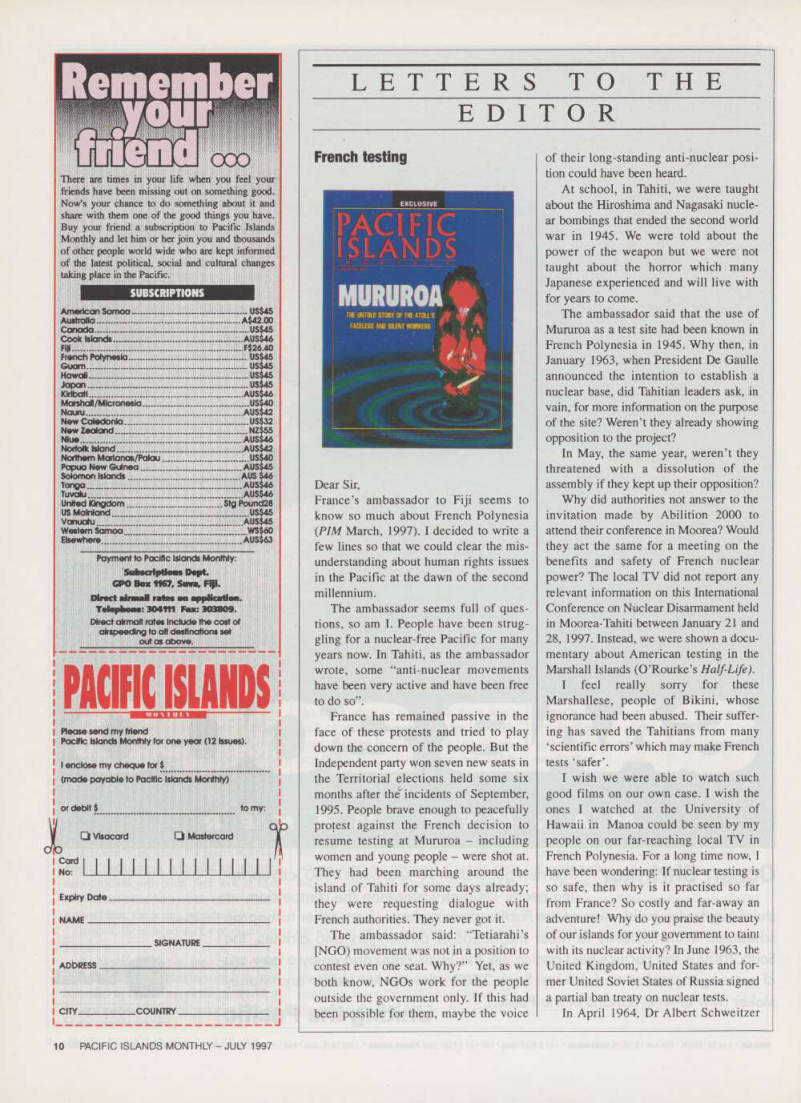
Dear Sir, France’s ambassador to Fiji seems to know so much about French Polynesia (PIM March, 1997). I decided to write a few lines so that we could clear the mis understanding about human rights issues in the Pacific at the dawn of the second millennium.
The ambassador seems full of ques tions, so am I. People have been strug gling for a nuclear-free Pacific for many years now. In Tahiti, as the ambassador wrote, some “anti-nuclear movements have been very active and have been free to do so”.
France has remained passive in the face of these protests and tried to play down the concern of the people. But the Independent party won seven new seats in the Territorial elections held some six months after the° incidents of September, 1995. People brave enough to peacefully protest against the French decision to resume testing at Mururoa - including women and young people - were shot at.
They had been marching around the island of Tahiti for some days already; they were requesting dialogue with French authorities. They never got it.
The ambassador said: “Tetiarahi’s [NGO) movement was not in a position to contest even one seat. Why?” Yet, as we both know, NGOs work for the people outside the government only. If this had been possible for them, maybe the voice
of their long-standing anti-nuclear posi tion could have been heard.
At school, in Tahiti, we were taught about the Hiroshima and Nagasaki nucle ar bombings that ended the second world war in 1945. We were told about the power of the weapon but we were not taught about the horror which many Japanese experienced and will live with for years to come.
The ambassador said that the use of Mururoa as a test site had been known in French Polynesia in 1945. Why then, in January 1963, when President De Gaulle announced the intention to establish a nuclear base, did Tahitian leaders ask, in vain, for more information on the purpose of the site? Weren’t they already showing
opposition to the project?
In May, the same year, weren’t they threatened with a dissolution of the assembly if they kept up their opposition?
Why did authorities not answer to the invitation made by Abilition 2000 to attend their conference in Moorea? Would they act the same for a meeting on the benefits and safety of French nuclear power? The local TV did not report any relevant information on this International Conference on Nuclear Disarmament held in Moorea-Tahiti between January 21 and 28, 1997. Instead, we were shown a docu mentary about American testing in the Marshall Islands (O’Rourke’s Half-Life).
I feel really sorry for these Marshallese, people of Bikini, whose ignorance had been abused. Their suffer ing has saved the Tahitians from many ‘scientific errors’ which may make French tests ‘safer’.
I wish we were able to watch such good films on our own case. I wish the ones I watched at the University of Hawaii in Manoa could be seen by my people on our far-reaching local TV in French Polynesia. For a long time now, I have been wondering: If nuclear testing is so safe, then why is it practised so far from France? So costly and far-away an adventure! Why do you praise the beauty of our islands for your government to taint with its nuclear activity? In June 1963, the United Kingdom, United States and for mer United Soviet States of Russia signed a partial ban treaty on nuclear tests.
In April 1964, Dr Albert Schweitzer
wrote, “Who ever pretends that nuclear testing is safe, is a liar.” Gratefully, we will never be able to afford to become a nucle ar power - another reason why we will never need it. We are already tattooed with its sad existence in the depth of our very selves, our fenua.
I wish my people could enjoy their beautiful islands for many more years to come. I wish you will not be abused as Pacific Islanders have been. I wish, I wish.
There are only wishes left now. The dam age has been done. However, I know we will again say to you, “ Haere mai, tipae mai I te fare nei [Come, stop by at home]” because our welcome is one thing in our tradition you have not yet taken away.
Mr Ambassador, we are not that differ ent, you and I. We are both prisoners of your hierarchy. Peacefully yours.
Bopp Maire,
Suva, Fiji
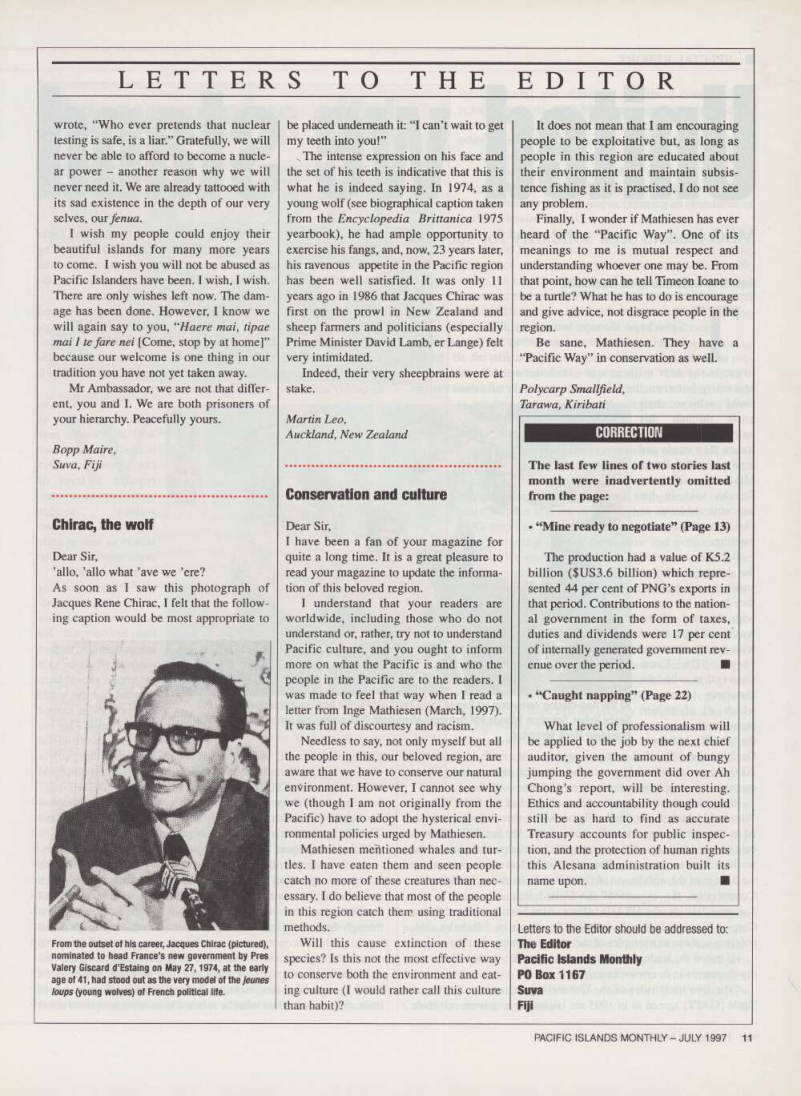
Chirac, the wolf Dear Sir, ’alio, ’alio what ’ave we ’ere?
As soon as I saw this photograph of Jacques Rene Chirac, I felt that the follow ing caption would be most appropriate to
be placed underneath it: “I can’t wait to get my teeth into you!” . The intense expression on his face and the set of his teeth is indicative that this is what he is indeed saying. In 1974, as a young wolf (see biographical caption taken from the Encyclopedia Brittanica 1975 yearbook), he had ample opportunity to exercise his fangs, and, now, 23 years later, his ravenous appetite in the Pacific region has been well satisfied. It was only 11 years ago in 1986 that Jacques Chirac was first on the prowl in New Zealand and sheep farmers and politicians (especially Prime Minister David Lamb, er Lange) felt very intimidated.
Indeed, their very sheepbrains were at stake.
Martin Leo,
Auckland, New Zealand
Conservation and culture
Dear Sir, I have been a fan of your magazine for quite a long time. It is a great pleasure to read your magazine to update the informa tion of this beloved region.
I understand that your readers are worldwide, including those who do not understand or, rather, try not to understand Pacific culture, and you ought to inform more on what the Pacific is and who the people in the Pacific are to the readers. I was made to feel that way when I read a letter from Inge Mathiesen (March, 1997).
It was full of discourtesy and racism.
Needless to say, not only myself but all the people in this, our beloved region, are aware that we have to conserve our natural environment. However, I cannot see why we (though I am not originally from the Pacific) have to adopt the hysterical envi
ronmental policies urged by Mathiesen.
Mathiesen mentioned whales and tur tles. I have eaten them and seen people catch no more of these creatures than nec essary. I do believe that most of the people in this region catch them using traditional methods.
Will this cause extinction of these species? Is this not the most effective way to conserve both the environment and eat ing culture (I would rather call this culture than habit)?
It does not mean that I am encouraging people to be exploitative but, as long as people in this region are educated about their environment and maintain subsis tence fishing as it is practised, I do not see
any problem.
Finally, I wonder if Mathiesen has ever heard of the “Pacific Way”. One of its meanings to me is mutual respect and understanding whoever one may be. From that point, how can he tell Timeon loane to be a turtle? What he has to do is encourage and give advice, not disgrace people in the
region.
Be sane, Mathiesen. They have a “Pacific Way” in conservation as well.
Polycarp Smallfield,
Tarawa, Kiribati
Letters to the Editor should be addressed to: The Editor Pacific Islands Monthly PO Box 1167 Suva Fiji
From the outset of his career, Jacques Chirac (pictured), nominated to head France’s new government by Pres Valery Giscard d'Estaing on May 27,1974, at the early age of 41, had stood out as the very model of the jeunes loups (young wolves) of French political life.