Briefs
pp. 6-7 · Read in the full issue
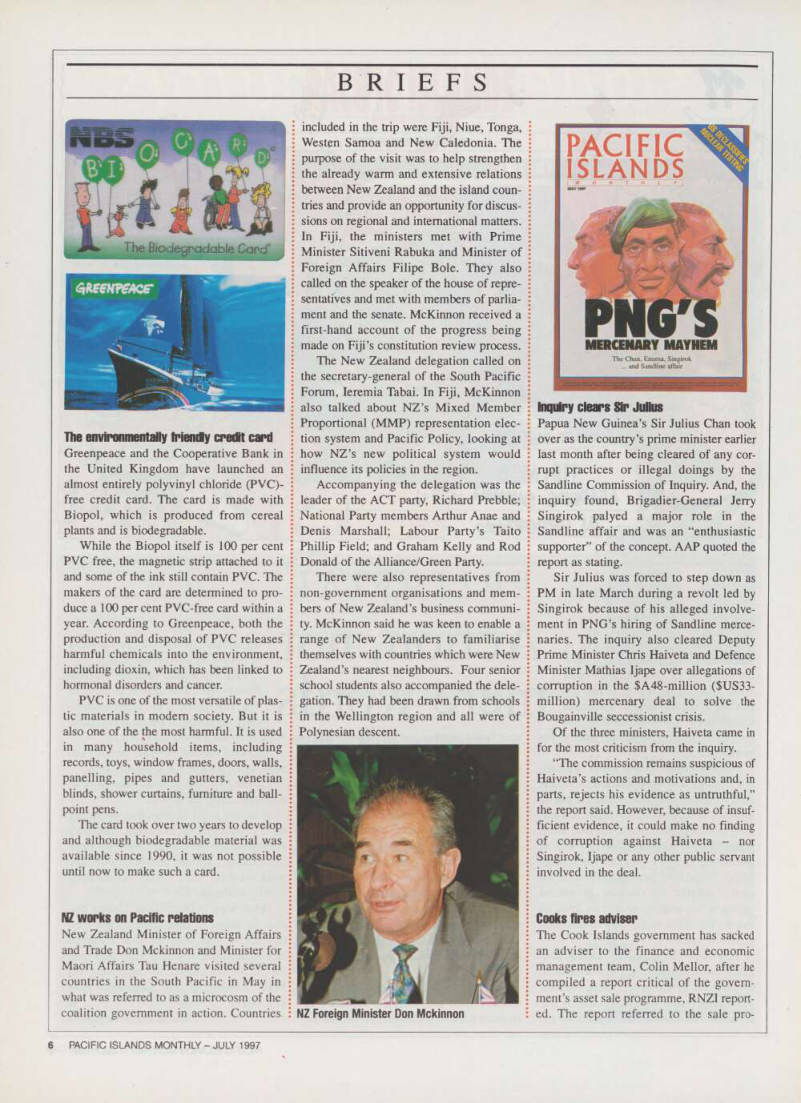

Die environmentally friendly credft card Greenpeace and the Cooperative Bank in the United Kingdom have launched an almost entirely polyvinyl chloride (PVC)free credit card. The card is made with Biopol, which is produced from cereal plants and is biodegradable.
While the Biopol itself is 100 per cent PVC free, the magnetic strip attached to it and some of the ink still contain PVC. The makers of the card are determined to pro duce a 100 per cent PVC-free card within a year. According to Greenpeace, both the production and disposal of PVC releases harmful chemicals into the environment, including dioxin, which has been linked to hormonal disorders and cancer.
PVC is one of the most versatile of plas tic materials in modem society. But it is also one of the the most harmful. It is used \ in many household items, including records, toys, window frames, doors, walls, panelling, pipes and gutters, Venetian blinds, shower curtains, furniture and ball
point pens.
The card took over two years to develop and although biodegradable material was available since 1990, it was not possible until now to make such a card.
NZ works on Pacific relations New Zealand Minister of Foreign Affairs and Trade Don Mckinnon and Minister for Maori Affairs Tau Henare visited several countries in the South Pacific in May in what was referred to as a microcosm of the coalition government in action. Countries
included in the trip were Fiji, Niue, Tonga, Westen Samoa and New Caledonia. The purpose of the visit was to help strengthen the already warm and extensive relations between New Zealand and the island coun tries and provide an opportunity for discus sions on regional and international matters.
In Fiji, the ministers met with Prime Minister Sitiveni Rabuka and Minister of
Foreign Affairs Filipe Bole. They also
called on the speaker of the house of repre sentatives and met with members of parlia ment and the senate. McKinnon received a first-hand account of the progress being made on Fiji’s constitution review process.
The New Zealand delegation called on the secretary-general of the South Pacific Forum, leremia Tabai. In Fiji, McKinnon also talked about NZ’s Mixed Member Proportional (MMP) representation elec tion system and Pacific Policy, looking at how NZ’s new political system would influence its policies in the region.
Accompanying the delegation was the leader of the ACT party, Richard Prebble; National Party members Arthur Anae and Denis Marshall; Labour Party’s Taito Phillip Field; and Graham Kelly and Rod Donald of the Alliance/Green Party.
There were also representatives from non-govemment organisations and mem bers of New Zealand’s business communi ty. McKinnon said he was keen to enable a range of New Zealanders to familiarise themselves with countries which were New Zealand’s nearest neighbours. Four senior school students also accompanied the dele gation. They had been drawn from schools in the Wellington region and all were of Polynesian descent.
Inquiry clears Sir Julius Papua New Guinea’s Sir Julius Chan took over as the country’s prime minister earlier last month after being cleared of any cor rupt practices or illegal doings by the Sandline Commission of Inquiry. And, the
inquiry found, Brigadier-General Jerry
Singirok palyed a major role in the Sandline affair and was an “enthusiastic supporter” of the concept. AAP quoted the report as stating.
Sir Julius was forced to step down as PM in late March during a revolt led by Singirok because of his alleged involve ment in PNG’s hiring of Sandline merce naries. The inquiry also cleared Deputy Prime Minister Chris Haiveta and Defence Minister Mathias Ijape over allegations of corruption in the SA4B-million (SUS 33million) mercenary deal to solve the Bougainville seccessionist crisis.
Of the three ministers, Haiveta came in for the most criticism from the inquiry.
“The commission remains suspicious of Haiveta’s actions and motivations and, in parts, rejects his evidence as untruthful,” the report said. However, because of insuf ficient evidence, it could make no finding of corruption against Haiveta - nor Singirok, Ijape or any other public servant involved in the deal.
Cooks fires adviser The Cook Islands government has sacked an adviser to the finance and economic management team, Colin Mellor, after he compiled a report critical of the govern ment’s asset sale programme, RNZI report ed. The report referred to the sale pro
NZ Foreign Minister Don Mckinnon
gramme as the biggest disappointment to date and states that while the budgeted asset sales are likely to generate about SUSI.S million this financial year, there is no expectation of attaining the largest of SUSI 2 million in unbudgeted asset sales.
The future of the Cook Islands Development Bank has been under a cloud, which has led the Asian Development Bank to abandon a technical assistance grant, according to the report. The money was to be used promote private sector growth after the government was forced to lay off most of its employees.
Australian lawyer acquitted
On May 6, Vanuatu’s court of appeal acquitted Australian lawyer Roger de Robillard, who was serving a two-month jail sentence in Port Vila’s tiny jail for con tempt of court. The sentence was pro nounced on March 27 by supreme court judge and acting Chief Justice Vincent Lunabek, who found de Robillard in con
tempt of court for failing to return case files to the attorney-general’s chambers.
The files related to a supreme court case against former British Chief Justice Charles Vaudin and the Vanuatu govern ment at which de Robillard had applied for
Lunabek’s disqualification, claiming bias.
Australian barrister Michael Adams told the court told the court of a heated exchange in which Lunabek said to de Robillard: “I hold you in contempt of my court and I will deal with you... You sit down because of your character, you just sit down ... Don’t direct my court any more.” De robillard had replied: “You have to stop that kind of behaviour. This is ridiculous.”
Fiji constitution review progress Fiji’s Great Council of Chiefs has accepted the Joint Parliamentary Select Committee Report on the constitution review. This was done at the council’s annual meeting last month where in an historic event, Jai Ram
Reddy, the leader of the opposition, made up largely of Indo-Fijians, was invited to address the chiefs. This was the first time an Indo-Fijian leader was invited to speak at the meeting.
A resolution passed by the chief of the Cakaudrove Province, Senator Ratu Talemo Raiakele, to accept the report was passed with two requests by the council: that when the council’s appointees in the senate voted on issues concerning entrenched legislation, it must reflect the wishes of the council; and that government continue negotiations with other political parties to declare Fiji a Christian state.
The JPSC has proposed the 71-member parliament comprise 46 communal seats and 25 national or open seats. The 46 com munal seats will compromise 23 Fijians, 19 Indians, three General Voters and one Rotuman. The governing political party, the Soqosoqo ni Vakavulewa ni Taukei (SVT), is proposing that the 25 open seats be contested according to provincial boundaries.