On our way to Poverty Bay
pp. 55-56 · Read in the full issue
Yachting
Story and photography by SALLY ANDREW
In Lyttleton, we bade farewell to Cruising Club manager Frank Wooley and his dog. Sailor (the canine commodore), then lis tened to another disappointing weather report.
For three weeks the wind had been blow ing from the north. We retired to bed dis gusted, and set the alarm for Sam. When we awoke, the wind seemed lighter. Our elation was short-lived. The forecast predicted northerlies of 20 knots up and down the east coast. We went back to sleep.
Two days later, we were at sea, motoring through a windless black night. Suddenly, bull kelp wrapped itself around our feather
ing propellor and we came to a thumping halt. Fellowship was dead in the water, with out wind to sail and no auxiliary propulsion.
Fortunately, the Kaikoura Peninsula was miles away, so we drifted during the long hours of darkness. At sunrise, we managed to cut the kelp and free the prop, and contin ued our northbound trek to Poverty Bay.
Mid-moming, we witnessed an eclipse of the sun.
The shipping lanes off New Zealand’s east coast are busy and, at night, dangerous.
Near Cape Campbell, the lights'of a south bound ship passed much too close before dis appearing quickly over the horizon. Then, a large ship, headed towards Cook Strait, crossed our bow. A good lookout is manda
tory. Off the notoriously windy Wairarapa
coast, our sails hung limp - not a zephyr of a breeze stirred the water. We motored slowly northwards. Moments before sunset, we moored Fellowship to the seawall at Napier Boating Club.
I had just started breakfast when Fellowship lurched over and crashed side ways into the dock. I leapt on deck and found that Napier Harbour was experiencing a tidal seiche - a mini-tidal wave. The tide had dropped a foot in mere minutes. It wouldn’t have been a problem except that it was low tide and Fellowship was already sitting in the mud. Over we went, leaning into the sea wall at a precarious 25-degree heel, our ton nage resting on a lifeline stanchion.
Mayhem below decks. Everything that I’d carefully laid out on the galley counter-
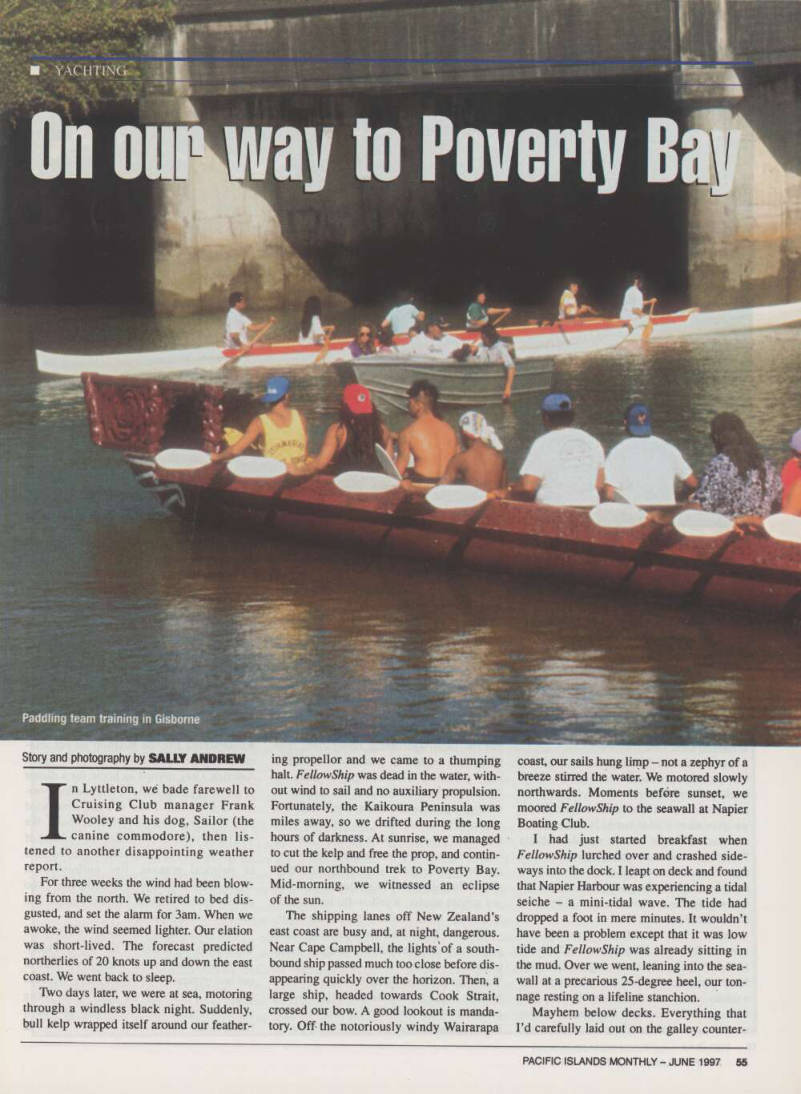
Paddling team training in Gisborne
top - eggs, toast, pots, plates - slid with a crash. Foster tried pushing Fellowship away from the wall. Standing on the high side was equally useless. Only when the water sud denly rushed back in, almost as fast as it had left, did Fellowship right herself. Ten min utes later, it dropped and rose a second time.
Quick repositioning of jerry jugs meant we fell over in the opposite direction, away from the seawall, with a bang and a boom, again, below decks. Day sailors, who were coming in the harbour at the same time, said they had experienced some weird and wicked currents in the entrance. I bet they did.
Local rain and flooding had set logs and clumps of trees adrift in Hawkes Bay.
Luckily, Taupo Maritime Radio reported the position of these hazards to navigation and we gave them a wide berth. Nonetheless, in the dead of night, as we rounded Mahia Peninsula, we side-swiped a log which hit us three times as we charged through a black, moonless night under greatly reduced sail. It was impossible to slow down in 30 knots of southwesterlies.
After 17 hours of scary sailing, we entered Gisborne harbour. An old friend, Father Phil Keane, came to greet us, arms filled with stacks of personal mail, boxes of cookies, bars of chocolate. It felt like Christmas. By contrast, Captain Cook was unable to obtain even bare necessities like
fresh water and wood to replenish his ship, Endeavour. Consequently, he saddled the area with the name Poverty Bay - a sore point to this day with many of the tangata whenua (local people).
Forty-five-knot winds and thunderstorms were forecast so we stayed in port. Two northbound Kiwi boats, Strider and Sequel, took shelter too. They tied up alongside the dredge Pukunui. Ham radio operator Grey Crone and his old dog (also named Pukunui) invited us for a home-cooked lunch.
Facilities for visiting yachtsmen are poor, but the local welcoming committee, John McFarlane on Janine, endeavours to make a stay pleasant. His one-page guide to Gisborne’s facilities includes the location of water, telephones, chandlers, repair facilities, supermarkets, and fuel. On the wharf, the
Gisbome-Tatapouri Sports Fishing Club was
organising a fishing tournament. Club mem ber Doug Kerr drove us to Tatapouri’s bay side clubhouse where huge stuffed gamefish - a striped marlin, a yellow-fin tuna and an 800-pound black marlin - dressed the walls.
Many of Gisborne’s predominantly Maori population are dedicated outrigger canoe paddlers. Teams train daily on the Turanganui River. Local carver and canoe builder Matahi Greg Brightwell, founding
president of the Maori/Polynesian Outrigger
Paddling Federation, has prosyletised the fit
ness benefits and cultural relevance of pad dling for over 10 years.
Brightwell has powerful mana and is a strong, if controversial, character. He was the first Maori in modem times to build a voyag ing canoe and sail it across the Pacific.
“A dream commanded me: ‘Build a sacred canoe, sail the olden route, repair the spirit road broken for seven generations...’”
In 1985, Brightwell sailed Hawaiki-Nui from Tahiti to New Zealand unescorted. With him was his father-in-law, Francis Puara Tuarongo Cowan, who, decades before, had accompanied Eric de Bisshop on his infa mous voyage by raft from Tahiti to South America. Greg invited us home for a dinner of chicken, puha, kumara and roasted pota toes and rewena. Puha is a delicious wild herb used in Aotearoa to flavour foods. We watched a video documenting his building of a magnificent 145’ waka taua which, because of political reasons, lies unfinished at Whangara. On the floor, one of his sons (who already speaks English, French, Tahitian and Maori) studied Japanese.
The following day at dawn, we sailed out of the harbour, bound for the Bay of Plenty.
As we departed, I could’t help but wonder if our last impression of Poverty Bay had been Captain Cook’s first: the light of the rising sun dancing on the white cliffs of Young Nicks Head. ■
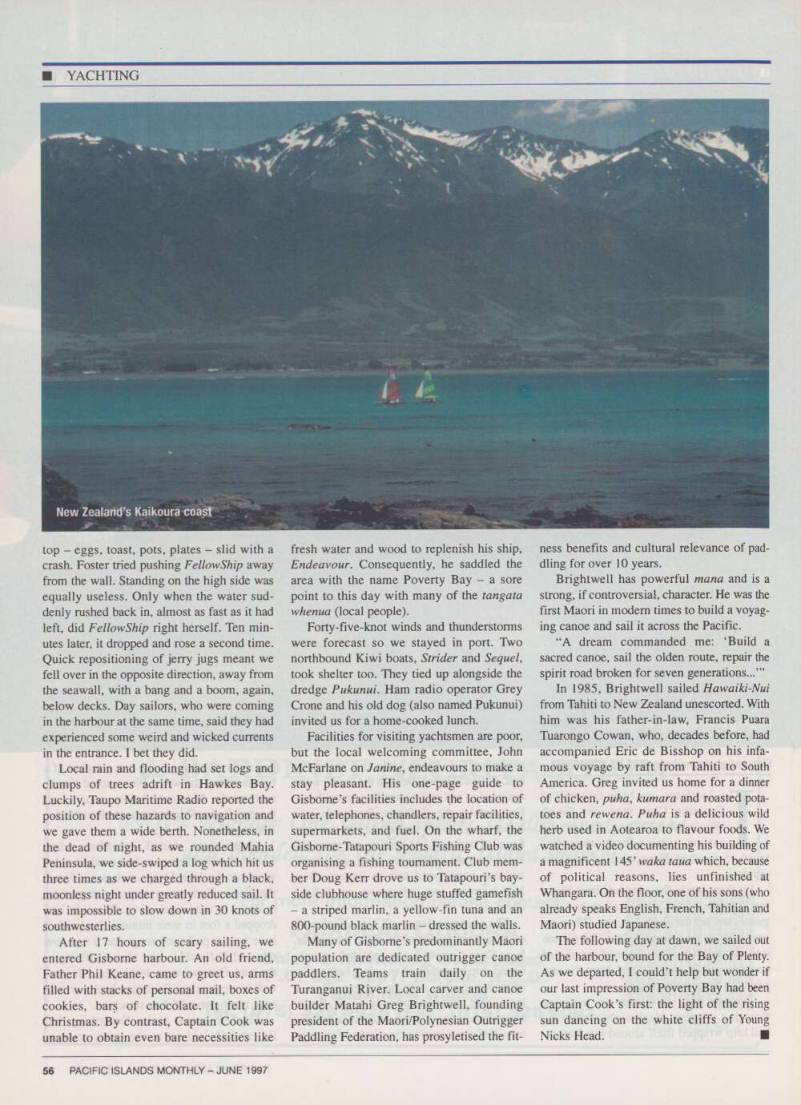
New Zealand’s Kaikoura coast