Fiji's prison
pp. 15-17 · Read in the full issue

Cover Stories
Exclusive
scandal
Investigations begin into allegations of drug dealing, nepotism and corruption behind Suva’s prison walls
By Bernadette Hussein
Fiji, which is at present trying to deal with allegations of corruption within its Customs Department (See page 18), must also contend with a prison scandal. Investigations by Pacific Islands Monthly have uncovered allegations of drug dealing, nepotism, abuse of office and cover-up of information at Suva Prison, in the country’s
capital.
A letter, dated April 4, 1997, and signed simply “Prison Intelligence Unit”, was sent to Fiji’s perma nent secretary for home affairs, Apisolome Tudreu.
The letter made serious allegations against the prison and did not stop short of naming names. It claimed bribery was rife, that there was a lack of discipline among prison officers and that prisoners moved freely around the security bay with no control over their movements to the visiting area.
Tudreu passed the letter on to the commissioner of prisons, Aisea Taoka, who, admitting to the prison’s drug problem, told PIM that investigations into the allegations had started. The investigating officers are from outside Suva Prison and are expected to inter view both officers and prisoners.
The anonymous letter writer said it was of the utmost urgency that Tudreu be informed of the situa tion at Suva Prison because things were escalating to a very “dangerous level”.
“Drug dealing among prisoners is common.
Prisoners are in possession of very large sums of money inside the prison to buy drugs and sell to oth
ers,” the letter stated. “Very recently, the Emergency Control Unit had to dig out a supply of drugs buried with a large sum of money from outside the jail.”
“Yes, there is a certain amount of drugs being found among prisoners and appropriate disciplinary actions have been taken against them,” Taoka con firmed.
But how do the drugs find their way in? Are visi tor security checks not thorough enough?
“Oh no, we still have security checks and these are quite thorough,” Taoka replied. But, over the years, the visitors have developed a system whereby they are able to smuggle these drugs in.
“It happens. It is the culture of prisons in the coun try - contraband items get in. We are still trying to find out how, as gifts and other parcels brought in - as well as the visitors - are checked.”
According to the letter, drugs were exchanged in the visiting area - where supervision of prisoners’ movements was lax. But Taoka is quick to deny this, saying the close proximity of officers to prisoners would not allow this.
On being asked why the problem was allowed to continue, Taoka replied: “I agree that it has to stop especially in a place of law and order but then that is the perfect situation we are talking about. These are the places that people least expect these sorts of things to happen but, yes, they are happening.
“A lot of things happen in prisons which we hear of and try to nip in the bud.” Taoka would not elabo rate on what these “things” were, but added that the problems were many.
“As for prisoners who are caught in possession of
drugs - they are reported to the police who charge them. These sentences often run consecutively with their time in prison sometimes they are added on.”
The letter goes on to claim that a pris oner who presented a superintendent with a tabua (whale’s tooth - highly valued in indigenous Fijian culture) and a bundle of fish, was soon after released on extramural duties.
The superintendent was also accused of nepotism, which the letter said was a major problem in the department. The letter claimed relatives of the superintendent were considered for promotions over deserving officers. Taoka, who said he was looking into this matter, qualified his state ment by adding that nepotism existed “in
all organisations”.
“There are businesses which employ family members to work for them. That is nepotism to the core. In a country as small as Fiji, most companies are run by families and everyone is related to the next person and, in some cases, it is unavoidable.”
He said nepotism occurred in govern ment departments as well as the private sector. When asked if its prevalence was its
justification, Taoka replied: “No, it’s not OK. We are related to people in one way or another and everybody needs to work but we should try to get the best people into the system. “People should not come in just because they are related to us.
“[But] first we have to find out if it is happening and, if it is, then we have to solve this problem in a diplomatic way.”
The letter alleges that one of the offi cers (who is a relative of the superinten dent in question) “was transferred from
another island to Suva because of house breaking, criminal trespass and attempted rape”.
“He was arrested and charged and he has already appeared in court. Early this year, the same officer was in charge of a cemetery work party when a newly issued lawnmower went missing.”
This officer was also reported to have grievously wounded a prisoner with a file in Suva, the letter continues, alleging that the police investigating officer who was
“Yes, there is a certain amount of drugs being found”
Commissioner
“A lot of things happen in prison”
looking into the case was later seen drink ing with this officer at one of the local clubs. The officer was also a close associ ate of another prison officer who abscond ed to New Zealand while on trial in Fiji, the letter stated. The two were seen at a local club the night before he left, the letter writer claimed.
There were also allegations of the superintendent being bribed with cartons of beer to help in promotions. The officer is regarded as a security risk and is alleged to have been involved in a grave scam where grave plots were being sold to help repay a personal loan, the letter writer claimed.
“He is telling us, his subordinate offi cers, things about other officers.
Something which he should not do. He is the same person who told people that the relationship between the former commis sioner of prisons and the deputy commis sioner of prisons was bad,” the letter stated.
The writer said the superintendent also told some prisoners and officers during a prison inquiry to highlight the “bad work ing relationship” between the then com missioner of prisons and his deputy which he (the writer) suspects was done to tarnish the reputation of both the officers. “For an outsider, everything is OK. But for some one like me, who is inside, it is like a lull before the storm.”
There are also allegations of another prison officer who while on duty on April 6, went out to a church to preach without making arrangements to be relieved. Taoka said these were serious allegations and, if they were true, the officers named would face serious disciplinary action.
The letter stated that several new offi cers were being used as carriers of unau thorised goods and information to and from
the prison. It said that these were usually officers who were unable to effectively deal with hardenend criminals.
“The new prison officers are just grow ing into the job, so to speak, and confi dence comes with experience. These offi cers, over time, will have that sort of expe rience and confidence which will help make them efficient prison officers. “You need to be thick-skinned to do the job
effectively.”
But Taoka added he was looking very closely into this and said he required proof before any further action could be taken.
“From what I have seen and exprienced the two groups [officers and prisoners] have been getting along quite well. Look at the prisoner-to-officer ratio which we have.
Sometimes, we have one officer taking a working party of 10 prisoners and, by the end of the day, they all come in.”So how
does he explain prisoners escaping from
working parties?
“Well, those are isolated cases because we don’t have a large number of
prisoners escaping from working parties.
In fact, the number is very small.” Among the problems highlighted by the letter was the general lack of security, and especially that the security bay was becoming a gath ering area for prisoners. “Presently, any prisoner may enter the security area at any time without restriction,” it said. However, Taoka retorted that this was highly
unlikely.
“Prisoners go into the security bay area when there is business to be done in the administration block. I am not denying that prisoners don’t have access, yes they do, but it’s controlled access. “That area is under lock and key and the officer in charge at the time ensures that the prison er coming into the security bay area requesting entiy has approved business in
the area.” According to the letter, the prob lem at the prison is not merely poor man agement. The letter writer expresses con cern that certain information is not report ed to higher authorities. The letter cites the example of a prisoner who escaped through the main gate. He had been readmitted after an earlier escape.
According to the letter, the prisoner was allowed unsupervised within the security area. He saw the gatekeeper open the main gate and he escaped, the letter stated.
Neither the Ministry of Home Affairs nor the media were given this information, the letter claimed.
The letter paints a picture where prison ers are gaining the upper hand and ordering officers about. The situation was getting out of hand and, although the management was fully aware of the situation, nothing was being done, the letter writer claimed.
The letter likened the situation to that before the prison riots in late 1979 and 1980 when there were prison breakouts around the country.
Referring to the alleged problems, Taoka said he could only speak from when he was given charge of prisons - which was June, last year. “In the past I would imagine there would have been complaints yes. There have been two prison riots, one in 1965 and the other in 1979-1980. The riots were a result of complaints and prob lems not being addressed.”
Taoka said he did not see the need for an inquiry. “There have already been six inquiries and most of the recommendations have been implemented but there are still some left.” Taoka himself has not been spared in the letter, which claims the majority of prison officers were “fed up” with his public comments on the things he was going to do to improve the situation.
It said Taoka was trying to please the officers by telling them of his plans, but which had still not been implemented.
“The public comments are related to my efforts in planning the improvement and upgrading of the prison system and its infrastructure,” he said. “Obviously, these things will take time to happen as they can not be done overnight. I have to work with the Ministry of Home Affairs and the polit ical leaders about what is to happen and these things take time.
“If they have a little more paitence and wait, they will see it happening.”
However, the letter writer feels differ ently and insists “drastic actions are urgently needed”. ■
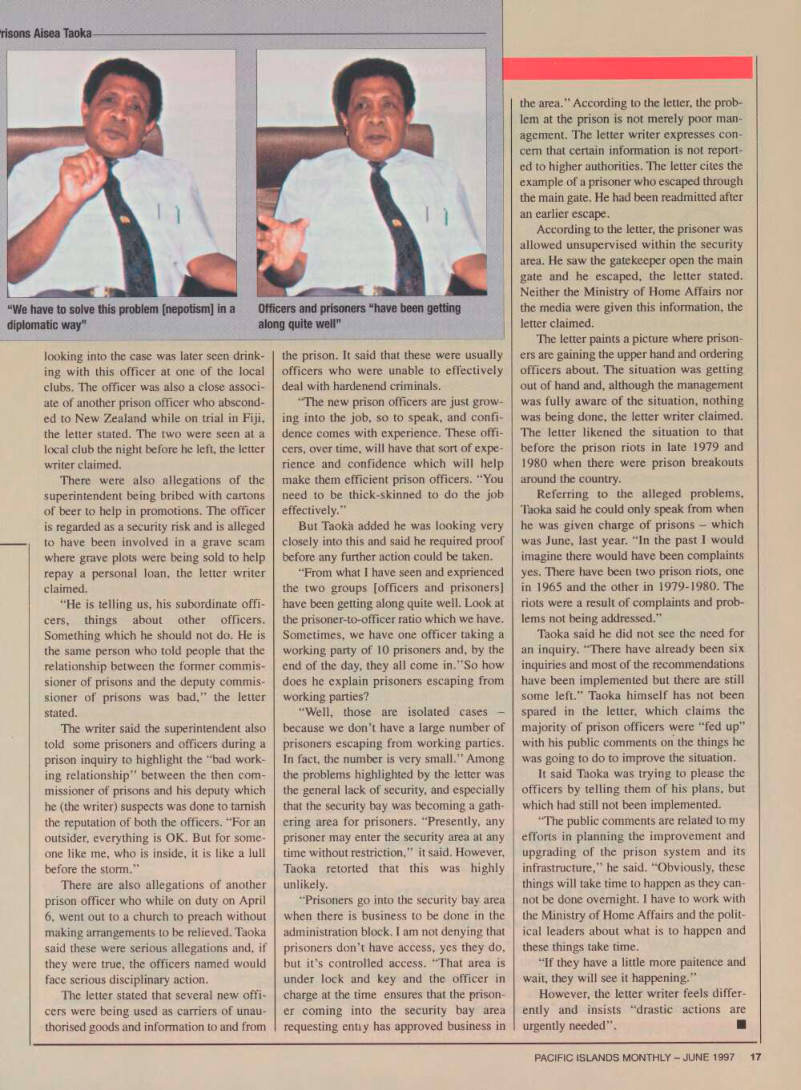
Prisons Aisea Taoka
“We have to solve this problem [nepotism] in a diplomatic way”
Officers and prisoners “have been getting along quite well”