and mining
pp. 11-12 · Read in the full issue
Special Report
Mercenaries and mining
Investigations into PNG’s Sandline scandal find link with Fiji’s Emperor Mines
By Alfred Sasako
Until March this year, little was known in the South Pacific about mercenaries - how these soldiers of fortune operate, who is behind them and the dodgy government deals from which they might make their millions. But the aborted attempt by Sir Julius Chan of Papua New Guinea to engage Sandline mercenaries on Bougainville has lifted the lid off their wheelings and dealings.
What has emerged is a tangled web of interconnections involving individuals, politicians, mining companies, soldiers of fortune and get-rich-quick schemes in the world of mining.
An investigation by Australia’s Radio National in a programme called Background Briefing has uncovered the tangled web of often complex interconnections. And some of these companies have links much closer to home than many have realised.
It is important to note that there is nothing legally wrong with these interconnections or with the fact that people in the mining industry have interests in many ventures, according to Background Briefing.
“The danger and the fascination with it all is that the risks - polit ical, military, geological - and the corruption and dodgy deals with dodgy governments are not seen as obstacles to business,” it said. In this case, one man’s name stands out - with links to mining compa nies, including Emperor Gold Mines in western Fiji - in a “tangled and complex web of companies and associations”.
That man, according to Background Briefing, is a Robert Friedland who owns a SA9-million ($F6.9-million) home in the Sydney suburb of Point Piper.
But who is he and who are the people around him? Friedland is a Canadian citizen and Australian resident whose corporate empire spans nearly the whole globe with offices in Australia, Canada and
Singapore.
In the mining industry, Friedland is nicknamed and known to some people in the industry as “Toxic Bob” because, in 1989, his gold mine in Summitville, in the United States, was found to be “one of the 10 most toxic sites in the USA”.
The US taxpayer has so far had to pay well over SUSIOO million in the ongoing clean up. The flamboyant mining entrepreneur is yet to make his contribution. And to this day, the US Justice Department is chasing “Toxic Bob” for a reported US$l5O million to help clean up the Summitville site.
Friedland has been active in the mining industry since the 1980 s.
In 1996, he made SUS6OO million when he sold his claim to the world’s richest nickel deposit in Voisey Bay in Labrador, Canada.
In recent years, Friedland has recruited the best and the brightest from the world’s big mining and investment houses, including those from the Hong Kong office of Jardine Fleming Bank.
Incidentally, Jardine Fleming is the firm Sir Julius approached to manage PNG’s proposed buy-out of RTZZ-CRA’s stake in the Panguna Copper mine on Bougainville.
One of the top executives Friedland has on his management team at Ivanhoe Capital (Friedland’s private company) is an Australian mining engineer by the name of Gordon Toil, a former mining exec utive with RTZ. Ivanhoe Capital is based in Singapore.
Today, Toll is the executive vice-president of Indochina Goldfields, a company listed on the Sydney Stock Exchange with investments in Burma, Vietnam and Fiji.
Toll is also chairman of another company called Australian Bulk Minerals. All these companies are connected to Friedland, accord
ing to Background Briefing.
But there’s more.
During investigations. Background Briefing discovered that Diamondworks, an associate company of Friedland’s, bought Branch Energy last year. Branch Energy is the mining company most closely associated with Executive Outcomes, Sandline International and Colonel Tim Spicer - the brain behind PNG’s
SUS36-million aborted mercenary deal.
In a controversial report prepared for Carson Gold (now Diamondworks), there is an interesting reference to the hotly denied closeness between mining and mercenaries. The report, prepared at the time Spicer and others were discussing the PNG deal, states that “both Sierra Leone and Angola have been under the duress of civil war, but peace has been achieved largely through military assistance provided by Executive Outcomes, Branch Energy’s parent company, to the governments of these countries”.
It is a controversial statement because it says what has always been denied: that Executive Outcomes, the mercenary company, owns Branch Energy. Hereon, the tangled and complex web of com panies and associations deepens. Records at the Vancouver Stock Exchange show that Diamondworks is listed there as a company.
Last October, Tim Spicer of 535 King’s Road, London, was granted 10,000 options to buy shares in Diamondworks. Spicer’s London address is also the address for Sandline International and Branch Energy. The granting of stock options to Spicer and other mining and mercenary employees was done under a section of the Securities Act of British Columbia, Canada.
It states that “certain persons who although in form are indepen dent contractors, in substance are employees”.
“It seems [that] when Branch Energy wanted to raise finance to expand, they headed for Canada, where they made contact with
Robert Friedland,” Background Briefing stated. Whiat do those behind mining companies closely associated with mercenaries look for as they scout around for opportunities, especially iin the Asia- Pacific region? What is their aim and when do they make their swoop?
Edward Hood, a director of Emperor Mines in Fiji and president of Indochina Goldfields, provides some insight for us in a corporate video.
Flood explained: “As a fund manager in San Fracisco, we looked at mining opportunities around the world [and] the Emperor Mine is the classic type of opportunity you are looking for.
“You are looking for a mine that is undervalued in terms of its comparable companies, it is undervalued in terms of the resource base that exists at the time, and it is undervalued in terms of what its future production is going to be. And the Emperor Mine fits that bill in all cases. It is a mine that has a growing production, it has pro jector costs which will be coming down, but it has a tremendous resource base to be able to grow from.”
It seems they had these areas were well covered when the Vatukoula mine began operations. And, according to Background Briefing, Indochina Goldfields told its shareholders in the Sydney Stock Exchange last December that its aim was to “create a large and growing presence in the Asia-Pacific and to become a major low-cost copper producer.” ■
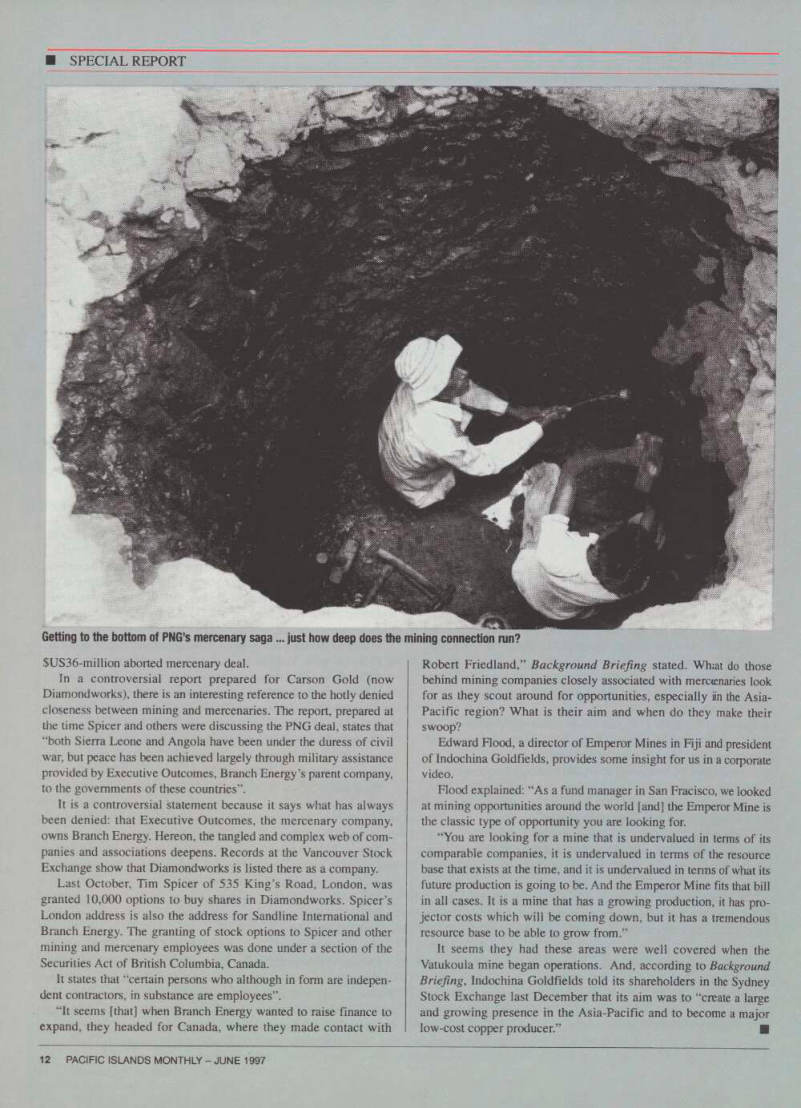
Getting to the bottom of PNG’s mercenary saga...just how deep does the mining connection run?