Decolonisation vs recolonisation
Dear Sir, When political party leaders tell Gabriel Tetiarahi what wonderful things they will do if they get elected he replies, “Your coconuts are too high!” Like many grass roots organisers in the Pacific, Tetiarahi is deeply suspicious of state power and those who would climb into its seats. He prefers leaders who come down from the coconut tree and talk with the people whose inter ests they claim to represent.
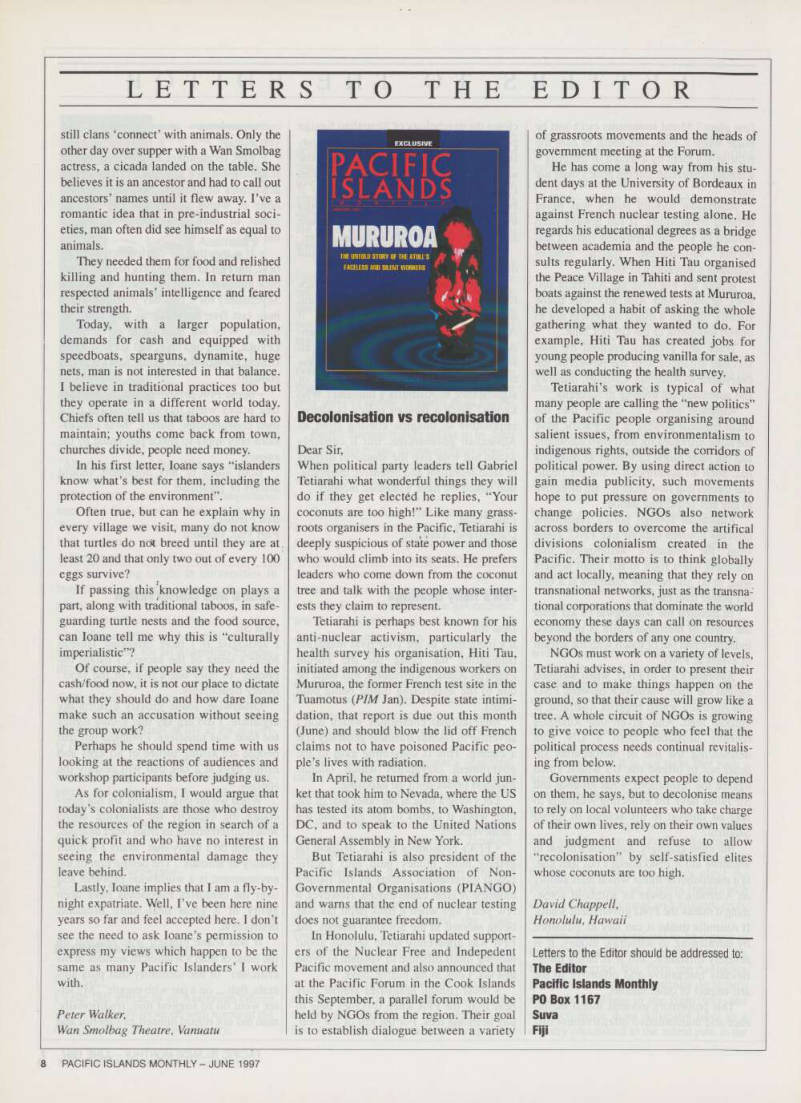
Tetiarahi is perhaps best known for his anti-nuclear activism, particularly the health survey his organisation, Hiti Tau, initiated among the indigenous workers on Mururoa, the former French test site in the Tuamotus ( PIM Jan). Despite state intimi dation, that report is due out this month (June) and should blow the lid off French claims not to have poisoned Pacific peo ple’s lives with radiation.
In April, he returned from a world jun ket that took him to Nevada, where the US has tested its atom bombs, to Washington, DC, and to speak to the United Nations General Assembly in New York.
But Tetiarahi is also president of the Pacific Islands Association of Non- Governmental Organisations (PIANGO) and warns that the end of nuclear testing does not guarantee freedom.
In Honolulu, Tetiarahi updated support ers of the Nuclear Free and Indepedent Pacific movement and also announced that at the Pacific Forum in the Cook Islands this September, a parallel forum would be held by NGOs from the region. Their goal is to establish dialogue between a variety
of grassroots movements and the heads of government meeting at the Forum.
He has come a long way from his stu dent days at the University of Bordeaux in France, when he would demonstrate against French nuclear testing alone. He regards his educational degrees as a bridge between academia and the people he con sults regularly. When Hiti Tau organised the Peace Village in Tahiti and sent protest boats against the renewed tests at Mururoa, he developed a habit of asking the whole gathering what they wanted to do. For example, Hiti Tau has created jobs for young people producing vanilla for sale, as well as conducting the health survey.
Tetiarahi’s work is typical of what many people are calling the “new politics” of the Pacific people organising around salient issues, from environmentalism to indigenous rights, outside the corridors of political power. By using direct action to gain media publicity, such movements hope to put pressure on governments to change policies. NGOs also network across borders to overcome the artifical divisions colonialism created in the Pacific. Their motto is to think globally and act locally, meaning that they rely on transnational networks, just as the transna tional corporations that dominate the world economy these days can call on resources beyond the borders of any one country.
NGOs must work on a variety of levels, Tetiarahi advises, in order to present their case and to make things happen on the ground, so that their cause will grow like a tree. A whole circuit of NGOs is growing to give voice to people who feel that the political process needs continual revitalis ing from below.
Governments expect people to depend on them, he says, but to decolonise means to rely on local volunteers who take charge of their own lives, rely on their own values and judgment and refuse to allow “recolonisation” by self-satisfied elites whose coconuts are too high.
David Chappell,
Honolulu, Hawaii
Letters to the Editor should be addressed to: The Editor Pacific Islands Monthly PO Box 1167 Suva Fiji