Nipping corruption
pp. 5-14 · Read in the full issue
Editorial
Nipping corruption in the bud
Three months ago.
Pacific Islands
Monthly highlighted
allegations of vio lence, corruption and drug dealing at Papua New Guinea’s Bomana jail (“Crime and Punishment”
March, 1997).
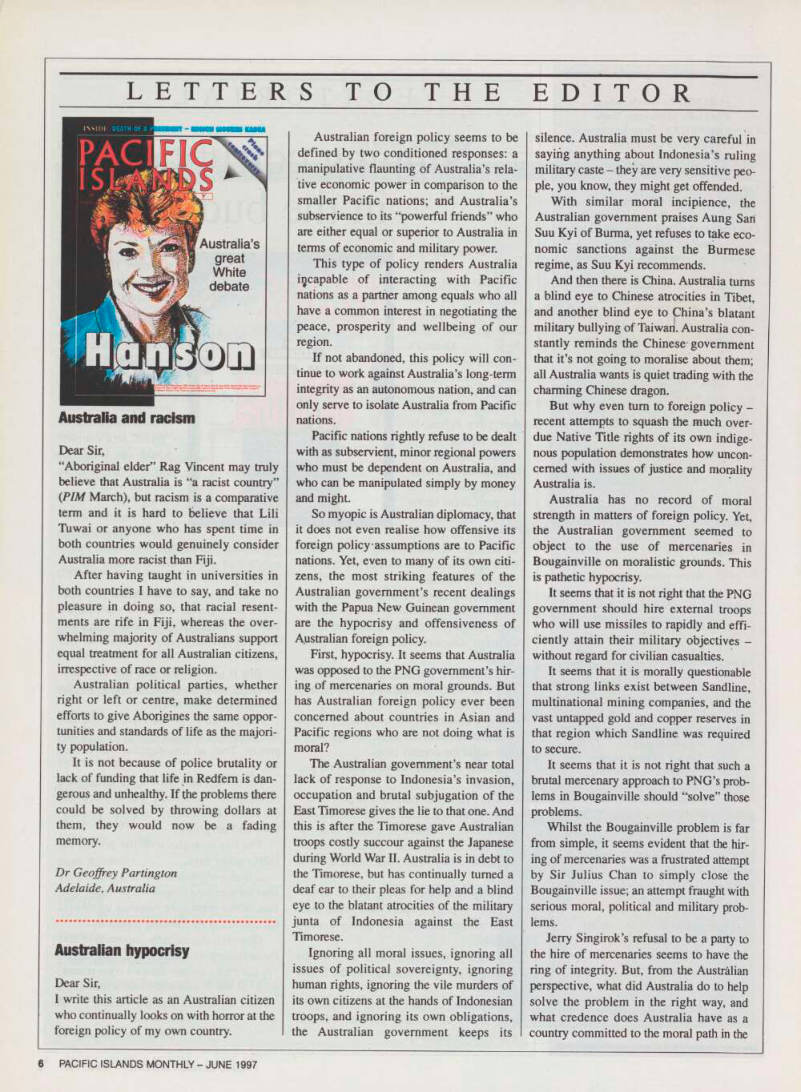
Now, it appears that Suva Prison, in Fiji’s capital, is in a similar situation highlighted in a letter mysteriously sent to the permanent secre tary for home affairs.
Fiji is, of course,
no stranger to corruption; the National Bank of Fiji scandal is enough to put to rest any debate on that.
But allegations of prison corruption, which come fast on the heels of a commis sion of inquiry into fishy goings on in the Customs Department, cannot be taken lightly.
Certainly, it can be argued, corruption exists in every department, country and region in the world.
Fiji’s commissioner of prisons, Aisea Taoka, states as much when he says nepo tism is rife the country over.
But, as Taoka also admits, this is no jus tification.
The Prisons Department is part of the nation’s law and order system. And every effort must be made to ensure that the enforcers of law and order are above reproach. Else, what hope is there for a nation?
Just why are the region’s people so sus ceptible to petty bribes? One senior cus toms officer admitted to taking a mere
Sfsooo.
Could it have anything to do with the generally low pay structure in the South Pacific?
According to one Customs officer, offi cers in Fiji are earning between SFSOOO and SFBOOO annually.
Fiji’s permanent secertary for labour, Anare Jale, claims there may be reasons other than low wages behind civil servants accepting bribes, and points his finger at
“greediness”.
However, it cannot be disputed that there is more temptation to “greed” in a country where the levels of pay do not live up to the high costs of living A Senate Select Committee report on
Fiji’s police force last year found that a number of police officers were on the poverty line.
A series of prison breakouts last year saw a huge public outcry in the country leading to the replacement of then commis sioner of prisons, Apolosi Vosanibola, with Taoka.
This is not the first time that the coun try’s Prisons Department has come into the spotlight of controversy.
Allegations of prison rape, highlighted last year, have still not been proven or dis proven. True, an investigation was carried out.
But the last the public heard, files of the investigation were being shuffled between the office of the director of public prosecu tions and the police.
The file now sits with the police, the DPP’s office says.
It is all very well to conduct one inquiry after another into allegations of shady deal ings, which seem to be cropping up all over the country with alarming regularity.
However, it is equally important to take the necessary measures to “nip” corruption “in the bud”, to use Taoka’s own phrase.
And, as the concerned letter writer says, “drastic actions are urgently needed”. ■
• Cover stories on page 14