Marshalls' taurism
pp. 24-25 · Read in the full issue
takes (scuba) dive
Optimism. That’s the operative word among tourism promoters in the Marshall Islands these days. It hasn’t always been like this. This is a country that’s been lucky to have five or six hundred tourists arrive in a year.
In 1996, however, overall tourist statis
tics jumped by 60 percent; the num ber of scuba divers heading to Bikini will triple this year com pared to last year; the first package tour of sports fishermen from the United States arrived in March, with more to fol low; and a joint effort by Continental Micronesia and Taiwanese pack age wholesalers is attempting to develop the Marshalls as a destination for Taiwanese visitors.
Sure, for this North Pacific nation’s economy
as a whole, tourism is still the equivalent of a six-room motel on a backroad. But the government is putting some teeth in its tourism marketing, and with support from the Asian Development Bank and expansion of local facilities and package tours, the Marshall Islands finally has something with which to lure visitors.
Before concluding its session in
March, the Nitijela (parliament) approved
legislation creating the Marshall Islands Visitors Authority as an independent body
directed by a board that is dominated by private-sector representatives. “The gov ernment is firm in its commitment towards securing the necessary invest ment for developing this industry and to creating the ideal environment and condi tions for its growth,” President Imata Kabua said in a state of the nation address to the parliament the day that the visitor
authority was established.
“Although our tourism sector is relatively young, it has already demonstrated the capacity to gener ate as much as
Sus 4 To Sus 6
million a year”, he said.
“Estimates indi cate that the num ber of visitors per year can increase from last year’s 6000 to 15,000 by the year 1999.”
ADB tourism adviser Jan
Bjamason says
that 15,000 tourists a year by 2000 is more than
possible. “We’re
focusing our mar keting on tour
wholesalers in a systematic way,”
Bjamason said.
Previously, there was no system for dealing with tour operators’ inquiries and, likely as not, any letters or calls went unanswered, as sure a way as any to tor pedo a visit industry.
With the Visitors Authority in motion, it now receives many inquiries from wholesalers about possible tour options, Bjamason said.
“Before, nobody did any marketing
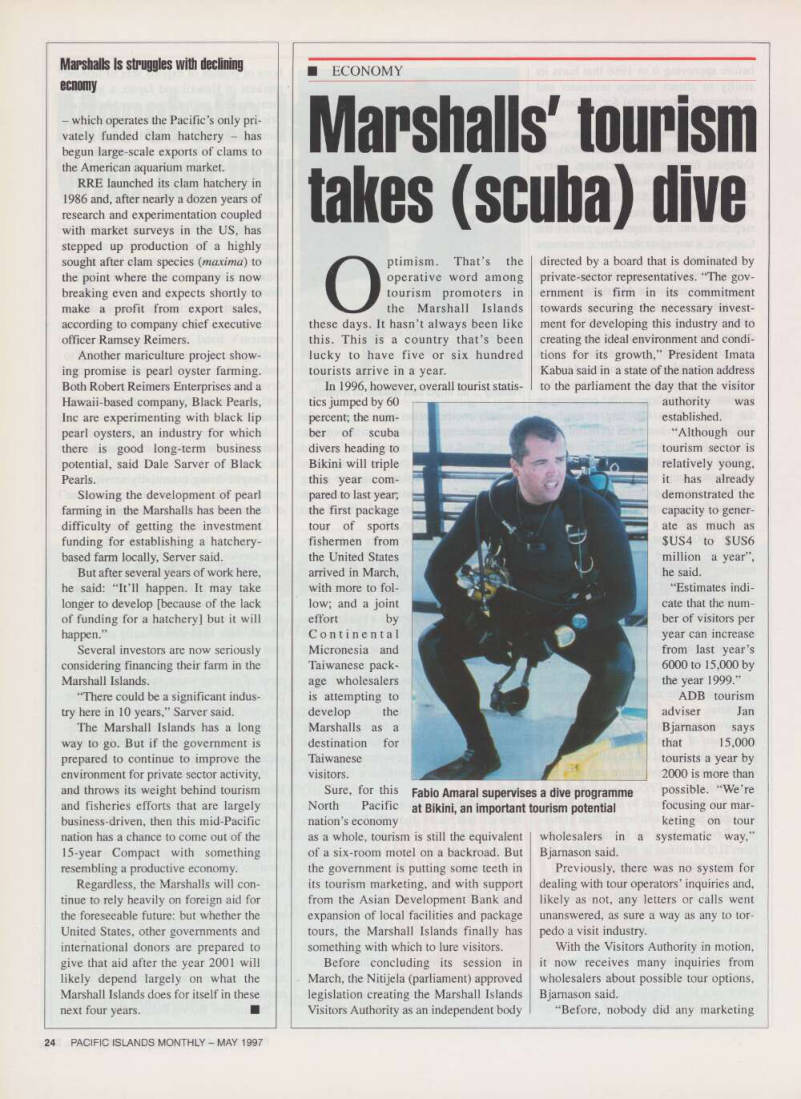
Fabio Amaral supervises a dive programme at Bikini, an important tourism potential
Marshalls' tourism takes a (scuba) dive
because there was nothing to sell,”
Bjarnason said. Now, Marshalls Dive Adventures has scuba dive programmes operating on Bikini, Mili, Arno and Majuro atolls, the Honolulu-based Outrigger Hotels is managing the govern ment’s 150-room hotel in Majuro and is promoting the Marshalls through its established network and, for the first time, Continental Micronesia is promoting the Marshalls as a destination, Bjarnason said.
Scuba diving, big game fishing, water sports and World War II relics are the main attractions that the Marshalls has.
“Because of its distance from major visitor markets (in Asia and the United States) and the relatively high expense of getting here, the Marshall Islands must offer something unique to attract visitors,” he said.
At the top of the list is Bikini, a scuba diving Mecca where a fleet of World War II vessels sunk by an atomic bomb awaits divers, Bjarnason said. Sportsfishing here isn’t unique, but it may be as good or bet ter than in other locations because of the variety and volume of fish, he said.
In other places (such as Hawaii), “anglers can go for several days without a strike”, Bjarnason said. “Here, the variety is incredible and you’ll catch many differ ent fish, not just marlin.”
On the World War II front, because of the large Japanese military presence before and during the war, “the Marshalls probably has more (war relics) than any other Pacific country”.
Shipwreck diving is a major market and, if that’s your interest, then Bikini has become a must dive. Among other attrac tions, it has the world’s only diveable air craft carrier. The USS Saratoga sits in 150 feet of water inside Bikini’s lagoon, with fighter planes still intact in its belly.
“It’s the best wreck diving in the world,” says Bikini divemaster Fabio Amaral, a Brazilian who supervises the deep dives at this distant atoll for Marshalls Dive Adventures. ..
“I’ve dived on the Saratoga 150 times and I still haven’t seen it all. The Saratoga alone is a world attraction, but we’ve got nine more battleships and submarines.”
These were part of the fleet used as tar get ships for the second atomic bomb at Bikini, an underwater blast, in 1946. US scientists have confirmed that the ships
present no radiation hazard to divers, and even the island of Bikini - where Marshalls Dive Adventures operates air conditioned rooms, a restaurant and other amenities for divers - is safe as long as you’re not eating locally grown foods.
“When I told my partner in Brazil that I was going to Bikini to start a dive oper ation,” Amaral said, “he told me: ‘You’ve just won the lottery! It’s not the money, but we’re on the cutting edge of the scuba world here.”
The most important feature about Bikini, Amaral believes, is that the atoll hasn’t been touched by humans in 40 years. Off limits since the 23 bomb tests ended in 1958, it only opened for diving last year after more than 20 years of sci entific research demonstrated the safety of Bikini for the dive operation.
“You hear ‘how-it-used-to-be’ stories everywhere you go,” he said. “Come to Bikini, it’s like it was 40 years ago. There are big manta rays, turtles, silver-tipped sharks.”
Indeed, with only a handful of regular residents on the atoll, the lagoon is so fish-filled, that during a recent trolling expedition, we encountered a school of mahi mahi inside the lagoon and, putting three lines out, continuously had three fish hooked until we filled a cooler in less than an hour.
With a modest start in 1996, the Bikini dive operation already has triple the num ber of divers booked for 1997.
Bikini in the last year has received widespread publicity in magazines, news papers and television - and for the first time the focus is not on bombs and radiation.
Bikini local council official Jack Niedenthal said that the dive operation gives the Bikinians the chance to tell a positive story about not only Bikini’s future but the Marshall Islands as a whole.
“It’s good for the whole country,” he said.
With foreign divers overnighting in Majuro hotels enroute to and from far flung Bikini, there are obvious economic
spin-offs.
Marshalls Dive Adventures and others hope that the ‘hook’ of Bikini will draw interest to other pristine dive locations in the Marshalls, such as Arno and Mili atolls that are near Majuro. Amaral observed that on a recent dive expedition to Amo - about an hour’s boat ride from Majuro - “we saw so many sharks that we stopped counting”. For many dive enthu siasts, that is music to their ears. ■