Marshalls Is struggles
pp. 22-24 · Read in the full issue
Economy
Marshalls Is struggles with declining economy
Stories and photography by GIFF JOHNSON
In December, the rains stop falling and the trade winds gust, blanketing the islands with a gritty salt spray that shrivels foliage and stunts the fruit crops.
The period, which in the Marshall Islands runs through April, is known as anenean.
By May, the trades ease to a gentle breeze and the rain pours: the flowers bloom, breadfruits, pandanus and bananas ripen, and the fish are plentiful in the calm lagoons. The season of rak has arrived.
The first eight years (from 1986) of the Compact of Free Association with American were like rak for the Marshall
Islands. Money flowed, government-fund ed projects flourished, the business service sector grew. But the Marshall Islands dependency on aid from Washington, DC has now turned the economy into the sea son of anenean: a time of belt-tightening, government cutbacks and private sector
layoffs.
Most of the government investments tried in the late 1980 s and early 1990 s did n’t pan out, leaving the Marshalls in the unenviable position now of having to fork out close to one-third of its national budget annually to pay off its foreign debt while almost no income-producing industries are in evidence.
The Compact brought a boom to the Marshalls economy when the first injec tion of aid began arriving in 1986. But it
was primarily a boon to the government and service sector activities such as restau rants, taxi companies, retail stores. While the government payroll skyrocketed from a pre-Compact 1985 figure of SUSIO.9 million to more than SUS 22 million 10 years later, little was happening in the pro ductive sector to enable this watery nation of 60,000 people to wean itself from the large American aid package, which expires in 2001.
The compact was intended to give the
country up-front capital to develop needed
infrastructure and fund business initiatives that would make the nation more self reliant. Solid infrastructure - power plant, docks, communications, air service - was put in place by the government.
Scant progress, however, has been made on productive industry. US officials won’t go so far as to admit that the Compact is an economic failure, saying that there are still several years to go. The Marshall Islands has blamed the US for removing key tax and trade incentives from the Compact (agreed to by both US and Marshalls Islands negotiators) just
before approving it in 1986 that hurts its ability to attract foreign investors and undermined its potential for serious pri
vate-sector development.
As the Marshalls government work force was growing to close to 2400, the
Compact funding was declining. Every
five years, a built-in step-down cut Compact money by $5 million. By 1995, as the Marshalls was looking at the second step-down and the impending end of the Compact, it was clear that drastic measures were needed.
The word from outside donors was crystal clear: unless the Marshalls cut gov ernment expenses and improved the envi ronment for the private sector to prosper, donors were not going to be forthcoming with aid. In 1995, the government opted for an austerity program endorsed by the Asian Development Bank, which has become a major player in the economy in the 1990 s - from injecting upwards of SUSSO million in loans and technical assis tance, to funding a resident policy adviso ry team that is assisting the government to implement a range of financial reforms.
“Government expenditure has been reduced from around SUSIOO million in fiscal year 1995 to a projected SUS6S mil lion in 1997,” Finance Minister Ruben R Zackhras told the Consultative Group meeting of donors late last year. This remarkable reduction was achieved by big cuts in development project spending, cuts in government workforce, phasing out or dramatically reducing subsidies to govern ment and quasi-govemment agencies, a five per cent cut in salaries for government officials earning over SUS 10,000, and reductions in the number of government ministries.
Government statistics give a sobering projection of what’s to come. While the government spent SUS4I.6 million on cap ital projects - infrastructure and develop ment-related - in 1995, it will spend only SUSI 4.3 this year and by 2001 the budget for capital projects will be less than $1 mil lion. Revenues from the Compact will fall from SUS 36 million in 1995 to $U527.3 in the final year of the Compact.
A recent government policy paper observed that “real hardship will certainly result” from the government employee cut backs unless the country gets assistance from outside donors. Because the Marshalls has launched the government reform programme, the ADB in January approved a SUS 12-million loan, SUSS mil lion of which will be used to provide
monthly compensation pay cheques to the terminated employees for up to three years, giving these workers a cushion of time to get other jobs or start their own businesses.
“The next two to three years are going to be tough,” said Christopher Browne, an International Monetary Fund official who is based in Washington, DC.
The urgency and necessity of develop
ing income-producing industries has
spurred an unprecedented push for tourism and, to a lesser extent, fisheries in the Marshall Islands.
“We believe that there is a bright poten tial for growth and employment generation in both tourism and fisheries,” Zackhras said recently.
The key element, as the ADB and other foreign donors have emphasised, is to get the government out of the development business and into a mode of improving the environment for private sector growth. It is clear that most of the government-promot ed development projects have been fail ures.
Air Marshall Islands jet service to Hawaii lost more than SUS4O million between 1990 and 1996, when it was final
ly terminated; expensive longline fishing
boats purchased in the early 1990 s with government development bank funds for local fishermen were a failure (one was recently repossessed for lack of payment on a loan and the others are used largely for charters, not fishing); the Marshalls tuna export industry is in the hands of Taiwan company Ting Hong, with relative ly little revenue - other than shoreside jobs - accruing to the government from the mil
lions of pounds of exports sent to sashimi markets in Hawaii and Japan; a govern
ment-funded milk-factory went bankrupt
twice; a Chinese-built garment factory has remained idle for more than two years since it was built, as the two nations have been unable to come to terms on a deal for its operation (there are, however, recent indications that the Marshalls may have found an operator).
There are big opportunities for the pri vate sector, and the government needs to deliver the right signals to encourage both local and foreign investors, the IMF’s Browne said.
“The private sector is absolutely crucial to the future,” he said. Privatising the gov ernment’s hotel and shipping services, making the regulatory framework easy to understand, concentrating on infrastructure
development, and establishing a friendly
environment are all key points for the gov ernment.
In fact, the relative strength of the Marshalls’ private sector is a major plus for the country.
Despite being essentially service-ori ented, the Marshalls private sector is one of the most advanced in this region.
Out of necessity, the government is pri
vatising and slashing subsidies. Its ship
ping service to the remote outer islands has largely been turned over to private compa nies, and subsidies to the electric and water companies were terminated, while subsi dies for copra makers and Air Marshall Islands have been dramatically cut in the past year.
For the past several years, the develop ment of nuclear waste storage has been a priority for the government. Government officials are eyeing potentially lucrative income that a nuclear waste storage facili ty - handling wastes unwanted by Asian nations - could generate.
How such a facility would affect attempts in tourism and fisheries develop ment here is uncertain.
In March, recently elected President Imata Kabua said that since he took office in January, the “centrepiece” of his admin istration had been economic development and public sector reforms.
But, he said, since making his inaugural speech in January, “something of immense interest... has begun to catch our attention.
Tourism is a sector which, by the look of things thus far, may play a very significant role in our general economic develop ment.”
In fisheries, Robert Reimers Enterprises
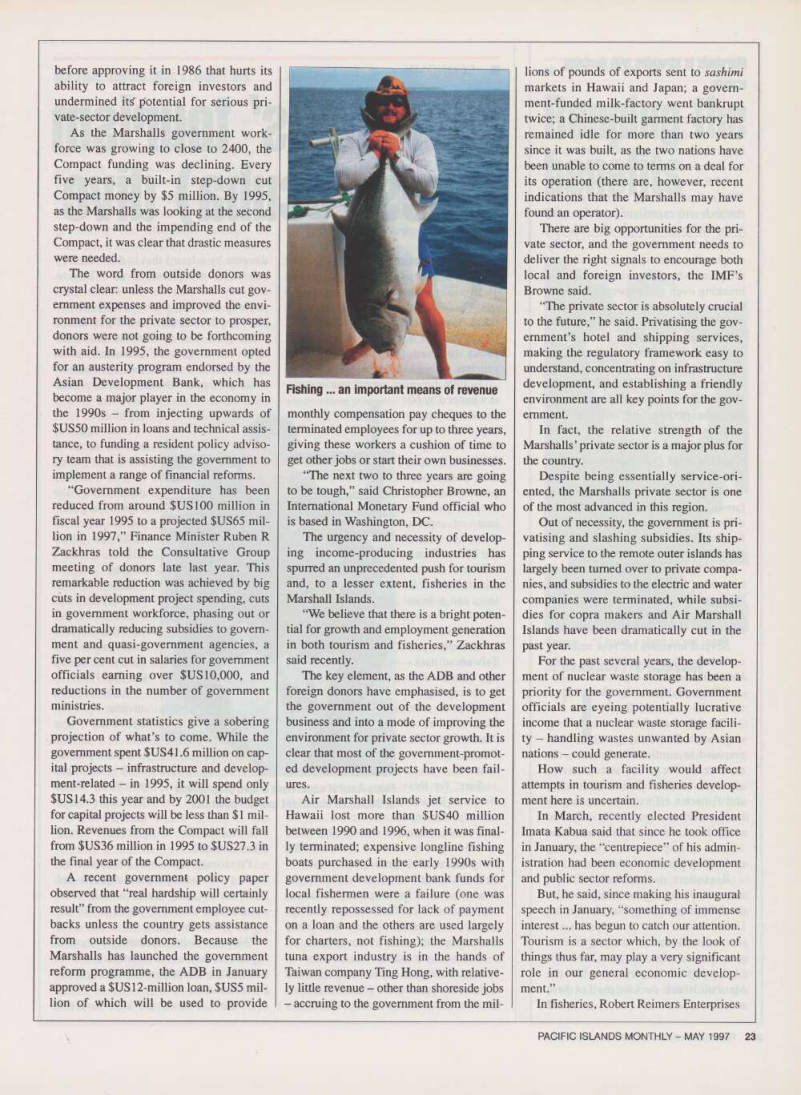
Fishing ... an important means of revenue
Marshalls Is struggles with declining ecnomy
- which operates the Pacific’s only pri vately funded clam hatchery - has begun large-scale exports of clams to the American aquarium market.
RRE launched its clam hatchery in 1986 and, after nearly a dozen years of
research and experimentation coupled
with market surveys in the US, has
stepped up production of a highly
sought after clam species ( maxima ) to the point where the company is now breaking even and expects shortly to make a profit from export sales, according to company chief executive officer Ramsey Reimers.
Another mariculture project show
ing promise is pearl oyster farming.
Both Robert Reimers Enterprises and a Hawaii-based company, Black Pearls, Inc are experimenting with black lip pearl oysters, an industry for which there is good long-term business potential, said Dale Sarver of Black Pearls.
Slowing the development of pearl farming in the Marshalls has been the difficulty of getting the investment funding for establishing a hatchery based farm locally. Server said.
But after several years of work here, he said: “It’ll happen. It may take longer to develop [because of the lack of funding for a hatchery] but it will
happen.”
Several investors are now seriously considering financing their farm in the Marshall Islands.
“There could be a significant indus try here in 10 years,” Sarver said.
The Marshall Islands has a long way to go. But if the government is prepared to continue to improve the environment for private sector activity, and throws its weight behind tourism and fisheries efforts that are largely business-driven, then this mid-Pacific nation has a chance to come out of the
15-year Compact with something
resembling a productive economy.
Regardless, the Marshalls will con tinue to rely heavily on foreign aid for the foreseeable future; but whether the United States, other governments and international donors are prepared to give that aid after the year 2001 will
likely depend largely on what the
Marshall Islands does for itself in these next four years. ■