A saga of corrupfion
pp. 20-21 · Read in the full issue
and shady deals
By Sam Vulum
Growing frustrations and resentment by Papua New Guineans over the government’s incessant “secretive and suspicious” deals have been building up over the years and only needed a major disturbance to ignite a flare-up.
The recent civil unrest was a direct result of the people’s frustrations, sparked by the sacking of former military comman der Brigadier-General Jerry Singirok for refusing to work with Sandline International mercenaries hired by the gov ernment to crush the eight-year-old Bougainville rebellion and his call for the resignations of Prime Minister Sir Julius
Chan, his deputy and Finance Minister Chris Haiveta and Defence Minister Mathias Ijape over the contract.
The public was frustrated with suspi cions, rumours and innuendo of corruption surrounding contracts such as the Cairns property, Port Moresby water and Poreporana freeway deals.
Many could not see the rationale behind the fact that while the government was hellbent on borrowing much-needed funds from the World Bank, International Monetary Fund and other offshore finan cial institutions to bail out its ailing econo my on the one hand, on the other, it could afford to spend millions of dollars in engaging Sandline.
But more disturbing, though, is that the contract is open ended and leaves the state
open to pay millions of kina of people’s money in penalties and other contractual obligations. The SUS 36 million was reported to have been paid to Sandline International. Part of the money, K 42 mil lion, was reported to have been confiscat ed by defence force officials during a search of the company’s chief executive Tim Spicer in Port Moresby. However, the officials have expressed concern that the government may have issued directives to cancel it and reissue a new one. Indications are that the cheque for K 24,557,534 was the second payment of at least K 42.6 mil lion to engage the Sandline consultants as well as purchase of the equipment.
In February, Deputy Prime Minister Chris Haiveta was reported to have hand delivered another cheque for K 8 million to Sandline representatives in Hong Kong.
Singirok said the SUS 36 million was for a three-month contract, but because the mercenaries were likely to remain in PNG for up to 12 months, the real cost would have been Kl2O million. He suggested some government officials involved in the contract may have profited from underhand
dealings. Singirok received nationwide
support.
For three days, the nation’s capital, Port
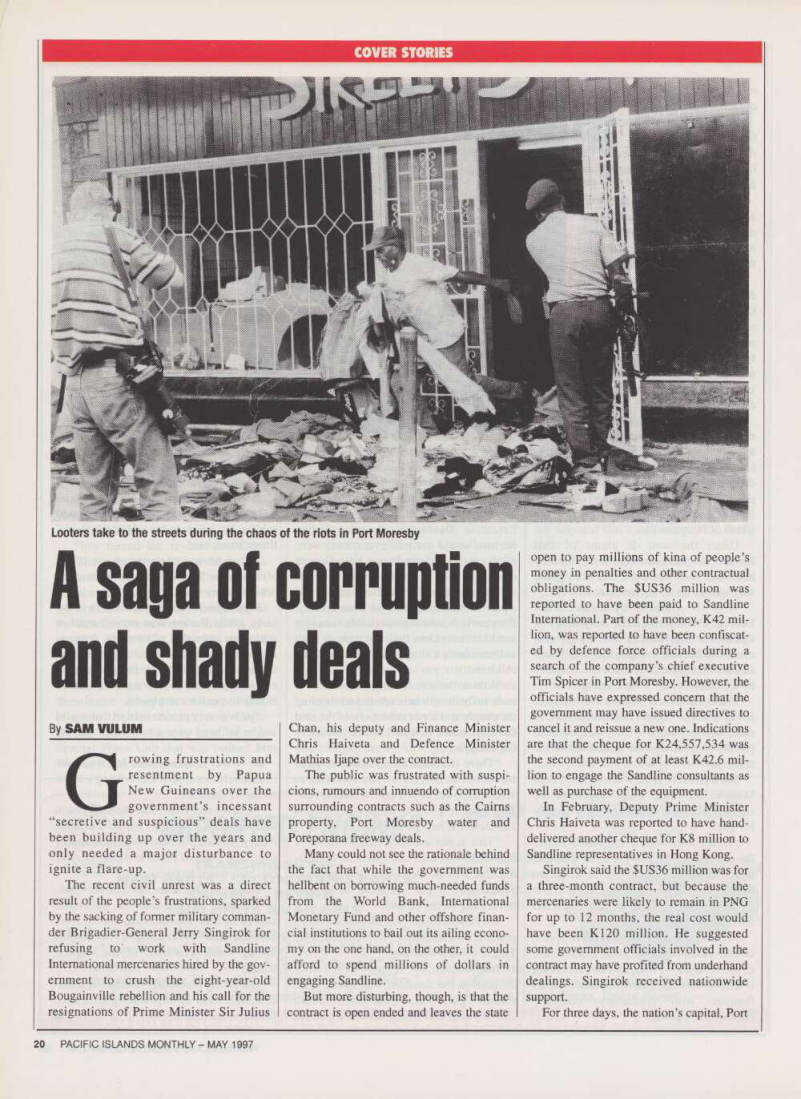
Looters take to the streets during the chaos of the riots in Port Moresby
Moresby, came to a complete halt as the political crisis turned into civil disorder with widespread looting and violence.
Riot police reinforcement were flown in
from the Highlands provinces to help
control the situation in Port Moresby,
blocking off roads and guarding major
shopping centres, banks and government offices, including a 24-hour guard of Parliament House.
The mayhem, which had cost the city millions of dollars to repair, forced banks, schools, and shops to close.
The chaos erupted outside the gates of the military headquarters at Murray Barracks, following a gathering of some thousands of city residents organised by non government organisations and unions to protest over the government’s sacking of Singirok on March 19.
Violent protests and looting ensued but police acted quickly to get the situa tion under control. However, the situa tion took a dangerous turn on March 20, when confined soldiers inside their bar racks were injured by rubber bullets and tear gas fired by riot police. At least 14 people were seriously injured in the riot ing. Angry soldiers tried to respond but a nearby weapons armoury was locked.
The firing of tear gas and rubber bullets was intended for rioters who fled into the barracks. During the incident, three men were wounded by rubber bullets and another had his arm severed with a machete. The man had been reaching into a store to steal something when a security guard inside the building struck him with the machete. On March 22, more than a hundred people gathered outside the gates to the barracks but were dispersed by police. Then the rioting spread across the country, mainly to Lae, Goroka and Mt Hagen.
The situation returned to normal in Port Moresby on March 22 with buses back on the road and shops opening for business. However, on March 25 thou sands of civilian protesters supported by armed military personnel blocked roads leading into and out of Parliament House as the house sat to decide the fate of Prime Minister Sir Julius Chan.
The protesters, who staged an all night vigil outside the Parliament House, returned peacefully to their homes fol lowing Sir Julius’ announcement to step . aside. The people’s outrage exposed a fundamental problem with the country’s economy. ■