The Sandline saga
pp. 18-19 · Read in the full issue

By Sam Vulum
It has become public knowl edge that the Papua New Guinea government had lied in saying that the engagement of Sandline International was not directly intended to wipe out the BRA rebel leadership in Bougainville but only to train PNG soldiers.
Sir Julius, however, had indirectly admitted on various occasions that the aim of the exercise was to wipe out the BRA leadership on the island.
This was further confirmed in the con tract, signed by the government and Sandline International on January 31. The contract required the company to provide personal and related services and equip ment to: • train the state’s Special Force Unit in tactical skills specific to the objective (to neutralise Bougainville rebels); • conduct offensive operations in Bougainville in conjunction with the PNG Defence Force; • render the BRA militarily ineffective and repossess the Panguna mine; and • provide follow-up operational support, to be further specified and agreed between the parties and subject to separate service provision levels and fee negotiations.
The more than 70 Sandline mercenaries have since left the country after the sus pension of the contract by the government.
However, PNG security forces detained and charged their chief, Tim Spicer, for being in possession of firearms.
The DPP later dropped the charges and Spicer left the country after giving evi dence to the Sandline inquiry.
The 44-year-old former Scots Guards officer had earlier pleaded not guilty to two firearms charges when he appeared in court.
A request to have his passport returned failed, despite a plea that he be allowed to travel to Hong Kong for medical reasons.
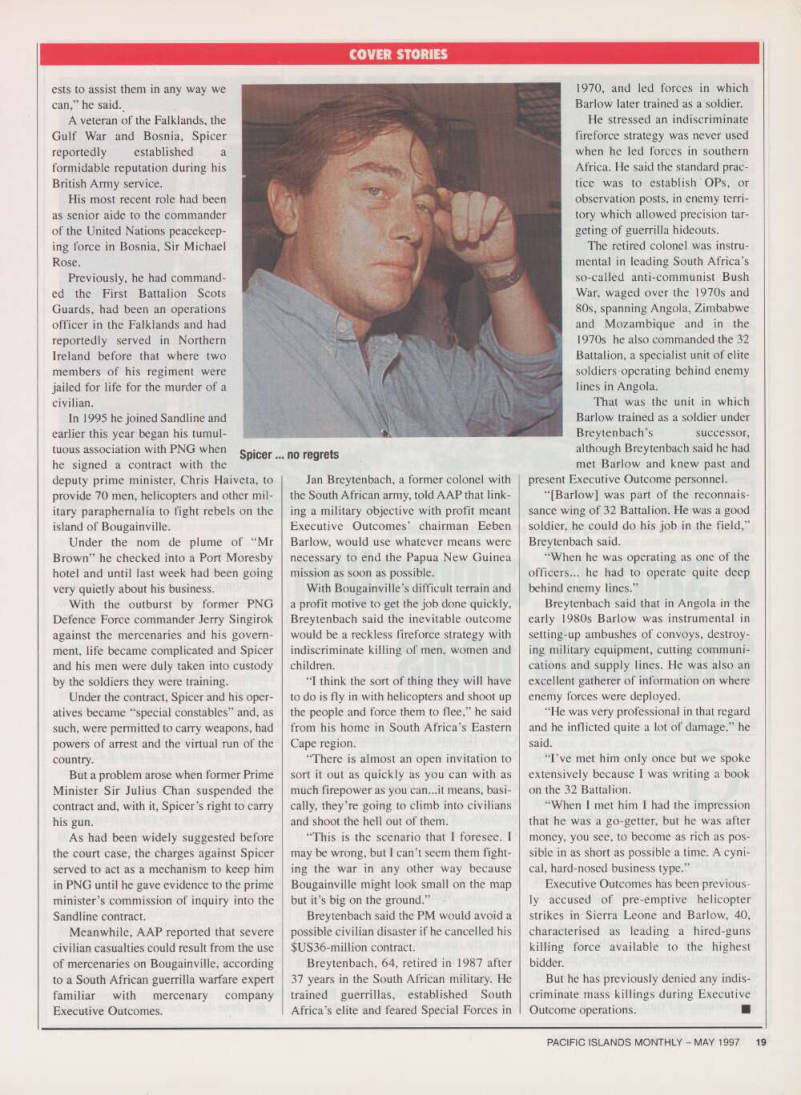
After leaving court, Spicer told journal ists he had no regrets about having entered into the mercenaries contract with the PNG government.
“I am not particularly concerned about my self image,” he said.
“I don’t particularly have problems with what I do. I don’t have a problem with what my company does.
“We try to do things in a reasonable manner within our technical profession.
“We try to assist governments that need our help and that’s all I really want to say about it.”
While refusing to elaborate on what his company was contracted to do in PNG, Spicer admitted he never anticipated the reaction that has occurred.
“I think the situation took us all by sur prise [but] I don’t want to get into a debate about the rights and wrongs of the issue.”
Spicer denied having any regrets about embarking on his PNG adventure but agreed “it hasn’t been a roaring success”.
He said he was happy to testify at the inquiry.
“Obviously, it is in the interests of the country and it is in our professional inter
ests to assist them in any way we can,” he said.
A veteran of the Falklands, the Gulf War and Bosnia, Spicer reportedly established a
formidable reputation during his
British Army service.
His most recent role had been as senior aide to the commander of the United Nations peacekeep ing force in Bosnia, Sir Michael Rose.
Previously, he had command ed the First Battalion Scots Guards, had been an operations officer in the Falklands and had reportedly served in Northern Ireland before that where two members of his regiment were jailed for life for the murder of a civilian.
In 1995 he joined Sandline and earlier this year began his tumul tuous association with PNG when he signed a contract with the
deputy prime minister, Chris Haiveta, to provide 70 men, helicopters and other mil itary paraphernalia to fight rebels on the island of Bougainville.
Under the nom de plume of “Mr Brown” he checked into a Port Moresby hotel and until last week had been going very quietly about his business.
With the outburst by former PNG Defence Force commander Jerry Singirok against the mercenaries and his govern ment, life became complicated and Spicer and his men were duly taken into custody by the soldiers they were training.
Under the contract, Spicer and his oper atives became “special constables” and, as such, were permitted to carry weapons, had powers of arrest and the virtual run of the country.
But a problem arose when former Prime Minister Sir Julius Chan suspended the contract and, with it, Spicer’s right to carry his gun.
As had been widely suggested before the court case, the charges against Spicer served to act as a mechanism to keep him in PNG until he gave evidence to the prime minister’s commission of inquiry into the Sandline contract.
Meanwhile, AAP reported that severe civilian casualties could result from the use of mercenaries on Bougainville, according to a South African guerrilla warfare expert familiar with mercenary company Executive Outcomes.
Jan Breytenbach, a former colonel with the South African army, told AAP that link ing a military objective with profit meant Executive Outcomes’ chairman Eeben Barlow, would use whatever means were necessary to end the Papua New Guinea mission as soon as possible.
With Bougainville’s difficult terrain and a profit motive to get the job done quickly, Breytenbach said the inevitable outcome would be a reckless fireforce strategy with indiscriminate killing of men, women and children.
“I think the sort of thing they will have to do is fly in with helicopters and shoot up the people and force them to flee,” he said from his home in South Africa’s Eastern
Cape region.
“There is almost an open invitation to sort it out as quickly as you can with as much firepower as you can...it means, basi cally, they’re going to climb into civilians and shoot the hell out of them.
“This is the scenario that I foresee. I may be wrong, but I can’t seem them fight ing the war in any other way because Bougainville might look small on the map but it’s big on the ground.”
Breytenbach said the PM would avoid a possible civilian disaster if he cancelled his SUS36-million contract.
Breytenbach, 64, retired in 1987 after 37 years in the South African military. He trained guerrillas, established South Africa’s elite and feared Special Forces in
1970, and led forces in which Barlow later trained as a soldier.
He stressed an indiscriminate fireforce strategy was never used when he led forces in southern Africa. He said the standard prac tice was to establish OPs, or observation posts, in enemy terri tory which allowed precision tar geting of guerrilla hideouts.
The retired colonel was instru mental in leading South Africa’s so-called anti-communist Bush War, waged over the 1970 s and 80s, spanning Angola, Zimbabwe and Mozambique and in the 1970 s he also commanded the 32 Battalion, a specialist unit of elite soldiers operating behind enemy lines in Angola.
That was the unit in which Barlow trained as a soldier under
Breytenbach’s successor,
although Breytenbach said he had
met Barlow and knew past and present Executive Outcome personnel.
“[Barlow] was part of the reconnais sance wing of 32 Battalion. He was a good soldier, he could do his job in the field,”
Breytenbach said.
“When he was operating as one of the officers... he had to operate quite deep behind enemy lines.”
Breytenbach said that in Angola in the early 1980 s Barlow was instrumental in setting-up ambushes of convoys, destroy ing military equipment, cutting communi cations and supply lines. He was also an excellent gatherer of information on where enemy forces were deployed.
“He was very professional in that regard and he inflicted quite a lot of damage,” he said.
“I’ve met him only once but we spoke extensively because I was writing a book on the 32 Battalion.
“When I met him I had the impression that he was a go-getter, but he was after money, you see, to become as rich as pos sible in as short as possible a time. A cyni cal, hard-nosed business type.”
Executive Outcomes has been previous ly accused of pre-emptive helicopter strikes in Sierra Leone and Barlow, 40, characterised as leading a hired-guns killing force available to the highest bidder.
But he has previously denied any indis criminate mass killings during Executive Outcome operations. ■
Spicer ... no regrets