NZ’s aid
p. 58 · Read in the full issue
dilemma
New Zealand’s new coalition gov ernment has presented itself with an aid dilemma: how to boost the country’s development assistance to the South Pacific while grabbing some of it back to compensate for unpaid hospital bills by non-resident islanders.
The National-NZ First coalition agree ment calls for “continual increase” in New Zealand’s foreign aid, with more money for the small independent Pacific Island states to which it acknowledges
“special obligations”.
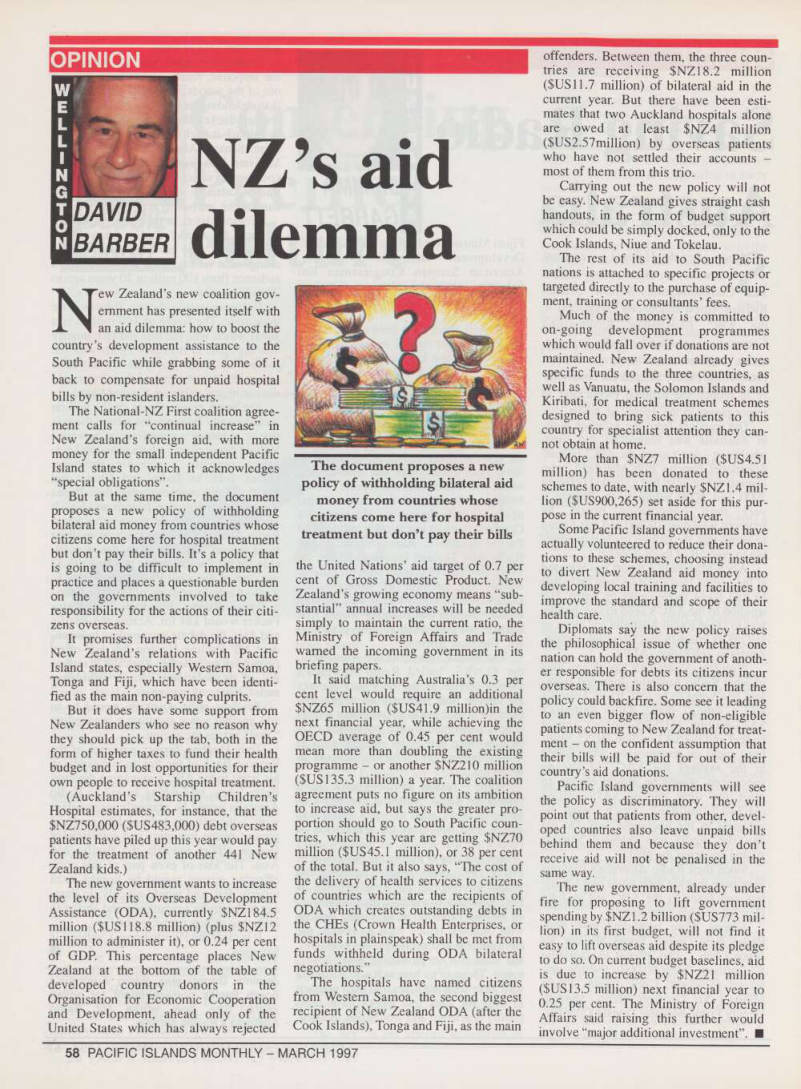
But at the same time, the document proposes a new policy of withholding bilateral aid money from countries whose citizens come here for hospital treatment but don’t pay their bills. It’s a policy that is going to be difficult to implement in
practice and places a questionable burden
on the governments involved to take responsibility for the actions of their citi zens overseas.
It promises further complications in New Zealand’s relations with Pacific Island states, especially Western Samoa, Tonga and Fiji, which have been identi fied as the main non-paying culprits.
But it does have some support from New Zealanders who see no reason why they should pick up the tab, both in the form of higher taxes to fund their health budget and in lost opportunities for their own people to receive hospital treatment. (Auckland’s Starship Children’s Hospital estimates, for instance, that the $NZ750,000 ($U5483,000) debt overseas patients have piled up this year would pay for the treatment of another 441 New Zealand kids.) The new government wants to increase the level of its Overseas Development Assistance (ODA), currently $NZ184.5 million (SUSIIB.B million) (plus SNZI2 million to administer it), or 0.24 per cent of GDP. This percentage places New Zealand at the bottom of the table of developed country donors in the Organisation for Economic Cooperation and Development, ahead only of the United States which has always rejected
the United Nations’ aid target of 0.7 per cent of Gross Domestic Product. New Zealand’s growing economy means “sub stantial” annual increases will be needed simply to maintain the current ratio, the Ministry of Foreign Affairs and Trade warned the incoming government in its
briefing papers.
It said matching Australia’s 0.3 per cent level would require an additional SNZ6S million (SUS4I.9 millionjin the next financial year, while achieving the OECD average of 0.45 per cent would mean more than doubling the existing programme - or another SNZ2IO million (SUS 135.3 million) a year. The coalition agreement puts no figure on its ambition to increase aid, but says the greater pro portion should go to South Pacific coun tries, which this year are getting SNZ7O million (SUS4S.I million), or 38 per cent of the total. But it also says, “The cost of the delivery of health services to citizens of countries which are the recipients of ODA which creates outstanding debts in the CHEs (Crown Health Enterprises, or hospitals in plainspeak) shall be met from funds withheld during ODA bilateral negotiations.”
The hospitals have named citizens from Western Samoa, the second biggest recipient of New Zealand ODA (after the Cook Islands), Tonga and Fiji, as the main
offenders. Between them, the three coun tries are receiving SNZIB.2 million (SUS 11.7 million) of bilateral aid in the current year. But there have been esti mates that two Auckland hospitals alone are owed at least SNZ4 million
(sUS2.s7million) by overseas patients
who have not settled their accounts most of them from this trio.
Carrying out the new policy will not be easy. New Zealand gives straight cash handouts, in the form of budget support which could be simply docked, only to the Cook Islands, Niue and Tokelau.
The rest of its aid to South Pacific nations is attached to specific projects or targeted directly to the purchase of equip ment, training or consultants’ fees.
Much of the money is committed to
on-going development programmes
which would fall over if donations are not maintained. New Zealand already gives specific funds to the three countries, as well as Vanuatu, the Solomon Islands and Kiribati, for medical treatment schemes designed to bring sick patients to this country for specialist attention they can not obtain at home.
More than SNZ7 million (SUS4.SI million) has been donated to these schemes to date, with nearly SNZI.4 mil lion ($U5900,265) set aside for this pur pose in the current financial year.
Some Pacific Island governments have actually volunteered to reduce their dona tions to these schemes, choosing instead to divert New Zealand aid money into developing local training and facilities to improve the standard and scope of their health care.
Diplomats say the new policy raises the philosophical issue of whether one nation can hold the government of anoth er responsible for debts its citizens incur overseas. There is also concern that the policy could backfire. Some see it leading to an even bigger flow of non-eligible patients coming to New Zealand for treat ment - on the confident assumption that their bills will be paid for out of their country’s aid donations.
Pacific Island governments will see the policy as discriminatory. They will point out that patients from other, devel oped countries also leave unpaid bills behind them and because they don’t receive aid will not be penalised in the same way.
The new government, already under fire for proposing to lift government spending by SNZI.2 billion (SUS 773 mil lion) in its first budget, will not find it easy to lift overseas aid despite its pledge to do so. On current budget baselines, aid is due to increase by SNZ2I million (SUSI3.S million) next financial year to 0.25 per cent. The Ministry of Foreign Affairs said raising this further would involve “major additional investment”. ■
Wellington
David
Barber
The document proposes a new policy of withholding bilateral aid money from countries whose citizens come here for hospital treatment but don’t pay their bills