Dreaded Drena
pp. 54-55 · Read in the full issue
Yachting
Weathering the storm Text and photography
by Sally Andrew
Nineteen-ninety-seven dawned
quietly. Our small ship’s cabin was decorated with branches of evergreen tied with red ribbon and Christmas cards on every bulkhead. Birds were singing in the trees. Even the boats reflecting in the mirror-like surface of Baie du Carenage suggested the arrival of a gentle new year. At midnight, red parachute flares and fireworks lit up the sky in celebration of both the New Year and our good luck. Tropical Cyclone Fergus had missed us.
Fergus had been named on Christmas Eve. In the Solomons, high winds and rain damaged crops and caused serious flooding on the southern isles of Rennell, Bellona and Guadalcanal.
Fergus came screaming down the gap between New Caledonia and Vanuatu and by December 28, cyclonic winds and tor rential rains were damaging the gardens of nearby Aneitium in Vanuatu’s Tafea Province.
In new Caledonia, 24 hours later, Fergus was history. Fergus headed south towards New Zealand bringing winds to 150 kilometres and rain and flooding from Cape Reinga to Wellington.
After the excitement of our close encounter with Cyclone Fergus, we relaxed for a few days. We hiked from the Wharf du Carenage to the Source Thermale, fording the Ruisseau des Kaoris by jumping from rock to rock across a huge stream. At the end of our trek, a sunken bath lay in the middle of the bush, filled with warm, crystal-clear natural spring water. We soaked until we looked like prunes. A couple of jet-skis ripped up the silence and terrorised the waterway. No doubt they were based out of the quiet little resort at Hot Casy.
The next day, we followed a stream bed, climbing to a big pool at the base of a picturesque waterfall. Cooling off in the water, fresh-water shrimp nibbled our toes.
A trip to Noumea for much-needed provisions was becoming critical but walking in the red hills of Prony is addic tive. You can trek for miles along old roads, exploring abandoned prison and mining ruins, cooling off in the millions
of streams and pools. We decided to stay for a couple more days.
A 14-kilometre walking trail leads from “Lac en 8” (a grand lake in the shape of a figure eight) to the old mining village at Prony. The anchorage is halfway between the two. Our first attempt to find
the lake was aborted. It was too hot and we made too many detours - up rugged red gashes to lookout points and stopping to swim in cool pools along the way.
Our second attempt, made on a rainy overcast day, was successful. We found the elusive lake. Located in the great plain
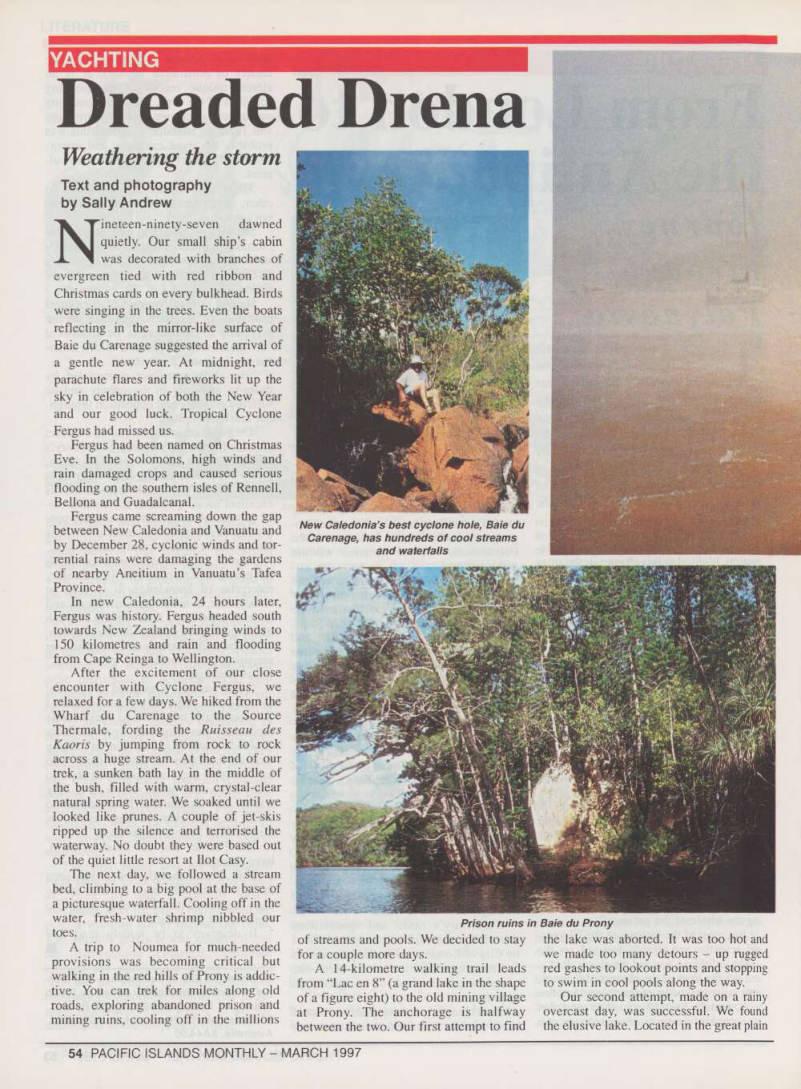
New Caledonia’s best cyclone hole, Bale du Carenage, has hundreds of cool streams and waterfalls
Prison ruins in Bale du Prony
of lakes, it is several hundred metres above sea-level. Following the Ruisseau des Kaoris, the well-marked trail rises to a cut in the ridge and the shores of "Lac en 8”. Having found the mysterious lake, it was time to sail back to Noumea.
Arrggh! While drinking our morning
coffee and contemplating all the good things we could buy back in port, a new tropical depression was reported to lie over the northern Banks and Torres group of islands. Not another cyclone! It was named Drena the following morning.
We tracked the cyclone. With a centre
pressure of 935 HPA, Drena was packing 90 knots maximum sustained winds with gusts to 135 knots. We set three anchors with chafing gear on each anchor rode, kept two more in reserve, and reduced our windage by removing all unnecessary deckgear - lee cloths, solar panels, even halyards - and stripped the mainsail off the boom. The dinghy was deflated and brought on board.
By the time Cyclone Drena arrived, my nerves were shot. Listening to too many weather reports drives you crazy.
We monitored broadcasts from Nadi via Arnold’s Weather Net (Cook Islands) and Taupo Maritime (New Zealand), copied Noumea Radio Fleet Code, collected Australian and New Zealand weather fax broadcasts via HF radio using our laptop computer. During the night, dreaded Drena arrived with awesome gusts of wind. Owing to the new moon it was very, very dark. The two of us stood watch all night, keeping an eye on our anchor and on our neighbours.
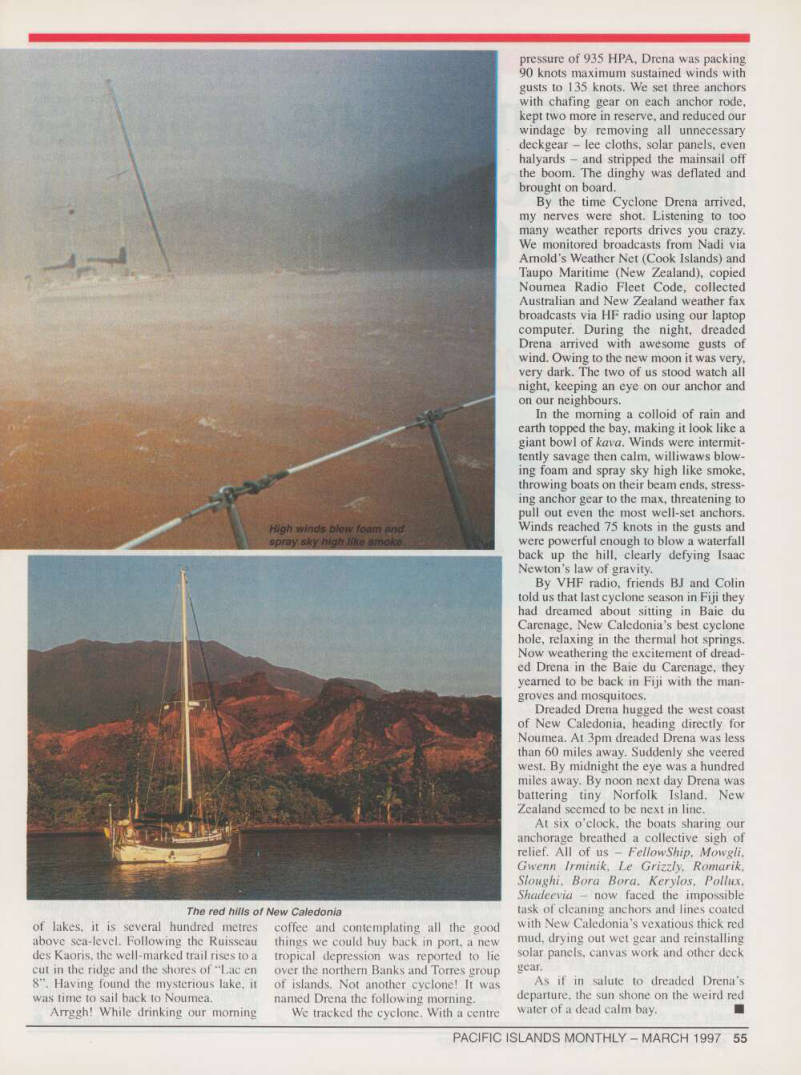
In the morning a colloid of rain and earth topped the bay, making it look like a giant bowl of kava. Winds were intermit tently savage then calm, williwaws blow ing foam and spray sky high like smoke, throwing boats on their beam ends, stress ing anchor gear to the max, threatening to pull out even the most well-set anchors.
Winds reached 75 knots in the gusts and were powerful enough to blow a waterfall back up the hill, clearly defying Isaac Newton’s law of gravity.
By VHF radio, friends BJ and Colin told us that last cyclone season in Fiji they had dreamed about sitting in Bale du Carenage, New Caledonia’s best cyclone hole, relaxing in the thermal hot springs.
Now weathering the excitement of dread ed Drena in the Baie du Carenage, they yearned to be back in Fiji with the man groves and mosquitoes.
Dreaded Drena hugged the west coast of New Caledonia, heading directly for Noumea. At 3pm dreaded Drena was less than 60 miles away. Suddenly she veered west. By midnight the eye was a hundred miles away. By noon next day Drena was battering tiny Norfolk Island. New Zealand seemed to be next in line.
At six o’clock, the boats sharing our anchorage breathed a collective sigh of relief. All of us - Fellowship, Mowgli, Gwenn Irminik, Le Grizzly, Romarik,
Sloughi, Bora Bora , Kerylos, Pollux,
Shadeevia - now faced the impossible task of cleaning anchors and lines coated with New Caledonia’s vexatious thick red mud, drying out wet gear and reinstalling solar panels, canvas work and other deck gear.
As if in salute to dreaded Drena’s departure, the sun shone on the weird red water of a dead calm bay. ■
The red hills of New Caledonia
High winds blew foam and spray sky high like smoke