The politics
pp. 53-54 · Read in the full issue
Culture
The politics of music
Kaneka music was horn out of the Kanak struggle for independence
Text and photography
by Liz Thompson
On stage at the Metro Theatre was a band of 11 Kanak men dressed in long grass skirts and armbands.
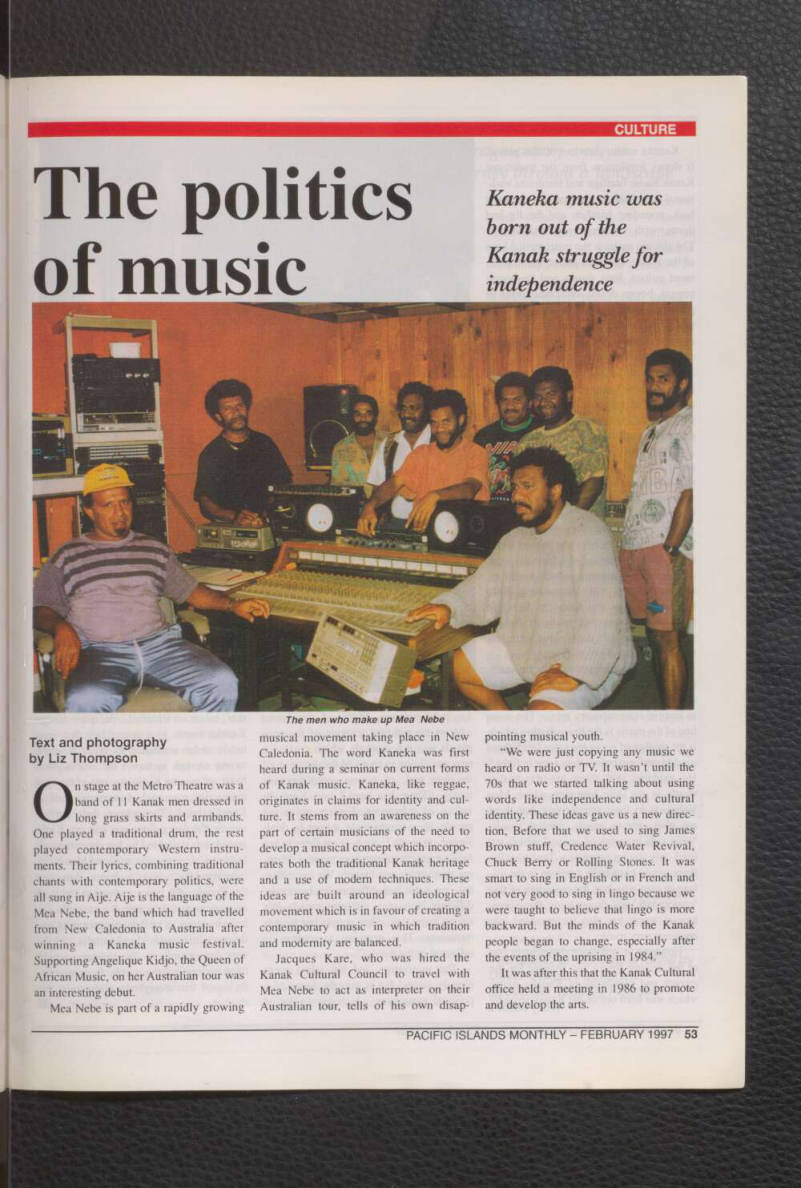
One played a traditional drum, the rest played contemporary Western instru ments. Their lyrics, combining traditional chants with contemporary politics, were all sung in Aije. Aije is the language of the Mea Nebe, the band which had travelled from New Caledonia to Australia after winning a Kaneka music festival.
Supporting Angelique Kidjo, the Queen of
African Music, on her Australian tour was an interesting debut.
Mea Nebe is part of a rapidly growing
musical movement taking place in New Caledonia. The word Kaneka was first heard during a seminar on current forms of Kanak music. Kaneka, like reggae, originates in claims for identity and cul ture. It stems from an awareness on the part of certain musicians of the need to develop a musical concept which incorpo rates both the traditional Kanak heritage and a use of modem techniques. These ideas are built around an ideological movement which is in favour of creating a contemporary music in which tradition and modernity are balanced.
Jacques Kare, who was hired the Kanak Cultural Council to travel with Mea Nebe to act as interpreter on their Australian tour, tells of his own disap
pointing musical youth.
“We were just copying any music we heard on radio or TV. It wasn’t until the 70s that we started talking about using words like independence and cultural identity. These ideas gave us a new direc tion, Before that we used to sing James Brown stuff, Credence Water Revival, Chuck Berry or Rolling Stones. It was smart to sing in English or in French and not very good to sing in lingo because we were taught to believe that lingo is more backward. But the minds of the Kanak
people began to change, especially after
the events of the uprising in 1984.”
It was after this that the Kanak Cultural office held a meeting in 1986 to promote and develop the arts.
The men who make up Mea Nebe
Kaneka music grew out of that period.
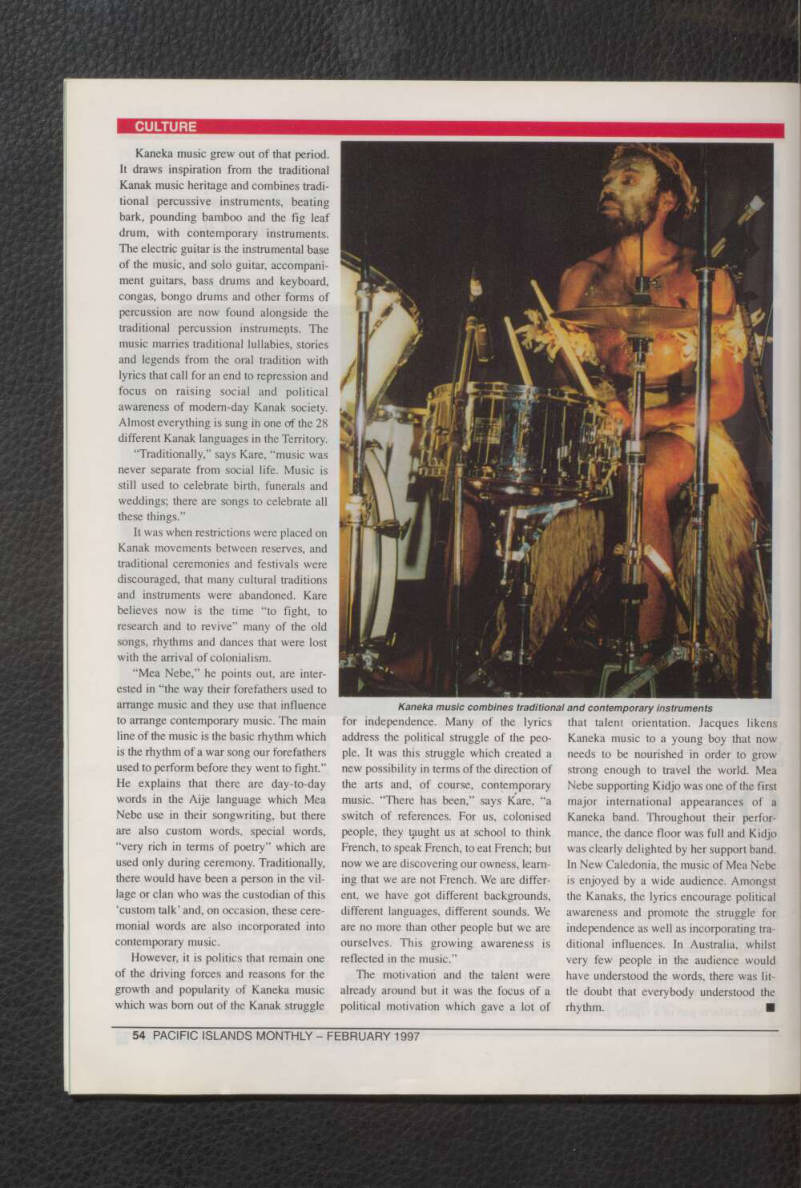
It draws inspiration from the traditional Kanak music heritage and combines tradi tional percussive instruments, beating bark, pounding bamboo and the fig leaf drum, with contemporary instruments.
The electric guitar is the instrumental base of the music, and solo guitar, accompani ment guitars, bass drums and keyboard, congas, bongo drums and other forms of percussion are now found alongside the traditional percussion instruments. The music marries traditional lullabies, stories and legends from the oral tradition with lyrics that call for an end to repression and focus on raising social and political awareness of modem-day Kanak society.
Almost everything is sung in one of the 28 different Kanak languages in the Territory.
“Traditionally,” says Kare, “music was never separate from social life. Music is still used to celebrate birth, funerals and weddings; there are songs to celebrate all
these things.”
It was when restrictions were placed on Kanak movements between reserves, and traditional ceremonies and festivals were discouraged, that many cultural traditions and instruments were abandoned. Kare believes now is the time “to fight, to research and to revive” many of the old songs, rhythms and dances that were lost with the arrival of colonialism.
“Mea Nebe,” he points out, are inter ested in “the way their forefathers used to arrange music and they use that influence to arrange contemporary music. The main line of the music is the basic rhythm which is the rhythm of a war song our forefathers used to perform before they went to fight.”
He explains that there are day-to-day words in the Aije language which Mea Nebe use in their songwriting, but there are also custom words, special words, “very rich in terms of poetry” which are
used only during ceremony. Traditionally,
there would have been a person in the vil lage or clan who was the custodian of this ‘custom talk’ and, on occasion, these cere monial words are also incorporated into contemporary music.
However, it is politics that remain one of the driving forces and reasons for the growth and popularity of Kaneka music which was bom out of the Kanak struggle
for independence. Many of the lyrics address the political struggle of the peo ple. It was this struggle which created a new possibility in terms of the direction of the arts and, of course, contemporary music. “There has been,” says Kare, “a switch of references. For us, colonised people, they taught us at school to think French, to speak French, to eat French; but now we are discovering our owness, learn ing that we are not French. We are differ ent, we have got different backgrounds, different languages, different sounds. We are no more than other people but we are ourselves. This growing awareness is reflected in the music.”
The motivation and the talent were already around but it was the focus of a political motivation which gave a lot of
that talent orientation. Jacques likens Kaneka music to a young boy that now needs to be nourished in order to grow strong enough to travel the world. Mea Nebe supporting Kidjo was one of the first major international appearances of a Kaneka band. Throughout their perfor mance, the dance floor was full and Kidjo was clearly delighted by her support band.
In New Caledonia, the music of Mea Nebe is enjoyed by a wide audience. Amongst the Kanaks, the lyrics encourage political awareness and promote the struggle for independence as well as incorporating tra ditional influences. In Australia, whilst very few people in the audience would have understood the words, there was lit tle doubt that everybody understood the
rhythm. ■
Kaneka music combines traditional and contemporary instruments