.... again
pp. 42-43 · Read in the full issue
Manu Samoa bounce back ... again
By Atama Raganivatu
Western Samoa confirmed them selves as being among the world’s most resilient rugby union teams by enjoying a successful tour of Britain, just a few months after thqir 60-0 hammering by Fiji seemed to have signalled their demise as a side of real international consequence. For the umpteenth time in recent years, Manu Samoa have recovered remarkably quick ly from a traumatic setback.
Having been forced to leave several injured and fatigued star players at home (including the New Zealand National
Provincial Championship’s leading
tryscorer, Brian Lima), the Pacific Islands side appeared ripe for plucking by many of the illustrious combinations they were about to face. The tour opener was cer tainly inauspicious. English first division club Saracens, boasting the legendary French star Philippe Sella at centre, inflicted a 53-40 loss. However, the Samoans gained some consolation from a
spirited second-half performance. They
trailed 39-13 at the break.
It was not until late into the second encounter, against Oxford University, that the effects of jet lag were fully shaken off though. The students actually led 20-18 shortly after halftime but the tourists then pulled away to win 58-27.
Supporters of Irish provincial selection Munster still talk about their side’s extraordinary victory over the All Blacks almost two decades ago. There was no such triumph when Western Samoa crossed the Irish Sea, however. Even so, the Munstermen did create some anxious
moments before going down 35-25 and the loss of hooker Trevor Leota, sent off for a high tackle in the 56th minute, dampened the Samoans’ after-match cele brations. The Munster fixture marked the return to international rugby union of for mer All Black Va’aiga Tuigamala, after three years’ absence playing rugby league, and everybody recognised that “Inga the Winger” would be a key man in the Test with Ireland three days later. It was equally certain this encounter would provide the tour’s defining moment.
It took Tuigamala just two minutes to confirm he was just as effective in the Test arena as ever. A surging run required five Irishmen to block his progress, - but he then freed the ball and, two long passes later, winger Afato So’oalao began the 80metres sprint that ended with him claim ing the match’s first try.
Only 12 more minutes were to pass before Tuigamala again glided effortless ly through the Irish rearguard and sent the exciting George Leaupepe scampering away for try number two.
The game was then effectively over as a contest. Five tries to one reflects Samoa’s true supremacy and only some dubious decisions by Argentinian referee Santiago Borsani (who awarded the home side 27 penalties and their opponents just nine) enabled Ireland to escape with “just” a 40-25 loss.
Such a convincing performance
against one of world rugby’s traditional forces must be regarded as a red letter day for Western Samoan rugby and it ranks alongside the wins over Wales, Scotland, Queensland and Auckland. The fact that Ireland had hammered Fiji 44-8 almost
exactly one year earlier made victory even sweeter. With the only Test of the tour having now been played and won, there were fears that the rest of the expedition could become a sad anti-climax and the
lax display against Cambridge University
did indeed suggest the-remaining month would regress into an embarrasment.
Manu Samoa required a great deal of luck before overcoming the Light Blues 14-13.
Worse followed three days later. Not only was a 23-15 loss suffered at the hands of perpetual Welsh power Llanelli, but two Samoan players received yellow cards during an all-out brawl. The ill-dis cipline that has cast a shadow over Manu Samoa too often in the past seemed des tined to set the tone for the second half of the tour, during which they were certain to encounter provocative opposition players and unsympathetic referees. Whatever coach Bryan Williams and the rest of the tourists’ management team said during the days immediately after the Llanelli clash, it certainly worked wonders. Against an admittedly depleted Cardiff, Manu Samoa
were at their brilliant best both in terms of form and behaviour. So’oala’s hat trick of tries against Wales’ most famous club was but one amongst many highlights during the 53-29 win.
The following 36-17 loss to English champions Bath was only a slight set back, as an experimental side took the field and the Samoans actually “won” the second half of an always enthralling exhi bition of running rugby 14-13.
It was back to winning ways two days later when a composite side drawn from high-profile English clubs Leicester and Northampton succumbbed 33-20. Then, the tour concluded with two successes over lesser lights on the English club scene, Newbury and Richmond, 35-21 and 32-12 respectively.
An eight-wins, three-losses overall tour record delighted Bryan Williams, particularly as one of the wins came in the sole Test. Flowever, the most positive aspect of the trip was the number of
young players who proved they were capable of thriving at the highest level.
“We came here with 20 players who were in their first year of international rugby.
Many of them have made big progress in a short time,” Williams enthused just before returning to his Auckland home.
Amongst the youngsters to “come of age” in Britain was Mark Fatialofa, an elusive back who displayed remarkable consistency despite being asked to play in a variety of positions.
First five-eighth Earl Va’a had only appeared in two games of rugby union before being selected for the tour. Yet the former Wellington rugby league represen tative soon looked every inch a seasoned exponent of the 15-a-side game and his accurate place kicking provided an enor mous bonus. The electric pace of the pre viously unsung Afato So’oalao ensured that Brian Lima was hardly missed and Isaac Feaunati appears destined to join the long ranks of great Samoan loose for
wards. The older generation played a huge part in the tour’s success, too, though. Pat Lam performed heroically and was described by Williams as “the epitome of the good tour captain”.
Those who doubted his worth to suc ceed the remarkable Peter Fatialofa in the skipper’s role must now be eating their words. Mark Birtwhistle ensured a wealth of possession from the lineouts and To’o Vaega further enhanced an already
formidable reputation.
Add to this Tuigamala’s announce ment just before Christmas that he had downgraded his contract with rugby league club Wigan and would, hence forth, place greatest accent upon rugby union and there is little wonder why Williams can anticipate a happy new year.
To those who, after the Fiji debacle, predicted Manu Samoa’s expiration he can now, like Mark Twain, state that reports of their death were greatly exag
gerated. ■
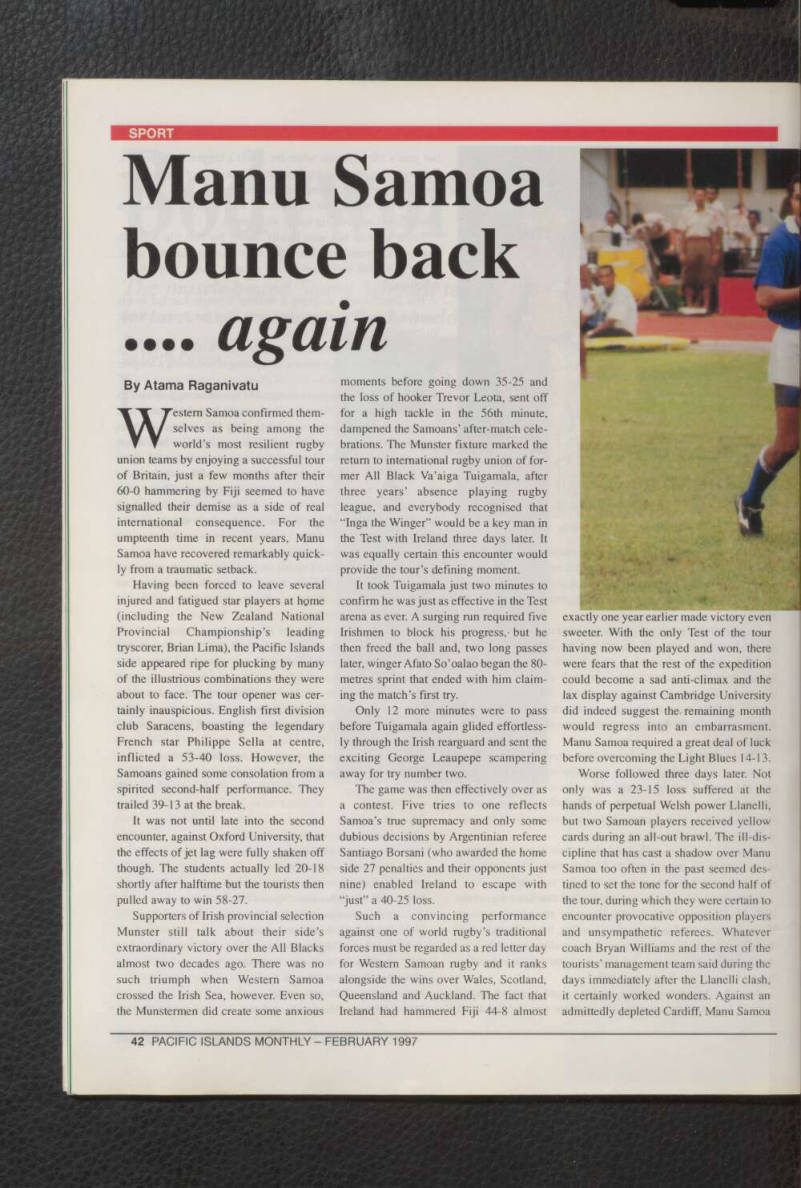
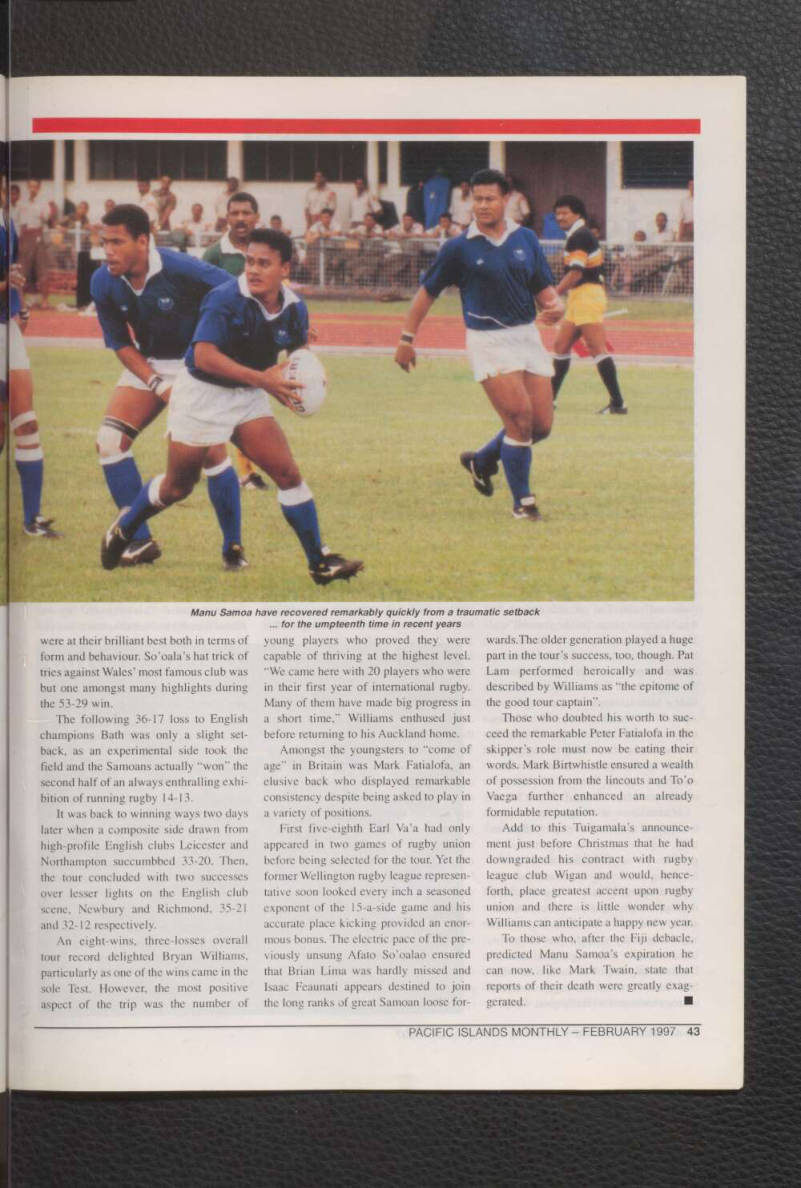
Manu Samoa have recovered remarkably quickly from a traumatic setback ... for the umpteenth time in recent years