Readying for the 28th Forum
28th Forum
T H E F O R U M
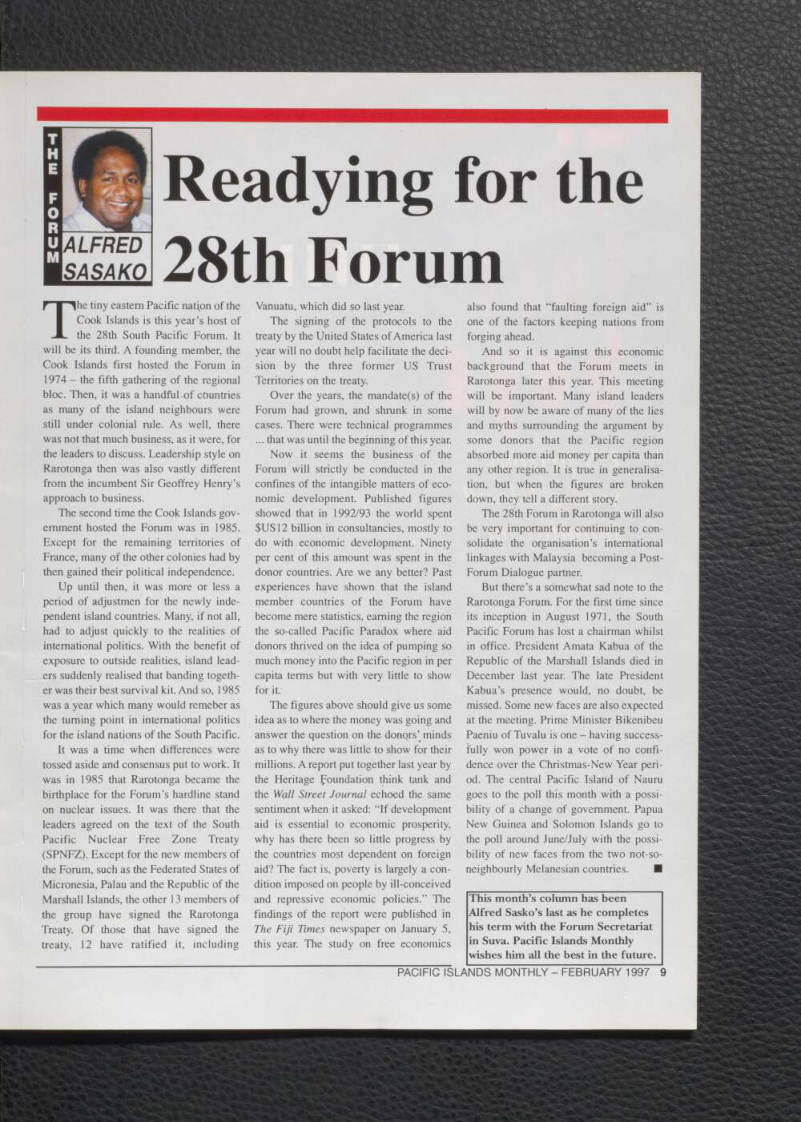
\Alfred
I Sasakq
The tiny eastern Pacific nation of the Cook Islands is this year’s host of the 28th South Pacific Forum. It will be its third. A founding member, the Cook Islands first hosted the Forum in 1974 - the fifth gathering of the regional bloc. Then, it was a handful .of countries as many of the island neighbours were still under colonial rule. As well, there was not that much business, as it were, for the leaders to discuss. Leadership style on Rarotonga then was also vastly different from the incumbent Sir Geoffrey Henry’s approach to business.
The second time the Cook Islands gov ernment hosted the Forum was in 1985.
Except for the remaining territories of France, many of the other colonies had by
then gained their political independence.
Up until then, it was more or less a period of adjustmen for the newly inde pendent island countries. Many, if not all, had to adjust quickly to the realities of international politics. With the benefit of exposure to outside realities, island lead
ers suddenly realised that banding togeth
er was their best survival kit. And so, 1985 was a year which many would remeber as
the turning point in international politics
for the island nations of the South Pacific.
It was a time when differences were tossed aside and consensus put to work. It was in 1985 that Rarotonga became the birthplace for the Forum’s hardline stand on nuclear issues. It was there that the leaders agreed on the text of the South Pacific Nuclear Free Zone Treaty (SPNFZ). Except for the new members of the Forum, such as the Federated States of Micronesia, Palau and the Republic of the Marshall Islands, the other 13 members of the group have signed the Rarotonga Treaty. Of those that have signed the treaty, 12 have ratified it, including
Vanuatu, which did so last year.
The signing of the protocols to the treaty by the United States of America last year will no doubt help facilitate the deci sion by the three former US Trust Territories on the treaty.
Over the years, the mandate(s) of the Forum had grown, and shrunk in some cases. There were technical programmes ... that was until the beginning of this year.
Now it seems the business of the Forum will strictly be conducted in the confines of the intangible matters of eco
nomic development. Published figures
showed that in 1992/93 the world spent SUSI 2 billion in consultancies, mostly to do with economic development. Ninety per cent of this amount was spent in the donor countries. Are we any better? Past experiences have shown that the island member countries of the Forum have become mere statistics, earning the region the so-called Pacific Paradox where aid donors thrived on the idea of pumping so much money into the Pacific region in per capita terms but with very little to show for it.
The figures above should give us some idea as to where the money was going and answer the question on the donors’ minds as to why there was little to show for their millions. A report put together last year by the Heritage foundation think tank and the Wall Street Journal echoed the same sentiment when it asked: “If development aid is essential to economic prosperity, why has there been so little progress by the countries most dependent on foreign aid? The fact is, poverty is largely a con
dition imposed on people by ill-conceived
and repressive economic policies.” The findings of the report were published in The Fiji Times newspaper on January 5, this year. The study on free economics
also found that “faulting foreign aid” is one of the factors keeping nations from
forging ahead.
And so it is against this economic background that the Forum meets in Rarotonga later this year. This meeting will be important. Many island leaders will by now be aware of many of the lies and myths surrounding the argument by some donors that the Pacific region absorbed more aid money per capita than any other region. It is true in generalisa tion, but when the figures are broken down, they tell a different story.
The 28th Forum in Rarotonga will also be very important for continuing to con solidate the organisation’s international
linkages with Malaysia becoming a Post-
Forum Dialogue partner.
But there’s a somewhat sad note to the Rarotonga Forum. For the first time since its inception in August 1971, the South Pacific Forum has lost a chairman whilst in office. President Amata Kabua of the Republic of the Marshall Islands died in December last year. The late President Kabua’s presence would, no doubt, be missed. Some new faces are also expected at the meeting. Prime Minister Bikenibeu Paeniu of Tuvalu is one - having success fully won power in a vote of no confi dence over the Christmas-New Year peri od. The central Pacific Island of Nauru goes to the poll this month with a possi bility of a change of government. Papua New Guinea and Solomon Islands go to the poll around June/July with the possi bility of new faces from the two not-so neighbourly Melanesian countries. ■
This month’s column has been Alfred Sasko’s last as he completes his term with the Forum Secretariat in Suva. Pacific Islands Monthly wishes him all the best in the future.