copper, coffee down
pp. 35-36 · Read in the full issue
Commodity prices:
Coconut oil up, copper, coffee down
By David North
World commodity prices, direct ly or indirectly, affect every Island nation.
If the price of imports - like meat or grain - increases, it is belt-tightening time, but if the price goes up for the Islands’ exports, it is good news for at least some Islanders - and, of course, the reverse of both statements is equally true.
At the moment, the price for two major Island exports, copper and coconut oil, are charging off in different directions: coconut oil to new highs, and copper off sharply. The price movements of both are tied directly to two different Pacific Rim disasters, one in the Philippines, and the other in Japan.
When Pacific Islands Monthly last wrote about the subject (“Coconut oil price soars” December, 1994), the price on the index market had moved from (US)2O cents to 30 cents cents a pound, a 50 per cent increase in less than a year.
Now, the Wall Street Journal, which car ries this and other prices daily, reports coconut oil at 47 cents a pound. (The price, like most commodity prices, is for delivery at a particular place; in this instance, dockside in New Orleans.) Currently, coconut oil, which is pro duced in commercial quantities in at least five South Pacific nations, is the priciest major vegetable oil around; compare its price to that of soybean or com oil (both produced in the US) at about 22 cents, or tropical palm oil, at 21 cents.
Why is coconut oil doing so well? It is, after all, shot through with fats and is avoided as cooking oil by weight-con scious people all over the world (except for the slim folk of Japan, who continue to use it in their diet).
There is a two-part answer to the ques tion. First, coconut oil is regarded highly by people who make and buy beauty
products, like shampoo; this is its princi pal use in the United States - the texture and fragrance are hard to beat.
Second, there was a terrible typhoon in the coconut-producing part of the Philippines about a year ago, which ruined literally millions of trees. Since the Philippines exports more coconut prod ucts than any other nation, the shortfall in that crop boosted prices elsewhere.
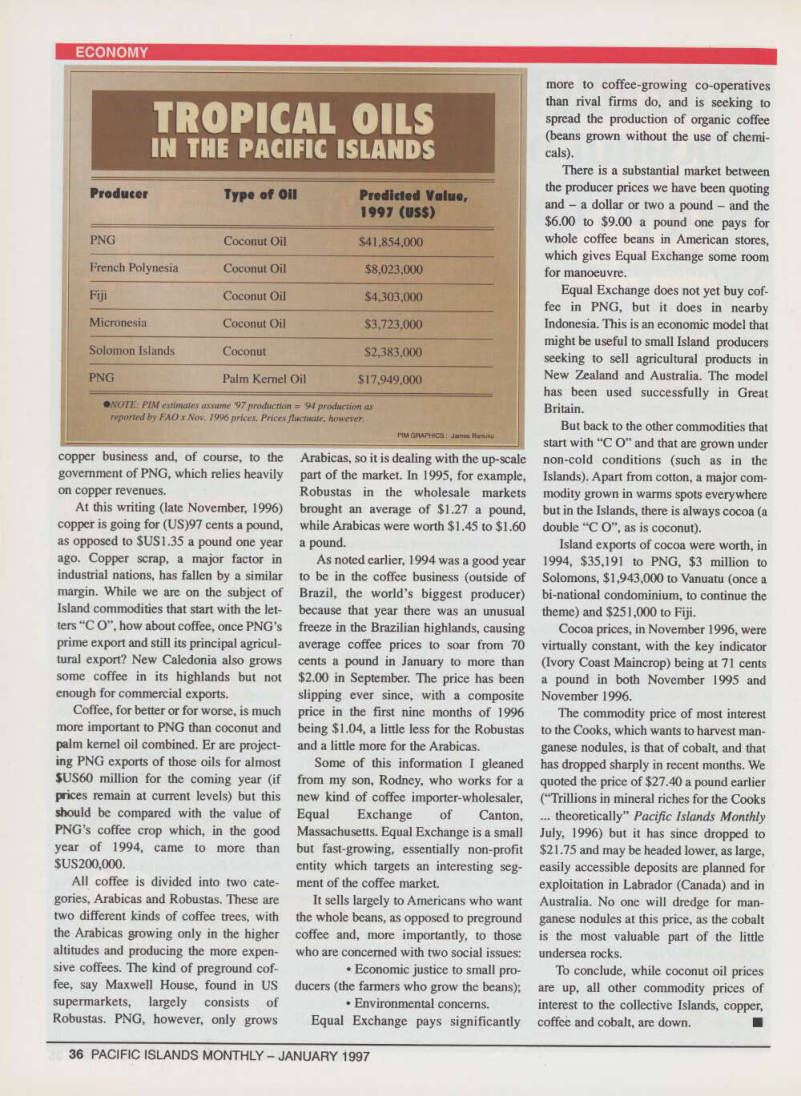
There is even a spill-over effect that works to the benefit of the Islands; when the price of coconut oil soars, some users switch to palm kernel oil, which has many of the same qualities. It is now going for 37 cents a pound, as opposed to 32 cents a year ago. Papua New Guinea is the princi pal Island exporter of this commodity. For the impact of the price increases on the five major producers of tropical oils, see the table (Page 36). These estimates, for the value of tropical oils delivered over seas in 1997, are based on the 1994 pro duction as reported by the Food and Agricultural Organisation (FAO) in Rome, multiplied by November, 1996 prices. The actual value of the production may be considerably different, given the fluidity of pricing.
The table, incidentally, carries the term “Micronesia” which reflects the FAO’s less-than-flrm grasp on its insular statis tics. FAO - like other international enti ties of a decade ago - still groups the CNMI, FSM, the Marshalls and Palau as “Micronesia”, as if the US trust territory were still in being. In fact, most, if not all of the area’s coconut oil production is from the Tobolar plant in Majuro.
Similarly, FAO calls Western Samoa (which is a major producer of coconuts) “Samoa” and shows some coconut oil production in 1992, but none since. FAO produces country profiles on agricultural activities of most nations in the world, but none for either of the Samoas. (American
Samoa’s heavily subsidised economy exports no agricultural products of any kind except tuna.) The previously mention far-away disasters, however, although helpful to the coconut and palm kernel oil producers, do not always work to the Islands’ best interests. Take the copper sit uation, for instance.
The world economy is getting a little busier, and that means more production of consumer goods, industrial goods and houses. That means that more copper is used and this would, routinely, drive up the price, encouraging news for PNG, which in a good year exports half-a-bil lion dollars worth of the stuff.
Watching this potential good news from Tokyo was a Japanese businessman, Yasuo Hamanaka, a copper trader for the giant Sumitomo corporation. He figured that if his firm could get a lot of copper under its control - some of it in its own warehouses, and some of it in futures - his firm (and he) could make a lot of money.
In the old days, this was called “cornering the market”.
Hamanaka’s idea was sound (if greedy) but his implementation skills were not up to his conceptual brilliance.
He mucked around in the world copper markets for years, seeking to run up prices by controlling a lot of the supply, but managed - and this is hard to believe - to lose SUS 2.2 billion, playing the copper market before his bosses noticed some thing was wrong. (The company is rich enough, or Japanese accounting standards are loose enough, so that the firm did not go bankrupt.) How does that impact the insular Pacific?
Well, the word in the copper business was that Hamanaka must have purchased, and hidden, millions of tons of copper; the statistical systems reporting on copper holdings apparently are not the best, and the other copper speculators figured that he had manipulated those systems, just as he had juggled the accounting systems of his firm. Thus, there must be a lot of extra copper out there, not recorded in the cus tomary way. More supplies, even hidden or suspected supplies, of course, means that the price drops, and so it was with copper, to the dismay of the Austrailain mine owners and their allies in the PNG
9NOTE: PIM estimates assume '97 production = '94 production as reported by FAO x Nov. 1996 prices. Prices fluctuate, however.
PIM GRAPHICS : James Ranuku
copper business and, of course, to the government of PNG, which relies heavily on copper revenues.
At this writing (late November, 1996) copper is going for (US)97 cents a pound, as opposed to SUSI.3S a pound one year ago. Copper scrap, a major factor in industrial nations, has fallen by a similar margin. While we are on the subject of Island commodities that start with the let ters “C O”, how about coffee, once PNG’s prime export and still its principal agricul tural export? New Caledonia also grows some coffee in its highlands but not enough for commercial exports.
Coffee, for better or for worse, is much more important to PNG than coconut and palm kernel oil combined. Er are project ing PNG exports of those oils for almost SUS6O million for the coming year (if prices remain at current levels) but this should be compared with the value of PNG’s coffee crop which, in the good year of 1994, came to more than
Sus2Oo,Ooo.
All coffee is divided into two cate gories, Arabicas and Robustas. These are two different kinds of coffee trees, with the Arabicas growing only in the higher altitudes and producing the more expen sive coffees. The kind of preground cof fee, say Maxwell House, found in US supermarkets, largely consists of Robustas. PNG, however, only grows
Arabicas, so it is dealing with the up-scale part of the market. In 1995, for example, Robustas in the wholesale markets brought an average of $1.27 a pound, while Arabicas were worth $1.45 to $1.60 a pound.
As noted earlier, 1994 was a good year to be in the coffee business (outside of Brazil, the world’s biggest producer) because that year there was an unusual freeze in the Brazilian highlands, causing average coffee prices to soar from 70 cents a pound in January to more than $2.00 in September. The price has been slipping ever since, with a composite price in the first nine months of 1996 being $1.04, a little less for the Robustas and a little more for the Arabicas.
Some of this information I gleaned from my son, Rodney, who works for a new kind of coffee importer-wholesaler, Equal Exchange of Canton, Massachusetts. Equal Exchange is a small but fast-growing, essentially non-profit entity which targets an interesting seg ment of the coffee market.
It sells largely to Americans who want the whole beans, as opposed to preground coffee and, more importantly, to those who are concerned with two social issues: • Economic justice to small pro ducers (the farmers who grow the beans); • Environmental concerns.
Equal Exchange pays significantly
more to coffee-growing co-operatives than rival firms do, and is seeking to spread the production of organic coffee (beans grown without the use of chemi cals).
There is a substantial market between the producer prices we have been quoting and - a dollar or two a pound - and the $6.00 to $9.00 a pound one pays for whole coffee beans in American stores, which gives Equal Exchange some room for manoeuvre.
Equal Exchange does not yet buy cof fee in PNG, but it does in nearby Indonesia. This is an economic model that might be useful to small Island producers seeking to sell agricultural products in New Zealand and Australia. The model has been used successfully in Great Britain.
But back to the other commodities that start with “C O” and that are grown under non-cold conditions (such as in the Islands). Apart from cotton, a major com modity grown in warms spots everywhere but in the Islands, there is always cocoa (a double “C O”, as is coconut).
Island exports of cocoa were worth, in 1994, $35,191 to PNG, $3 million to Solomons, $1,943,000 to Vanuatu (once a bi-national condominium, to continue the theme) and $251,000 to Fiji.
Cocoa prices, in November 1996, were virtually constant, with the key indicator (Ivory Coast Maincrop) being at 71 cents a pound in both November 1995 and November 1996.
The commodity price of most interest to the Cooks, which wants to harvest man ganese nodules, is that of cobalt, and that has dropped sharply in recent months. We quoted the price of $27.40 a pound earlier (“Trillions in mineral riches for the Cooks ... theoretically” Pacific Islands Monthly July, 1996) but it has since dropped to $21.75 and may be headed lower, as large, easily accessible deposits are planned for exploitation in Labrador (Canada) and in Australia. No one will dredge for man ganese nodules at this price, as the cobalt is the most valuable part of the little undersea rocks.
To conclude, while coconut oil prices are up, all other commodity prices of interest to the collective Islands, copper, coffee and cobalt, are down. ■
Tropical Oils
In The Paciric Islands
Producer Type of Oil Predicted Value,
1997 (Iiss)
Png
Coconut Oil $41,854,000 French Polynesia Coconut Oil $8,023,000 Fiji Coconut Oil $4,303,000 Micronesia Coconut Oil $3,723,000 Solomon Islands Coconut $2,383,000
Png
Palm Kernel Oil $17,949,000