Winston’s
pp. 24-26 · Read in the full issue
u-turn
By Atama Raganivatu
In an amazing about face. New Zealand First Party head Winston Peters ended two months of uncertain ty by entering into coalition agreement with the governing National Party and permitting National’s leader, Jim Bolger,, to retain his position as prime minister.
When the October 12 general election ended in a stalemate with no party com manding a parliamentary majority, thus ensuring that New Zealand would have its first coalition government in modem times, a New Zealand First-National asso ciation led by Bolger appeared one of the least likely scenarios.
Throughout the election, voters were apparently faced with the choice of re electing National - possibly bolstered by
Despite earlier statements to the contrary, the New Zealand First Party leader joins forces with Bolger’s National Party to form NZ’s coalition government
support from the right-wing ACT and/or Christian party - or bringing to power a coalition comprising the three main oppo sition parties - Labour, Alliance and New Zealand First. The former two are left leaning, while New Zealand First posi tions themselves at the centre of the Kiwi political spectrum.
The only other possibility perceived was a union between New Zealand First and a National Party headed by someone more responsive to New Zealand First’s philosophies than the rigidly conservative Bolger.
A working arrangement between Bolgers and Peters had long ago been dis missed as inconceivable, such is the antipathy between the two.
Peter’s comments in 1996 about Bolger and his National government included the following; • “Jim Bolger is not fit for the job of prime minister and come 12th October, he will be out. He should not get on his phone and call me (to form a coali tion) because we are not interested in political quisling behaviour. We are not into state treachery.” • “This government is bereft of ideas and bereft of economic and social performance.” • “We (New Zealand First) believe the kind of politician depicted by Bolger is not to be promoted into Cabinet.
As a consequence, we will not have any truck with him.”
• “Our message to Jim Bolger is: ‘Give it away, Jim. Enjoy the remainder of your days as prime minister. Get the removal van up close to the office and start packing early on election day.’” • “New Zealand First is the only political party today that can beat the National Party at the next election and New Zealand First intends to do just that.”
In addition. New Zealand First’s deputy, Tau Henare, said at the party’s annual convention in July, “I will not serve in any coalition in which Jim Bolger is prime minister.”
But, the more protracted and complex
New Zeland First’s coalition negotiations became with National and Labour (which holds 37 seats, com pared to the Nats’ 44 and New Zealand First’s 17), the more unlikely a New Zealand First-Labour- Alliance trumvirate became. After two months of secret liaisons and late night rendezvous, Peters announced his prefer nce for National.
The major reasons for Peters’ choice were the National government’s aptitude for economic management. Labour’s refusal to appoint him to the newly created position of treasurer
(who now oversees all government spend ing) and his mistrust of Alliance, which has most of the left-wing platform of any mainstream New Zealand political party within living memory.
Theoretically, the coalition will com bine National’s ability to maintain eco nomic growth, reduce unemployment and diminish government debt - which has been proven over the six years in power with New Zealand First’s desire for greater social responsibility.
The deal stitched together by Bolger, Peters and their negotiating teams provide for SNZS billion (SUS3.S billion) extra in
government spending over the coalition’s first term in office, 60 per cent of which has been allocated to health and educa tion.
According to projections, this will still enable the incoming government to main tain a healthy fiscal surplus and further reduce debt (though not to the same degrees as a solely National administra tion would have envisaged).
Being disproportionately represented in the lower-income group, Pacific Island people will welcome increased funding for public health and education. However, they must have mixed feelings about the coalition’s other policy commitments which affect them.
The most contentious plan revealed by the new government is their intention to compel those receiving the unemploy ment benefit to work part time on com munity projects.
With 13 per cent of the New Zealand Pacific Islands populace of working age “on the dole” this will have a major impact upon them.
When the National government intro duced the Employment Contracts Act in 1991, the level of unemployment amongst Pacific Island people was 23 per cent.
This controversial piece of legislation has certainly delivered jobs, yet most of them are lowly paid and both Labour and Alliance pledged to scrap the act if they came to power. New Zealand first, in con trast, wanted merely to amend it and raise the minimum wage.
Peters has succeeded in getting his party’s preference adopted as coalition policy. Due to the ECA, National gained an unprecedented amount of support from young people, many of whom were delighted to have acquired paid work any paid work.
One suspects, therefore, that the majority of Pacific Island youth wanting employment will be pleased at what has eventuated.
Housing stood alongside health, employment and education as a major concern of Pacific Island consituents dur ing the election.
Labour and Alliance were intent upon reducing the rents on state-owned residen tial dwellings, while National indicated they would continue in their endeavours
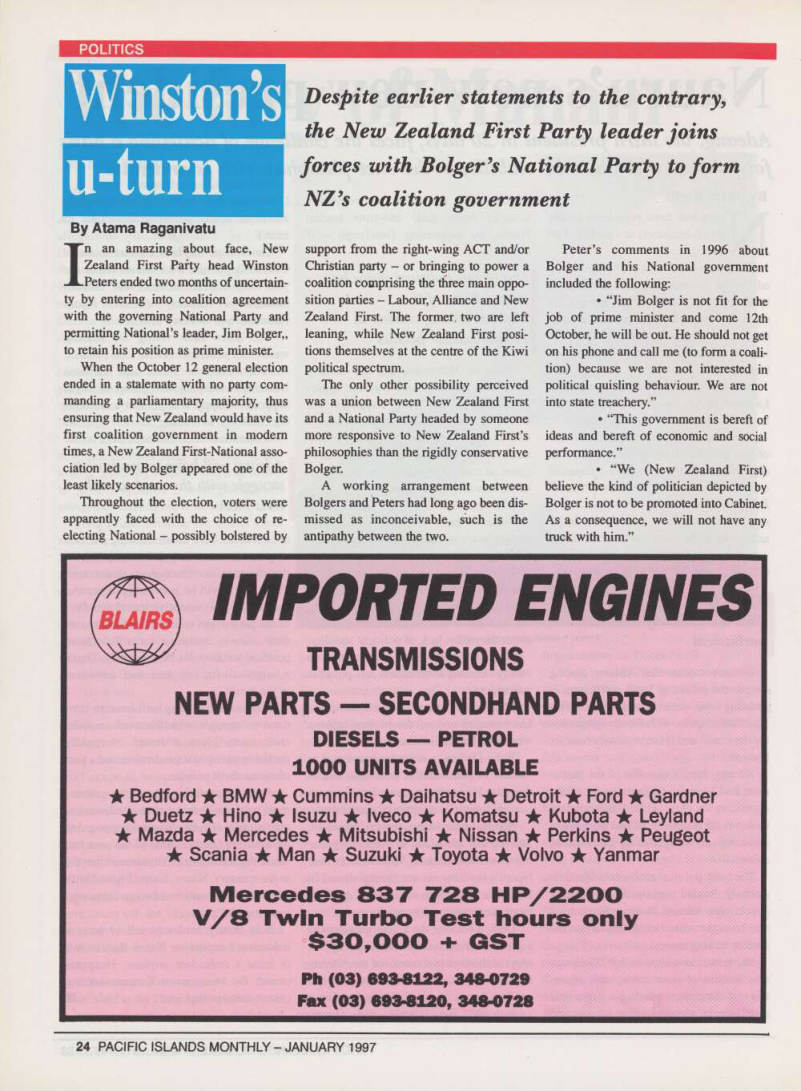
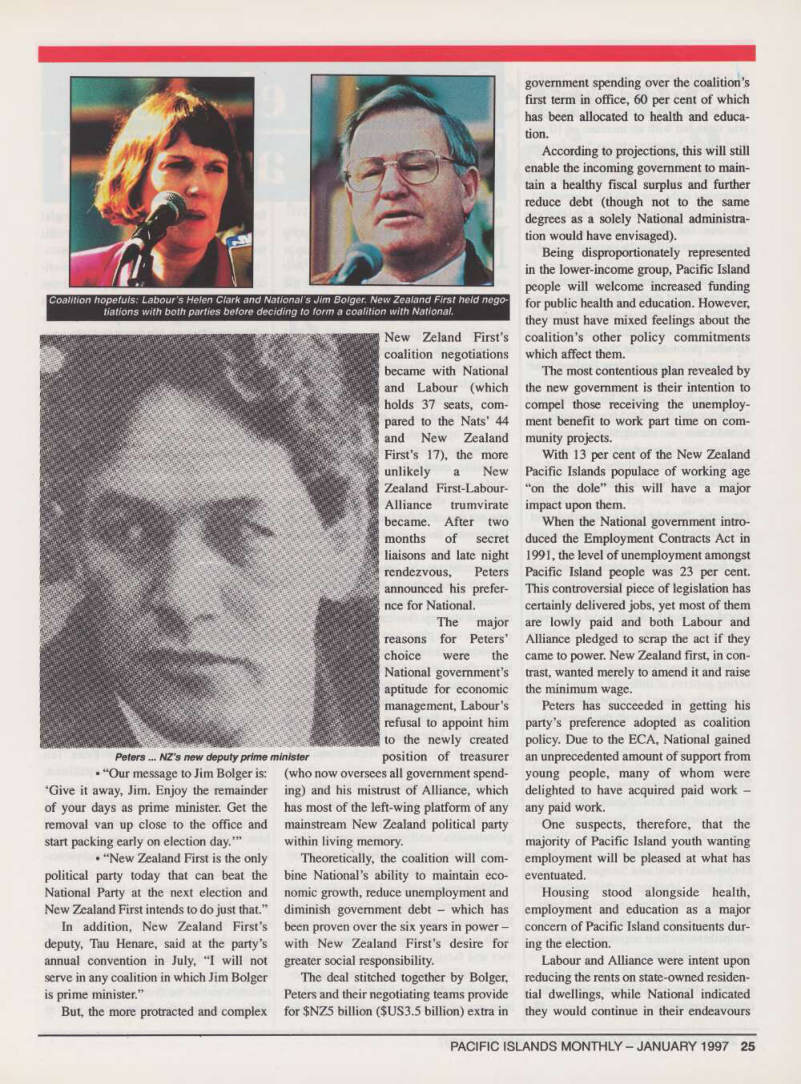
Coalition hopefuls: Labour's Helen Clark and National's Jim Bolger. New Zealand First held nego tiations with both parties before deciding to form a coalition with National.
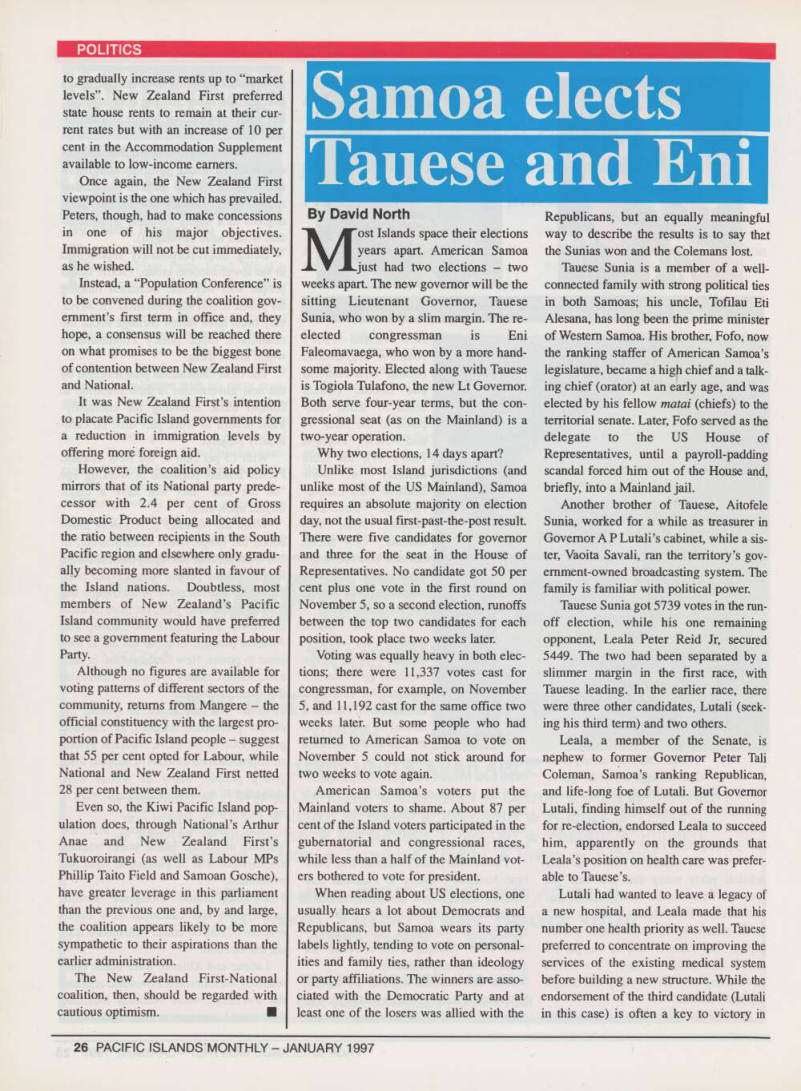
Peters ... NZ’s new deputy prime minister
to gradually increase rents up to “market levels”. New Zealand First preferred state house rents to remain at their cur rent rates but with an increase of 10 per cent in the Accommodation Supplement available to low-income earners.
Once again, the New Zealand First viewpoint is the one which has prevailed.
Peters, though, had to make concessions in one of his major objectives.
Immigration will not be cut immediately, as he wished.
Instead, a “Population Conference” is to be convened during the coalition gov ernment’s first term in office and, they hope, a consensus will be reached there on what promises to be the biggest bone of contention between New Zealand First and National.
It was New Zealand First’s intention to placate Pacific Island governments for a reduction in immigration levels by offering more foreign aid.
However, the coalition’s aid policy mirrors that of its National party prede cessor with 2.4 per cent of Gross Domestic Product being allocated and the ratio between recipients in the South Pacific region and elsewhere only gradu ally becoming more slanted in favour of the Island nations. Doubtless, most members of New Zealand’s Pacific Island community would have preferred to see a government featuring the Labour Party.
Although no figures are available for voting patterns of different sectors of the community, returns from Mangere - the official constituency with the largest pro portion of Pacific Island people - suggest that 55 per cent opted for Labour, while National and New Zealand First netted 28 per cent between them.
Even so, the Kiwi Pacific Island pop ulation does, through National’s Arthur Anae and New Zealand First’s Tukuoroirangi (as well as Labour MPs Phillip Taito Field and Samoan Gosche), have greater leverage in this parliament than the previous one and, by and large, the coalition appears likely to be more sympathetic to their aspirations than the earlier administration.
The New Zealand First-National coalition, then, should be regarded with cautious optimism. ■