Checking the damage
pp. 17-18 · Read in the full issue
International team studies impact of French tests on the environment and nearby communities
By Bernadette Hussein
An international study into the radiological situation at the for mer French nuclear sites of Mururoa and Fangataufa atolls in French Polynesia is currently under way at the request of French authorities.
The study is being carried out under the guidance and direction of an International Advisory Committee con vened by the International Atomic Energy Agency.
Over 75 scientists from 20 countries are part of the study to assess the radio logical situation, both present and future, at the atolls and involved areas from the point of view of radiological safety, ascer tain whether there are any radiological hazards to people and make recommenda tions on the form, scale and duration of any monitoring, remedial action or other follow-up action that may be required.
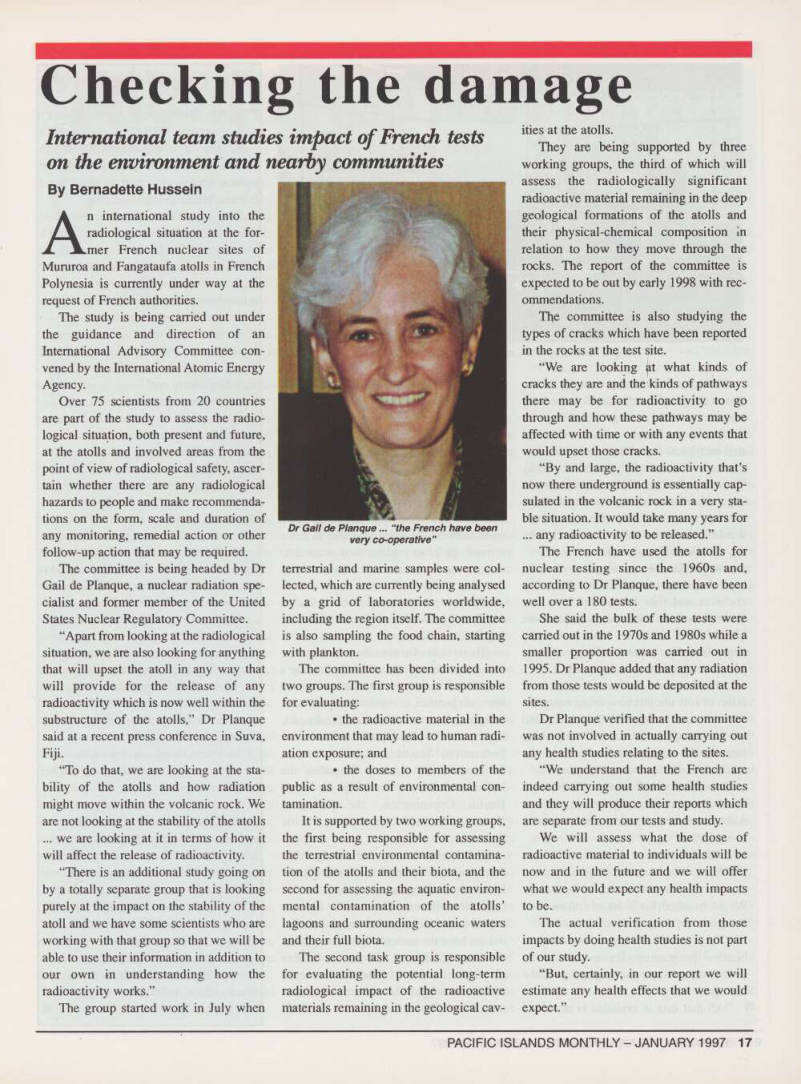
The committee is being headed by Dr Gail de Planque, a nuclear radiation spe cialist and former member of the United States Nuclear Regulatory Committee.
“Apart from looking at the radiological
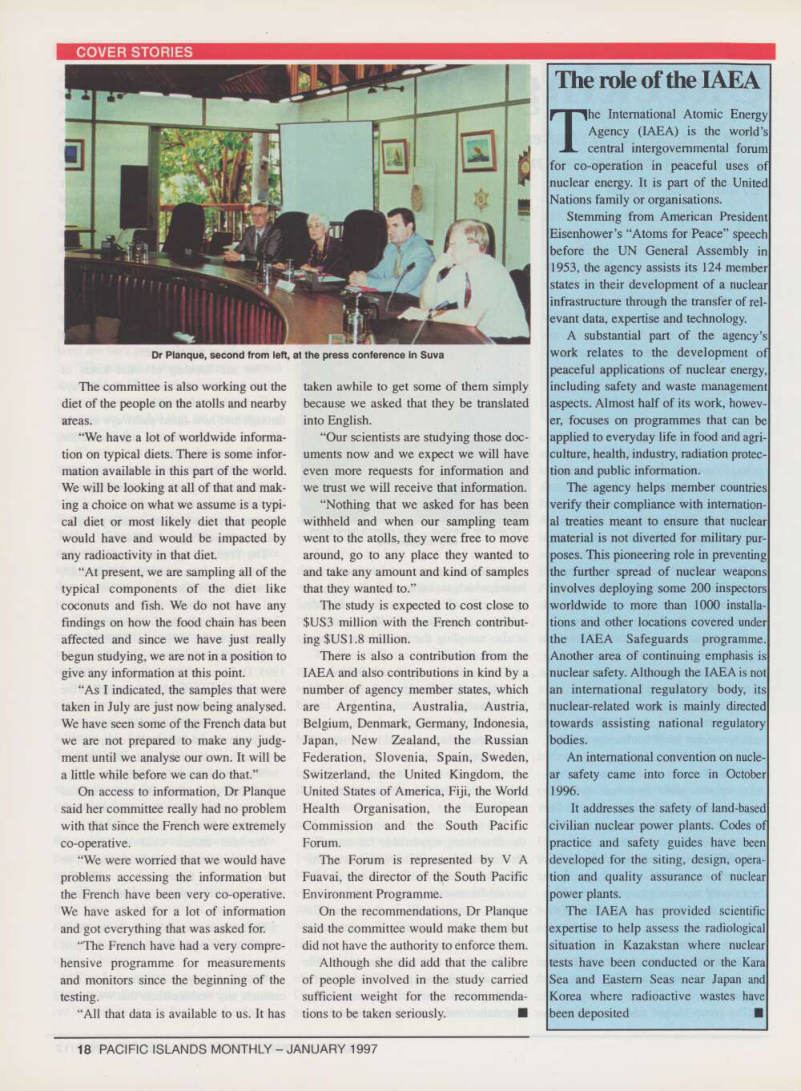
situation, we are also looking for anything that will upset the atoll in any way that will provide for the release of any radioactivity which is now well within the substructure of the atolls,” Dr Planque said at a recent press conference in Suva,
Fiji.
“To do that, we are looking at the sta bility of the atolls and how radiation might move within the volcanic rock. We are not looking at the stability of the atolls ... we are looking at it in terms of how it will affect the release of radioactivity.
“There is an additional study going on by a totally separate group that is looking purely at the impact on the stability of the atoll and we have some scientists who are working with that group so that we will be able to use their information in addition to our own in understanding how the
radioactivity works.”
The group started work in July when
terrestrial and marine samples were col lected, which are currently being analysed by a grid of laboratories worldwide, including the region itself. The committee is also sampling the food chain, starting with plankton.
The committee has been divided into two groups. The first group is responsible for evaluating: • the radioactive material in the environment that may lead to human radi ation exposure; and • the doses to members of the public as a result of environmental con tamination.
It is supported by two working groups, the first being responsible for assessing the terrestrial environmental contamina tion of the atolls and their biota, and the second for assessing the aquatic environ mental contamination of the atolls’ lagoons and surrounding oceanic waters and their full biota.
The second task group is responsible for evaluating the potential long-term radiological impact of the radioactive materials remaining in the geological cav
ities at the atolls.
They are being supported by three
working groups, the third of which will
assess the radiologically significant
radioactive material remaining in the deep geological formations of the atolls and
their physical-chemical composition in
relation to how they move through the rocks. The report of the committee is expected to be out by early 1998 with rec ommendations.
The committee is also studying the types of cracks which have been reported in the rocks at the test site.
“We are looking what kinds of cracks they are and the kinds of pathways there may be for radioactivity to go through and how these pathways may be affected with time or with any events that would upset those cracks.
“By and large, the radioactivity that’s now there underground is essentially cap sulated in the volcanic rock in a very sta ble situation. It would take many years for ... any radioactivity to be released.”
The French have used the atolls for nuclear testing since the 1960 s and, according to Dr Planque, there have been well over a 180 tests.
She said the bulk of these tests were carried out in the 1970 s and 1980 s while a smaller proportion was carried out in 1995. Dr Planque added that any radiation from those tests would be deposited at the sites.
Dr Planque verified that the committee was not involved in actually carrying out any health studies relating to the sites.
“We understand that the French are indeed carrying out some health studies and they will produce their reports which are separate from our tests and study.
We will assess what the dose of radioactive material to individuals will be now and in the future and we will offer what we would expect any health impacts to be.
The actual verification from those impacts by doing health studies is not part of our study.
“But, certainly, in our report we will estimate any health effects that we would
expect.”
Dr Gail de Planque...“the French have been very co-operative"
The committee is also working out the diet of the people on the atolls and nearby areas.
“We have a lot of worldwide informa tion on typical diets. There is some infor mation available in this part of the world.
We will be looking at all of that and mak ing a choice on what we assume is a typi cal diet or most likely diet that people would have and would be impacted by any radioactivity in that diet.
“At present, we are sampling all of the typical components of the diet like coconuts and fish. We do not have any findings on how the food chain has been affected and since we have just really begun studying, we are not in a position to give any information at this point.
“As I indicated, the samples that were taken in July are just now being analysed.
We have seen some of the French data but we are not prepared to make any judg ment until we analyse our own. It will be a little while before we can do that.”
On access to information, Dr Planque said her committee really had no problem with that since the French were extremely
co-operative.
“We were worried that we would have problems accessing the information but the French have been very co-operative.
We have asked for a lot of information and got everything that was asked for.
“The French have had a very compre hensive programme for measurements and monitors since the beginning of the testing.
“All that data is available to us. It has
taken awhile to get some of them simply because we asked that they be translated
into English.
“Our scientists are studying those doc uments now and we expect we will have even more requests for information and we trust we will receive that information.
“Nothing that we asked for has been withheld and when our sampling team went to the atolls, they were free to move around, go to any place they wanted to and take any amount and kind of samples that they wanted to.”
The study is expected to cost close to SUS 3 million with the French contribut ing SUSI.B million.
There is also a contribution from the lAEA and also contributions in kind by a number of agency member states, which are Argentina, Australia, Austria, Belgium, Denmark, Germany, Indonesia, Japan, New Zealand, the Russian Federation, Slovenia, Spain, Sweden, Switzerland, the United Kingdom, the United States of America, Fiji, the World
Health Organisation, the European
Commission and the South Pacific Forum.
The Forum is represented by V A Fuavai, the director of the South Pacific Environment Programme.
On the recommendations. Dr Planque said the committee would make them but did not have the authority to enforce them.
Although she did add that the calibre of people involved in the study carried sufficient weight for the recommenda tions to be taken seriously. ■
Dr Planque, second from left, at the press conference in Suva