NZ politics
pp. 4-5 · Read in the full issue
Letters
Islanders and NZ politics
Dear Sir Whilst I read Atama
Ranganivatu’s article (Pacific
Islands Monthly November, 1996) with interest, I was concerned that his opinion was not a balanced point of view and the article failed to spell out rel evant facts resulting from the election.
The 1996 election results gave Labour its lowest result since 1928, while Alliance support plummeted to 10 per cent. In my opinion, these results alone give a clear message from voters to coali
tion negotiators.
The bulk of the people in this country voted for an end to dependency and are looking to the MMP environment to pro
vide employment, education opportuni
ties and an improvement in health issues.
Since 1990, the National government has created in excess of 200,000 new jobs. Compare this to the thousands of jobs that were lost under Labour between 1984 and 1990. The recent Revolution programme on television has reminded people of that. Your article states that “...Kiwis no longer want Bolger as their
prime minister”.
What is the basis of this statement?
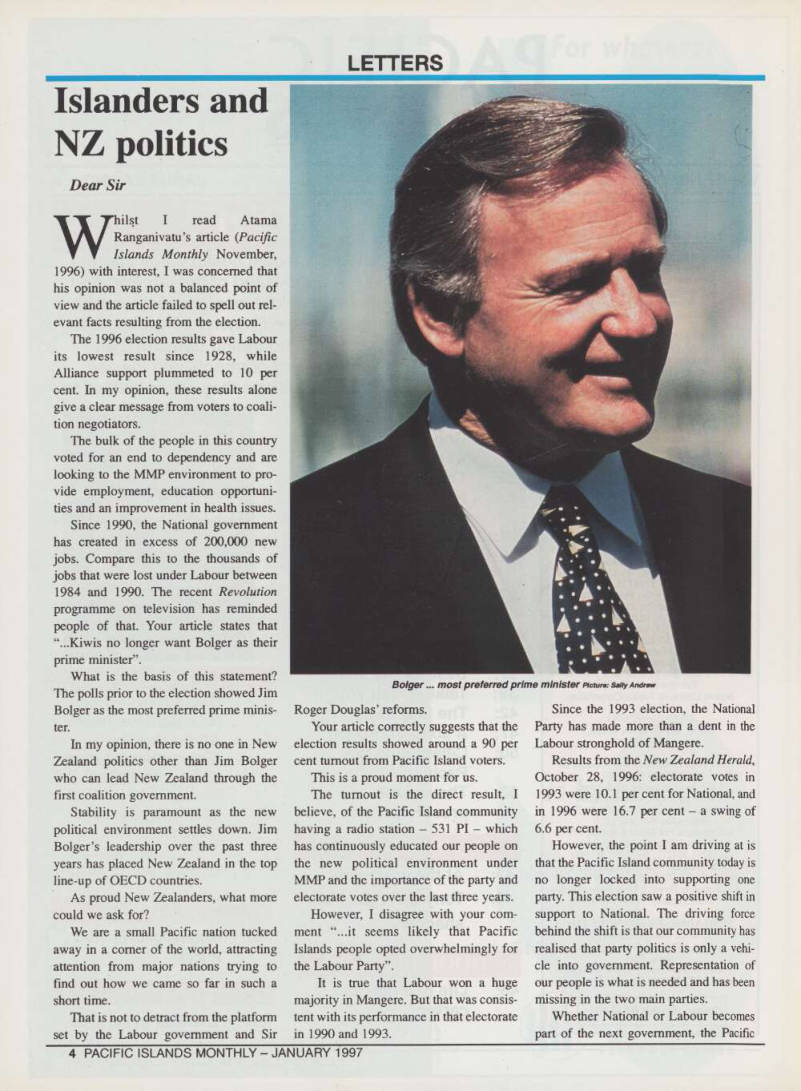
The polls prior to the election showed Jim Bolger as the most preferred prime minis ter.
In my opinion, there is no one in New Zealand politics other than Jim Bolger who can lead New Zealand through the first coalition government.
Stability is paramount as the new political environment settles down. Jim Bolger’s leadership over the past three years has placed New Zealand in the top line-up of OECD countries.
As proud New Zealanders, what more could we ask for?
We are a small Pacific nation tucked away in a comer of the world, attracting attention from major nations trying to find out how we came so far in such a short time.
That is not to detract from the platform set by the Labour government and Sir
Roger Douglas’ reforms.
Your article correctly suggests that the election results showed around a 90 per cent turnout from Pacific Island voters.
This is a proud moment for us.
The turnout is the direct result, I believe, of the Pacific Island community having a radio station - 531 PI - which has continuously educated our people on the new political environment under MMP and the importance of the party and electorate votes over the last three years.
However, I disagree with your com ment “...it seems likely that Pacific Islands people opted overwhelmingly for the Labour Party”.
It is true that Labour won a huge majority in Mangere. But that was consis tent with its performance in that electorate in 1990 and 1993.
Since the 1993 election, the National Party has made more than a dent in the Labour stronghold of Mangere.
Results from the New Zealand Herald, October 28, 1996: electorate votes in 1993 were 10.1 per cent for National, and in 1996 were 16.7 per cent - a swing of 6.6 per cent.
However, the point I am driving at is that the Pacific Island community today is no longer locked into supporting one party. This election saw a positive shift in support to National. The driving force behind the shift is that our community has realised that party politics is only a vehi cle into government. Representation of our people is what is needed and has been missing in the two main parties.
Whether National or Labour becomes part of the next government, the Pacific
Bolger...most preferred prime minister picture: selly Andrew
Islands people need a voice in parlia ment.
The other point that has been missed in your article is that our parliament now has four MPs with Pacific Islands ethnic ity. Taito Philip Field and Mark Gosche
for Labour, Tukuoroirangi Morgan (part
Cook Islander) for NZ First and myself.
This representation gives us the opportunity to get together as an infor mal caucus to discuss Pacific Island issues. I hope that as a result of this cau cus, Pacific Island issues will be taken back to each individual’s party for seri ous consideration, and not used as politi cal footballs in the house.
It cannot be stressed enough that Pacific Islanders are part of New Zealand and do not expect to be treated different ly. But there are also specific issues which need to be addressed to enable us to contribute fully to New Zealand and share the fruits of our adopted country.
The main issues I want to tackle are
employment opportunities, immigration,
education (especially early childhood
development), broadcasting and superan nuation.
New Zealand has given us the oppor tunity to succeed, and many of our peo ple have. We only need to look at the results of our students graduating each year from university and polytechnic.
Back home such progress would have
been impossible.
I don’t believe the few that fail should distract from the achievements Pacific Islanders have proven we can make.
Arthur Anae MP
New Zealand