Dowiygo takes over Nauru
p. 41 · Read in the full issue
By David North
Bouncing cheques, bare grocery shelves, a drought, and a nearly 50 per cent reduction in govern ment spending all brought grief to
Nauru’s president, Lagumot Harris but it was two unhappy members of his own faction that brought down the government.
A nine-to-seven vote of no-confi dence in the legislature - following a week of tie votes - led to the rein stallation on November 7 of Bernard Dowiyogo as the nation’s president. (The president of Nauru, as the pres ident of the Marshall Islands, is, in
fact, a prime minister elected by the legis lature.) Dowiyogo had lost the presidency about a year earlier to Harris when Nauru’s long-enduring financial crisis finally caught up with the faction in power, but Dowiyogo had not lost the election by much; the Harris group had only a single-vote margin in parliament.
Over the years, phosphate-rich Nauru had become not-so-rich Nauru, as the phosphate was sold to outsiders and as successive governments wasted the phos phate money on a very expensive govern ment, a heavily subsidised airline, and on a series of financial disasters (bad invest ments, a losing fling with a London musi cal, and being victimised by conmen and
conwomen, all reported by Pacific Islands
Monthly - see, for instance, “Nauru attacks its fiscal problems” August, 1996).
Harris and his allies, notably then Education Minister Kennan Adeang, took a deep breath and introduced a remark
ably lean budget, cutting expenditures
from SABO million (SUS 63 million) to SA46 million (SUS 36 million). But the efforts to raise some substantial sums of money from import duties Nauru, thanks to the phosphate, had been a virtu ally tax-free society - brought limited results, and soon Nauru was in a financial crisis visible not just to accountants, but to the man in the street.
For instance, cash disappeared as peo ple stuck it in mattresses and in overseas
banks; soon Nauru became a
cheque-dominated economy, and then cheques (even those with substantial backing in the Bank of Nauru) began to bounce, because the bank was having its own financial problems.
Meanwhile, the bad old habits of Nauru’s free-spending government were not totally erased by the Harris regime.
For instance, when the government shipped 12 people, at considerable expense, off to the Olympics in Atlanta earlier this year, it also sent along a cabi net member and his wife to “manage” the team. But Harris did reduce Air Nauru to a one-plane - not a two-plane - airline, and that promised substantial savings.
The cash shortage created immediate, visible problems on the Island. Australian firms that had previously been quite happy to ship Nauru canned and fresh food, meat and dairy products, stopped the deliveries and the grocery shelves became pretty bare. No payment: no ship ment. People who had not done so in a generation or two started living on fish and coconuts.
Meanwhile, it became more difficult to grow fruit and vegetables because of a long-lasting drought. Nauru has no creeks, much less lakes or rivers. There is a little underground water, but as it was pumped out it became brackish.
Household water was expensive because it came from the desalinisation plant.
Because of these factors, and internal friction, the support for the Harris govem
ment dwindled. Adeang, one of the ablest of Nauru’s politicians, left cabinet. The only woman in the usually all-male par liament, Ruby Dediya, once a Harris sup porter, became restive.
At first there was a stand-off in the 18member body, with seven voting for the government and seven against; the others were abstentions, absentees and the speaker, who traditionally does not vote on such issues. Then, on November 7, everything clicked for the opposition; one of its legislative backers returned from a trip to Australia and a couple of unhappy supporters of Harris wandered off the reservation. Dowiyogo was back in power, at least for the moment. But the continuing financial crisis is still with Nauru, no matter who is in power.
Harris had earlier this year survived what might have been a disastrous turn of events. One of his ministers, a long-time member of parliament. Public Works
Minister Roy Demanguwe Degoregore,
died in office, and a by-election was called.
In another setting, in another nation, a quickly called vote of confidence might have gone against Harris, but the tradition is that the speaker, under these circum stances, supports the people in power.
After a while the by-election did take place, and Remy Namoduk, a Harris sup porter, won the race, restoring the slender Harris margin in the parliament.
It was defections, not a death, that brought Harris down. ■
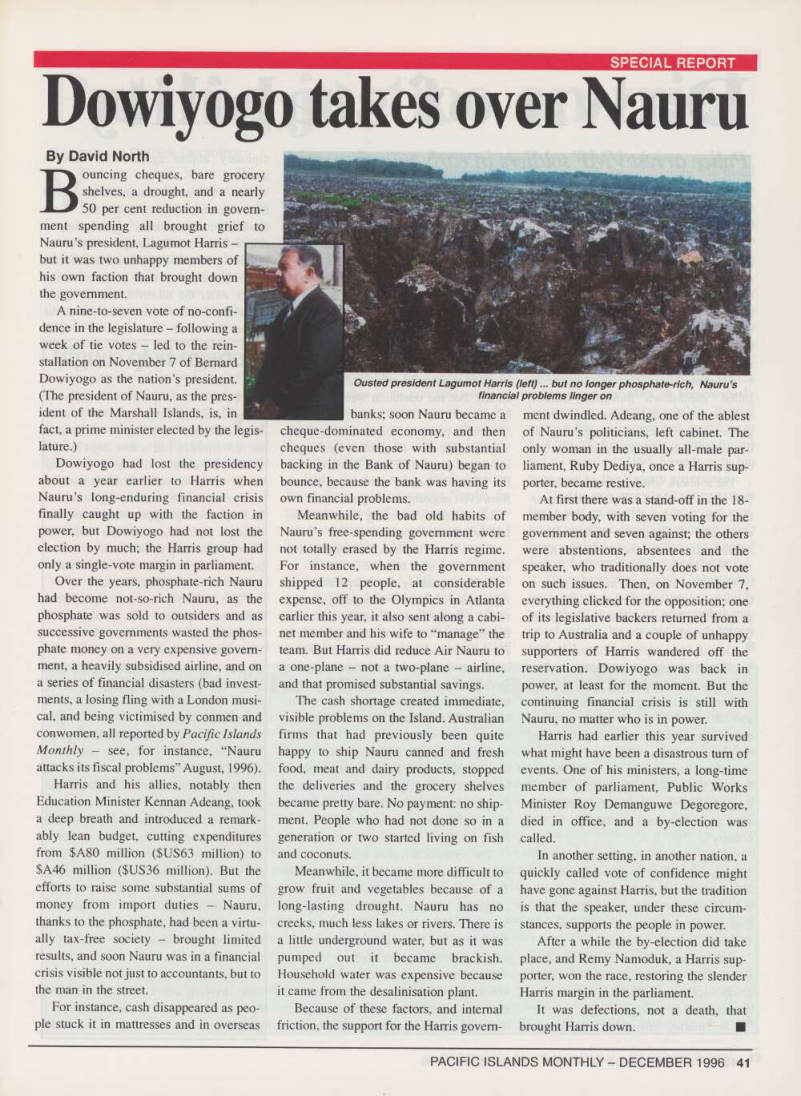
Ousted president Lagumot Harris (left)... but no longer phosphate-rich, Nauru’s financial problems linger on